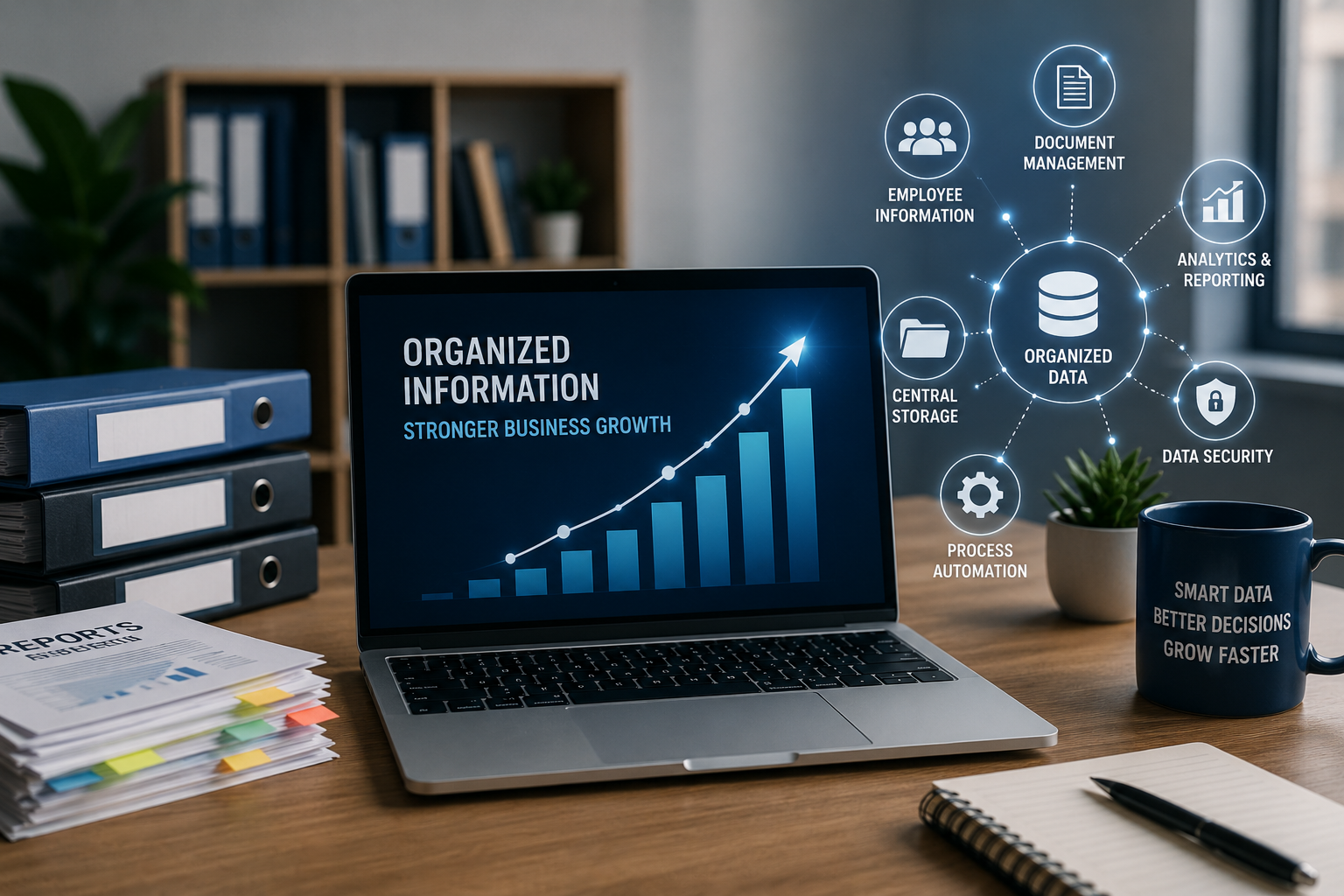
Why Business Growth Depends on Organized Information
Business growth is usually associated with positive things: more customers, more employees, more projects, more revenue, and more opportunities. However, growth also creates something that businesses do not always notice immediately—more information. Every new customer creates records, every employee generates HR information, every project produces documents and updates, every purchase creates financial information, and every department creates its own collection of reports, forms, approvals, and records. At a small company, employees may be able to manage this information through shared folders, spreadsheets, email conversations, and personal knowledge because everyone knows one another and understands how the business operates. But as the organization becomes larger, this informal approach becomes increasingly difficult to maintain. People change roles, departments become specialized, information becomes scattered, and employees may no longer know where to find the information they need.
This is why business information management becomes an important part of sustainable growth. A company can have excellent employees and strong products, but if its information is poorly organized, everyday operations can become slower and more complicated. Employees may spend time searching for files instead of working on important tasks, managers may receive different versions of the same information, and departments may make decisions using incomplete records. Growth then creates additional administrative effort rather than simply creating additional business value. Organized information provides the structure that allows a growing company to handle increasing amounts of work without allowing information-related confusion to grow at the same speed.
When Business Information Starts Becoming Difficult to Manage
Most businesses do not suddenly become disorganized. Information problems usually develop slowly. A team creates a spreadsheet because it is convenient. Another department starts using its own spreadsheet. Someone saves an important document on a local computer. Another employee keeps a copy in an email. A project team creates a separate folder for its files. Over time, these individual decisions create a complicated information environment.
The problem becomes visible when employees need to find something quickly. A manager may ask for the latest project information, but three different versions may exist. An employee may need an old customer document but not know which folder contains it. HR may need information from another department, but the data is stored in a different system. Finance may have one figure while the operations team is working with another. None of these problems necessarily come from employees doing something wrong. They happen because the organization has grown faster than its information structure.
As a company becomes larger, it needs to move from “Where did someone save this?” to “Where does the organization keep this information?” That change is fundamental. It shifts information from being individually managed to being organizationally managed.
What Organized Information Really Means
Organized information does not simply mean putting every file into folders. A business can have thousands of neatly named folders and still struggle to manage its information. Organization means creating a clear structure around information so employees understand where it belongs, who should access it, how it should be maintained, and how it connects to business activities.
For example, employee information should have a clear relationship with HR processes. Project documents should be associated with the appropriate projects. Financial information should be maintained through controlled processes. Important business policies should have clear ownership and current versions. Information should not exist as isolated pieces that employees have to manually connect in their minds.
A well-organized information environment should make everyday questions easier to answer. Employees should be able to understand where information is located, which information can be trusted, and what action they should take with it. This becomes increasingly important as the organization grows because employees cannot rely on personal knowledge to navigate every process.
Why Business Information Management Matters
Business information management is about ensuring that information is collected, organized, stored, accessed, maintained, and used effectively throughout the organization. It brings structure to one of the most important resources a business owns: its information.
Good information management can help employees find information faster, reduce duplicate records, improve collaboration, support decision-making, and maintain greater consistency across departments. It can also help organizations reduce unnecessary manual work because employees do not have to repeatedly recreate or request information that already exists.
The value becomes particularly clear when a company grows. A process that depends on one experienced employee may work when the company is small, but it becomes risky when the business has hundreds of employees. Organizations need systems and structures that allow knowledge and information to remain available even when people change roles or leave the company.
This means information management is not simply an administrative responsibility. It is part of building an organization that can continue functioning effectively as it becomes larger.
The Connection Between Information and Productivity
Employees lose productivity in many small ways. They search through folders, look for old emails, ask colleagues for files, verify whether information is current, recreate documents, and manually transfer data from one system to another. None of these tasks may appear significant individually, but they can consume a considerable amount of working time when repeated across an entire organization.Organized information reduces this friction.
When employees know where information is stored and can access the information relevant to their responsibilities, they can spend more time completing their actual work. A project employee can focus on project delivery rather than searching for an old document. An HR employee can work on employee-related activities rather than repeatedly collecting the same information. A manager can review available information instead of waiting for separate updates from multiple teams.
The productivity benefit is therefore not only about saving a few minutes here and there. It is about creating a workplace where employees do not have to constantly perform administrative work simply to find the information required to do their jobs.
How Organized Data Supports Better Decisions
Every important business decision depends on information. Management may need to decide whether to invest in a new project, hire additional employees, change a process, increase resources, or adjust priorities. These decisions become more difficult when the underlying information is incomplete, outdated, or scattered across different locations.
Organized data provides a stronger foundation for decision-making because information can be reviewed in a more structured way. Managers can compare information, identify patterns, understand current conditions, and evaluate previous records before making decisions.
For example, if management wants to understand why a project is delayed, it may need information from project management, Finance, Procurement, and the relevant employees. If every department maintains information separately, creating a complete picture may take considerable time. A more organized information environment makes it easier to bring the relevant pieces together.
Better decisions do not come simply from having more data. They come from having relevant, accessible, understandable, and reliable information when decisions need to be made.
Breaking Down Departmental Information Silos
Departments naturally develop their own systems and ways of working. HR has employee information. Finance manages financial records. Project teams maintain project information. Procurement manages vendor and purchasing information. Management needs visibility across all of them.
The problem begins when these departments operate as information islands.
An information silo occurs when important information is available to one team but difficult for other authorized teams to access or understand. Employees may then rely on emails, meetings, spreadsheets, and manual requests to move information between departments.This creates delays and increases the possibility of misunderstandings.
A more connected information environment allows departments to work with shared information where appropriate while still maintaining access controls. Employees do not necessarily need access to everything, but they should be able to access the information required for their responsibilities.
This improves collaboration because teams can spend less time asking, “Can you send me that information?” and more time using the information to complete their work.How Digital Transformation Changes Information Management
Digital transformation is often described as the process of adopting digital technologies, but successful transformation involves much more than replacing paper with software. It changes how an organization creates, manages, shares, and uses information.
A business may digitize a paper form, but if employees still have to manually copy the information into another system, the organization has only changed the format of the work. True digital transformation looks at the entire process.
For example, instead of creating a document, sending it by email, waiting for approval, saving a copy, and manually updating a record, a digital process can connect these activities into a structured workflow. Information can move through the appropriate stages while employees maintain visibility into what is happening.
This makes information more useful because it becomes part of the business process rather than simply being stored as a file.The Role of Enterprise Software in Organizing Business Information
As organizations grow, managing every business function through independent spreadsheets and disconnected applications becomes increasingly difficult. This is where enterprise software can provide structure.
Enterprise software can bring multiple business activities into a more coordinated digital environment. Depending on the organization's needs, this may include HR, payroll, documents, communication, projects, accounting, cloud storage, visitor management, workflows, and other functions.
The important benefit is not simply having many features in one place. The real value comes from connecting people, processes, and information.
For example, information created in one business process may be relevant to another process. A project may require documents, approvals, employee assignments, and financial information. When these activities are managed in a connected environment, employees do not need to repeatedly move information manually between unrelated systems.
Enterprise software can therefore become part of the organization's information infrastructure, helping businesses create a more structured digital workplace as they grow.
Protecting Information Without Making It Difficult to Access
Organizing business information also means protecting it. Not every employee should have access to every document or record. Employee information, financial records, contracts, business plans, and other sensitive information may require controlled access.However, security should not make legitimate work unnecessarily difficult.
A strong information environment balances accessibility and control. Employees should be able to access the information they need to perform their responsibilities while information remains protected from unauthorized access.Role-based permissions, controlled sharing, access management, and clear ownership can help businesses achieve this balance.
The goal is not to hide information. The goal is to ensure that the right information reaches the right people at the right time.
Turning Business Knowledge Into a Long-Term Asset
Employees accumulate valuable knowledge through experience. They learn how processes work, how customers prefer to communicate, how particular projects are managed, and how problems are solved.
If this knowledge remains only in employees' minds, the organization can become dependent on individuals.
Documentation and organized information help turn personal knowledge into organizational knowledge.
Important procedures can be documented. Business policies can be maintained. Project information can be recorded. Common questions can be answered through internal resources. Processes can be described clearly so that new employees do not have to learn everything through informal conversations.
This creates organizational continuity.When employees change roles or leave the organization, important knowledge can remain available to the business.
Preparing Information Systems for Business Growth
A business should not wait until information becomes unmanageable before creating better systems. By that point, employees may already have developed complicated workarounds, duplicate records may exist, and important information may be distributed across many locations.
Organizations can prepare for growth by building information structures early.
This means considering questions such as:
- Where should important business information be stored?
- Who owns each type of information?
- Who should have access to it?
- How should information be updated?
- How can employees find it quickly?
- Which processes should be automated?
- Which information needs to be connected across departments?
Answering these questions early creates a foundation that can support future growth.
Building a Culture Around Better Information
Technology alone cannot solve every information-management problem. Employees also need to understand why information organization matters.
A business can have excellent software, but if employees continue creating duplicate files, storing important information in personal locations, or ignoring established processes, the organization will still struggle.
A strong information culture encourages employees to treat business information as an organizational resource.
Employees should understand the importance of:
- Keeping important information in approved locations.
- Using current information rather than outdated copies.
- Following established naming and documentation practices.
- Protecting confidential information.
- Updating records when required.
- Sharing information responsibly with authorized colleagues.
When these habits become part of everyday work, technology becomes much more effective.
A Practical Approach to Organizing Business Information
Businesses do not need to reorganize everything overnight. A practical approach is to begin with the areas that create the most problems.
First, identify where employees spend the most time searching for information or requesting it from other people. These areas often reveal weaknesses in the existing information structure.
Next, identify the most important types of business information and determine who owns them. Once ownership is clear, the organization can establish how information should be stored, updated, shared, and protected.Businesses can then gradually introduce digital systems and workflows where they provide the most value.
A practical information-improvement approach can include:
- Identify information bottlenecks where employees frequently search or wait.
- Centralize important information where practical.
- Remove unnecessary duplicates and outdated records.
- Define information ownership for important business records.
- Create consistent processes for maintaining information.
- Control access appropriately based on employee responsibilities.
- Connect related information across business processes.
- Review the system regularly as the organization changes.
The objective is not to create an overly complicated information strategy. It is to make everyday work simpler.
The Bigger Business Impact
When information becomes organized, the effects can reach almost every part of the organization. Employees can work faster because they spend less time searching. Managers can make decisions with greater confidence because relevant information is easier to access. Departments can collaborate more effectively because information does not remain isolated. New employees can learn processes more quickly because important knowledge is documented. Management can scale operations without depending entirely on individual employees to explain how everything works.
Organized information can also support innovation. When employees can find existing knowledge and understand previous work, they can build upon it instead of starting from zero. Teams can identify what has already been tried, learn from previous projects, and make improvements based on available information.
This creates a cycle in which better information supports better processes, better processes create better information, and the organization becomes increasingly capable of managing its growth.
Growth Needs Structure
Business growth is exciting, but growth without structure can create unnecessary complexity. As companies add employees, customers, projects, departments, and business activities, the amount of information they generate increases rapidly. If that information remains scattered across spreadsheets, emails, personal folders, disconnected applications, and individual knowledge, the organization can eventually spend more time managing information than using it.
Organized information provides the structure needed to grow more effectively.Strong business information management helps organizations understand where important information belongs, who should access it, how it should be maintained, and how it connects with everyday business processes. It reduces unnecessary searching, supports collaboration, protects organizational knowledge, and creates a more reliable foundation for decision-making.
The importance of organized data also becomes clearer as businesses become more data-driven. Companies do not simply need more information. They need information that employees and managers can understand and use. Data that is scattered, duplicated, or outdated has limited value. Structured information, on the other hand, can help businesses identify opportunities, understand problems, and make better decisions.
Digital transformation strengthens this process by changing the way businesses create and use information. Instead of simply converting traditional activities into digital versions, organizations can redesign processes so information moves more efficiently between people, departments, and systems. This can reduce repetitive work and create greater visibility throughout the organization.
Enterprise software can support this transformation by providing a more connected environment for business activities. When HR, documents, projects, communication, storage, accounting, and other processes can work within a coordinated digital environment, employees spend less time moving information manually between disconnected tools.
But technology is only part of the solution. Businesses also need a culture that values organized information. Employees need to understand that business information belongs to the organization and should be maintained accordingly. Clear ownership, consistent processes, appropriate access, and regular updates are essential for keeping information useful over time.Ultimately, organized information is not just an administrative advantage. It is part of the infrastructure that allows a business to scale.
A growing organization needs to be able to add employees without losing knowledge, add customers without losing information, add projects without creating document chaos, and add departments without creating communication barriers.
When information is organized, employees can find what they need. When information is accessible, teams can collaborate. When information is connected, processes can move more efficiently. When information is reliable, managers can make better decisions.That is why business growth depends on more than people, products, and revenue.It also depends on how well the organization manages what it knows.
A business that treats information as a strategic resource is better prepared to adapt, collaborate, automate, and scale. Instead of allowing information to become a source of complexity, it can turn information into an advantage.Growth creates more information—but organized information helps businesses turn that growth into something they can actually manage.