
Table of Contents
- Why Modern Businesses Need Role-Based Access Control
- Understanding Role-Based Access Control
- Why Traditional Access Management Creates Problems
- Why Every Employee Does Not Need Access to Everything
- Protecting Sensitive Business Information
- Simplifying User Management
- Supporting Business Growth
- Improving Enterprise Security
- Supporting Compliance and Audits
- Better Collaboration Without Sacrificing Security
- Supporting Remote and Hybrid Work
- Reducing Human Errors
- Business Benefits of Role-Based Access Control
- Preparing for the Future
- Conclusion
Why Modern Businesses Need Role-Based Access Control
In today's digital workplace, information has become one of the most valuable assets a business owns. Every day, organizations create and manage employee records, financial reports, customer databases, contracts, payroll information, confidential business strategies, product designs, project documents, and countless other types of sensitive data. While technology has made storing and accessing this information easier than ever, it has also introduced new security challenges.
Many businesses focus heavily on protecting their systems from external cyber threats such as hackers, malware, and phishing attacks. While these threats are certainly important, a significant number of security incidents actually begin inside the organization. Employees accidentally access confidential files they should not see, sensitive information is shared with the wrong department, former employees continue to have access to company systems after leaving, or managers unknowingly grant excessive permissions to team members. These situations often occur not because of malicious intent, but because businesses lack a structured access management strategy.
As organizations grow, managing who can access which information becomes increasingly complex. A company with ten employees may have relatively simple access requirements. However, an organization with hundreds of employees across Human Resources, Finance, Sales, Operations, Recruitment, Projects, IT, and Customer Support needs far more control. Every employee requires access to the information necessary for their role, but they should not automatically gain access to everything within the organization.This is where Role-Based Access Control (RBAC) becomes essential.
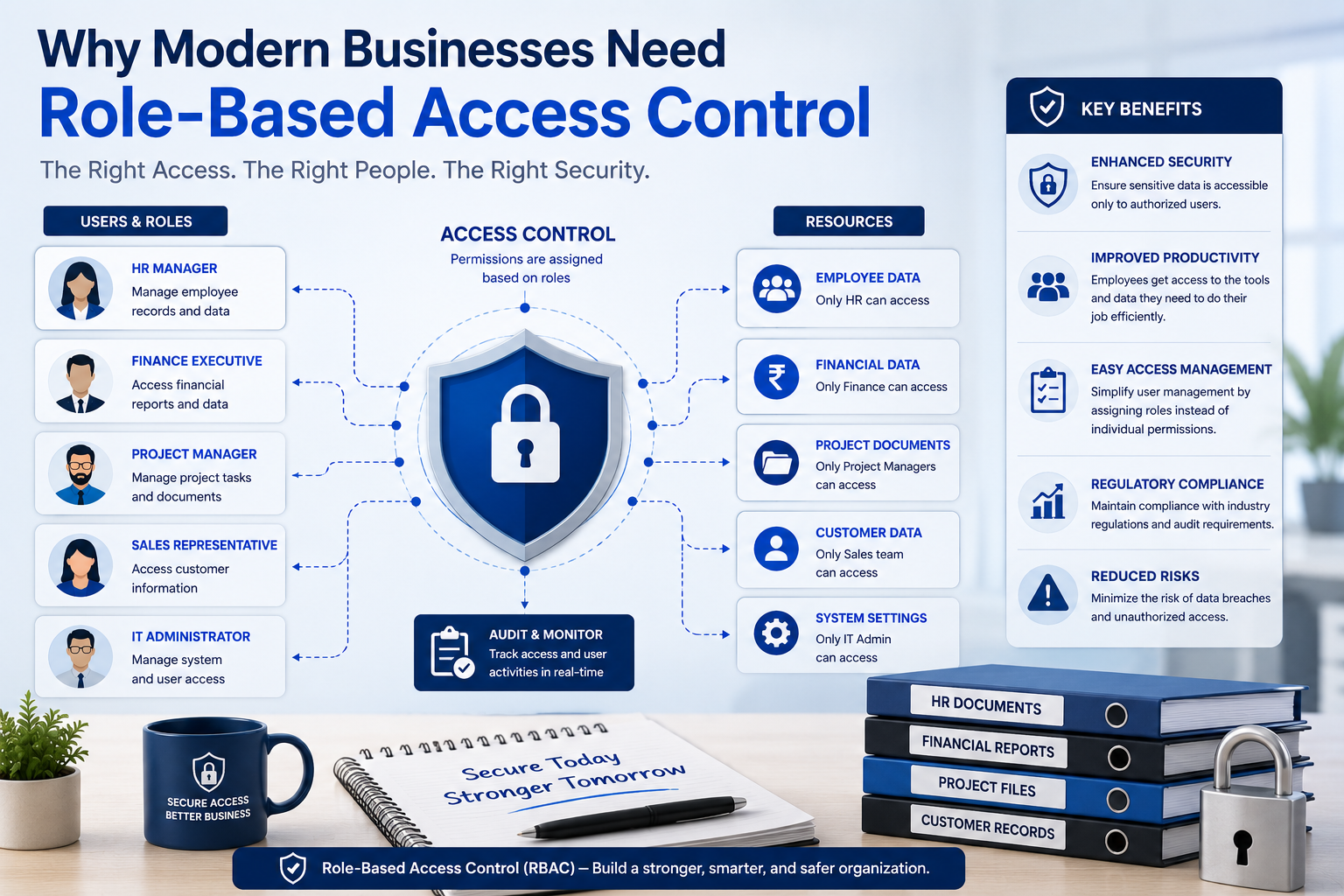
Role-Based Access Control is a modern access management approach that grants system permissions based on an employee's job role rather than assigning permissions individually. Employees automatically receive the level of access required for their responsibilities while confidential information remains protected from unauthorized viewing or modification.
More than simply improving security, RBAC helps businesses improve productivity, maintain compliance, simplify user management, reduce administrative work, and build stronger enterprise security practices.
As businesses continue adopting cloud technologies, digital workflows, remote work, and integrated business platforms, role-based access control is becoming one of the most important foundations of a secure and efficient digital workplace.
Understanding Role-Based Access Control
Role-Based Access Control, commonly known as RBAC, is a security model that assigns permissions according to an employee's role within the organization.
Instead of manually deciding which files, systems, or applications every employee can access, administrators define roles such as HR Manager, Finance Executive, Project Manager, Sales Representative, or System Administrator.
Each role includes specific permissions.When an employee joins the organization, they receive access based on their assigned role.
If their responsibilities change, administrators simply update the employee's role rather than manually changing permissions across multiple systems.
This structured approach makes access management much simpler while improving overall security.
Why Traditional Access Management Creates Problems
Many businesses still manage user access manually.Whenever someone joins the organization, administrators grant permissions individually.
Over time, employees receive additional access as their responsibilities change.Unfortunately, old permissions are rarely removed.
As a result, employees often have access to information that is no longer relevant to their current roles.This situation creates unnecessary security risks.
Former employees may continue accessing company systems.Sensitive documents become visible to unauthorized users.
Departments accidentally access confidential business information.Managing permissions manually becomes increasingly difficult as organizations grow.
Why Every Employee Does Not Need Access to Everything
One common misconception is that giving employees broad access makes collaboration easier.In reality, excessive access often increases business risks.
Consider an organization where every employee can view payroll records, financial reports, legal contracts, customer databases, and executive documents.
Even if no one intentionally misuses this information, the possibility of accidental exposure becomes much higher.Role-Based Access Control follows the principle of least privilege.
Employees receive only the access required to perform their responsibilities.
For example:
- Human Resources manages employee records.
- Finance handles financial transactions.
- Project teams access project documentation.
- Recruitment manages candidate information.
- Each department works efficiently without exposing sensitive information unnecessarily.
Protecting Sensitive Business Information
Every organization stores confidential information.
This may include:
- Employee salaries.
- Tax records.
- Customer contracts.
- Financial statements.
- Vendor agreements.
- Intellectual property.
- Business strategies.
- Legal documentation.
Without proper access control, these files become vulnerable to accidental exposure.
RBAC protects sensitive information by ensuring that only authorized individuals can view, edit, approve, or delete specific data.This greatly strengthens business security while reducing internal risks.
Simplifying User Management
Managing user permissions individually consumes significant administrative time.
Whenever employees join, leave, transfer departments, or receive promotions, IT teams must manually update multiple systems.Role-Based Access Control simplifies this process.
Administrators simply assign employees to predefined roles.Permissions update automatically.When employees change positions, their access changes with their role.
This reduces administrative effort while improving consistency across the organization.
Supporting Business Growth
Growing businesses frequently hire new employees, create new departments, and introduce additional business systems.
Without structured access management, maintaining security becomes increasingly difficult.RBAC provides scalability.Organizations can easily create new roles as business needs evolve.
Instead of redesigning permission structures repeatedly, businesses expand existing role definitions.This allows security practices to grow alongside the organization.
Improving Enterprise Security
Enterprise security involves much more than preventing cyberattacks.It also focuses on protecting internal business information.
Role-Based Access Control strengthens enterprise security by reducing unnecessary access throughout the organization.
Employees only interact with the systems required for their daily work.
Administrative privileges remain limited.Confidential information remains protected.Security becomes proactive rather than reactive.
Organizations reduce opportunities for both accidental and intentional data exposure.
Supporting Compliance and Audits
Many regulations require businesses to demonstrate how sensitive information is protected.
Auditors often review who has access to financial records, employee information, customer data, and confidential documents.
Role-Based Access Control simplifies compliance because permission structures are clearly defined.
Organizations can demonstrate:
- Who has access.
- Why access was granted.
- When permissions changed.
- Which activities were performed.
This transparency supports regulatory compliance while improving accountability.
Better Collaboration Without Sacrificing Security
Security should never prevent employees from collaborating effectively.RBAC balances both objectives.
Departments can share information securely without exposing unrelated data.
For example, Finance and HR may collaborate during payroll processing while maintaining separate access to confidential records.
Projects can involve multiple departments without giving every participant unrestricted access.This creates a more secure collaborative environment.
Supporting Remote and Hybrid Work
Modern workplaces increasingly support remote and hybrid employees.
Staff access business systems from offices, homes, client locations, and mobile devices.This flexibility makes access management even more important.
Role-Based Access Control ensures employees receive appropriate access regardless of location.
Combined with authentication, encryption, and secure connections, RBAC helps organizations maintain strong security across distributed workforces.
Employees remain productive while business information stays protected.
Reducing Human Errors
Many security incidents occur because of simple mistakes.Employees accidentally edit important files.Confidential reports are shared with the wrong people.
Unauthorized changes affect business operations.RBAC reduces these risks.Employees only see information relevant to their responsibilities.
Restricted permissions prevent accidental modifications to sensitive data.Organizations experience fewer operational disruptions caused by human error.
Business Benefits of Role-Based Access Control
Organizations implementing Role-Based Access Control often experience improvements across multiple areas.
Some of the most valuable benefits include:
- Stronger business security through controlled user permissions.
- Simplified access management with role-based administration.
- Better compliance through structured permission management.
- Reduced administrative workload for IT teams.
- Improved employee productivity through organized access to business systems.
These benefits help organizations build secure and scalable digital workplaces.
Preparing for the Future
Business technology continues evolving rapidly.Cloud computing, Artificial Intelligence, workflow automation, digital document management, and enterprise collaboration all depend on secure information access.
Organizations relying on outdated permission management methods will face increasing security challenges.
Role-Based Access Control provides a flexible foundation for future business growth.
As companies adopt new technologies, RBAC ensures that security remains consistent without creating unnecessary complexity.
Businesses become more resilient while maintaining operational efficiency.
Conclusion
Protecting business information has become one of the most important responsibilities for every modern organization. While external cybersecurity threats often receive the most attention, controlling internal access to sensitive information is equally important.
Role-Based Access Control provides a structured, scalable, and efficient approach to access management by ensuring employees receive only the permissions required for their specific roles. This not only strengthens enterprise security but also simplifies administration, improves compliance, supports collaboration, and reduces the risk of human error.
Rather than managing permissions manually for every employee, organizations create consistent security policies that grow alongside the business. Employees work more efficiently because they have access to the tools and information they need, while confidential business data remains protected.
As organizations continue embracing digital transformation, cloud platforms, and integrated business systems, role-based access control will become even more critical. Businesses that invest in strong access management today are building secure, compliant, and future-ready workplaces capable of protecting their most valuable asset—information.
In a world where data drives every business decision, controlling who can access that data is no longer optional. It is a fundamental part of building a secure, trustworthy, and successful organization.