
Table of Contents
- How to Start a Small Business in India (2026): Complete Guide to Business Registration, GST, Banking, Billing and Compliance
- 2. Understanding the different types of business structures in India
- Sole Proprietorship
- Partnership Firm
- Limited Liability Partnership (LLP)
- Private Limited Company
- One Person Company (OPC)
- Comparison of Business Structures
- 3. Choose a business name and define your business activity
- 4. Register your business in India
- 5. Udyam Registration: Register as an MSME
- MSME classification in India (effective 1 April 2025)
- How to apply for Udyam Registration
- 6. GST Registration for Small Businesses in India
- How to apply for GST registration
- When should a small business register for GST?
- 7. Other Licences and Registrations Required for Small Businesses
- 8. Open a Current Account for Your Business
- 9. Create Professional Business Invoices and Bills
- Sample business invoice
- 10. Maintain Proper Business Accounts and Financial Records
- 11. Employee Management and Payroll for Small Businesses
- 12. Common Mistakes First-Time Entrepreneurs Should Avoid
- 13. Practical Example: Starting a Small Business in India
- 14. How Digital Business Management Tools Help Small Businesses
- How i-SPUR supports business digitisation
- Frequently Asked Questions (FAQs)
- 1. How much money is required to start a small business in India?
- 2. Which business structure is best for beginners in India?
- 3. Is GST registration compulsory for every small business?
- 4. Is Udyam Registration free in India?
- 5. Can I start a business without registering a private limited company?
- 6. What is the difference between Udyam Registration and GST Registration?
- 7. Do small businesses need a current account?
- 8. Does every small business need a CA?
- 9. What documents are required to start a small business?
- 10. Can I run a small business from home?
- 11. When should a small business hire its first employee?
- 12. How can small businesses manage their operations digitally?
- Conclusion
- About the Author
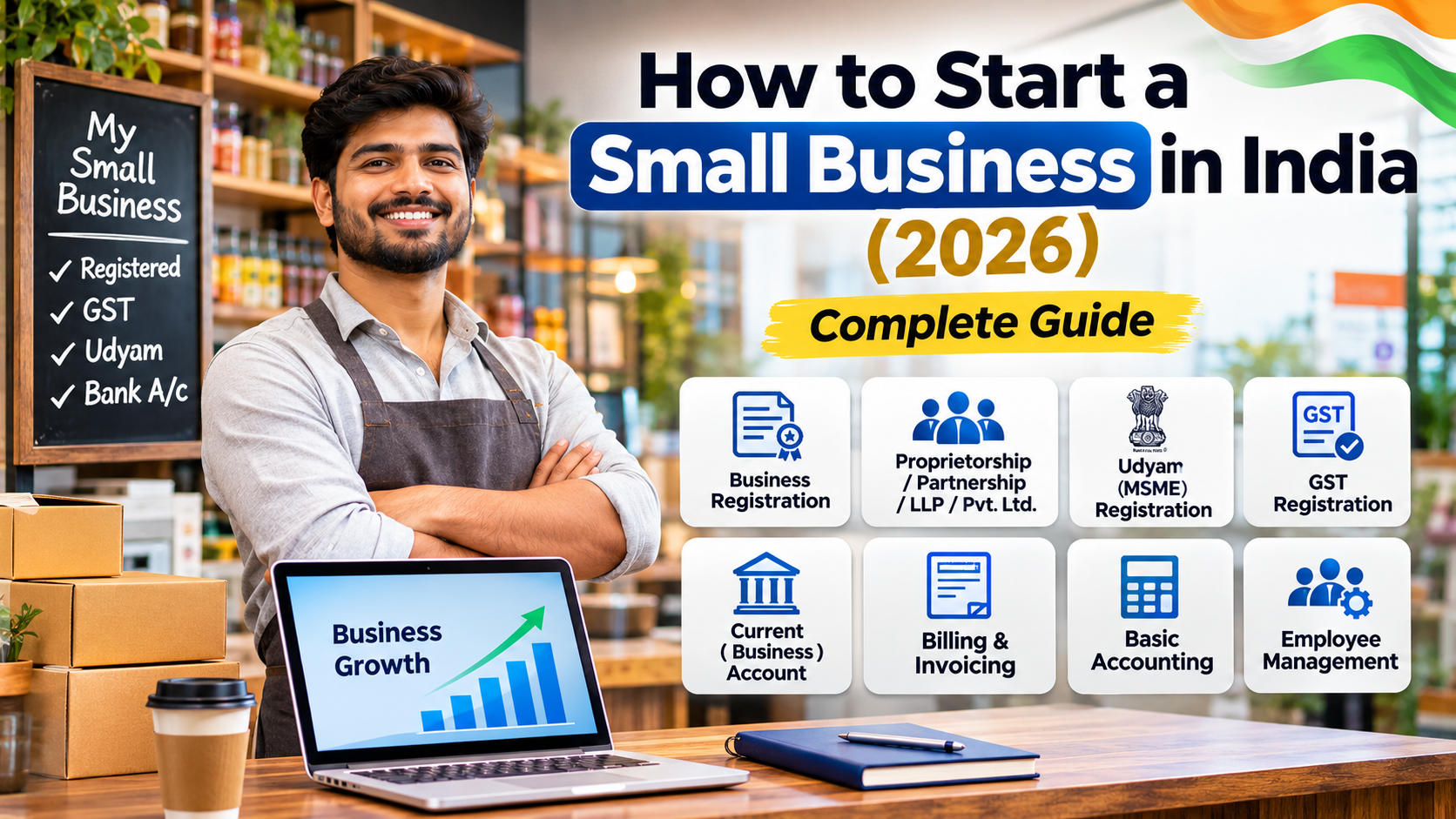
How to Start a Small Business in India (2026): Complete Guide to Business Registration, GST, Banking, Billing and Compliance
Starting a business in India is an exciting opportunity, whether you want to open a retail shop, launch a technology startup, operate a consultancy, start a manufacturing unit or build an online business. However, turning a business idea into a legally organised and financially sustainable operation requires more than finding customers and selling products.
New entrepreneurs must understand business structures, registration requirements, taxation, banking, invoicing, accounting and employee management. They also need to know which registrations are mandatory, which are optional and which depend on their business activities, turnover and location.
Many first-time entrepreneurs make the mistake of registering for every available licence without understanding whether it applies to their business. Others start operating without maintaining proper invoices, financial records or compliance documents. Both situations can create unnecessary expenses and difficulties later.
This guide explains how to start and manage a small business in India in 2026, using practical examples and straightforward explanations. It is intended to help first-time entrepreneurs, freelancers, shop owners, service providers, retailers, consultants and startup founders understand the process from business planning to daily operations.
2. Understanding the different types of business structures in India
Before registering a business, an entrepreneur must decide how the business will be legally organised. This decision affects ownership, personal liability, taxation, documentation, investment opportunities and future expansion.
India offers several business structures, and the right option depends on the number of owners, nature of operations, financial risk and long-term plans.
Sole Proprietorship
A sole proprietorship is one of the simplest ways to start a small business in India. It is owned and managed by one individual, who makes business decisions, receives profits and is responsible for business obligations.
For example, someone opening a grocery shop, clothing store, photography studio, freelance consultancy or small online store may start as a sole proprietor.
A proprietorship does not have a separate legal identity from its owner. There is no single central incorporation certificate for an ordinary proprietorship. Its existence is generally established through applicable business registrations, licences, tax registrations and banking documents.
The main advantage is simplicity. The owner can start operations without the incorporation process required for a company or LLP. However, the owner also carries personal liability for business debts and obligations.
Partnership Firm
A partnership firm is suitable when two or more people want to operate a business together and share responsibilities, investment and profits.
For example, two friends may open a restaurant. One partner may manage purchasing and operations, while the other handles finance, marketing and customer relationships.
A written partnership deed is strongly recommended. It should explain each partner's capital contribution, profit-sharing ratio, responsibilities, decision-making authority, withdrawal conditions and procedures for resolving disputes.
Partnerships are generally simpler to establish than companies, but ordinary partners have personal liability for partnership obligations. Registration of a partnership firm is governed by the Indian Partnership Act, 1932, and the consequences of non-registration should be considered before choosing this structure.
Limited Liability Partnership (LLP)
An LLP combines features of a partnership with a separate legal identity and limited liability protection, subject to applicable law and exceptions.
It is suitable for professional services, consulting firms, agencies, technology businesses and businesses operated by multiple founders who want a formal legal structure.
For example, two software developers starting a web development agency may choose an LLP to establish a formal business entity with defined partner responsibilities.
An LLP is incorporated through the Ministry of Corporate Affairs (MCA). It requires at least two partners and designated partners, and it has ongoing statutory filing and compliance requirements.
Private Limited Company
A private limited company is often suitable for businesses planning significant expansion, external investment, multiple shareholders or a formal corporate ownership structure.
For example, entrepreneurs developing a software product, SaaS platform, technology startup or scalable online marketplace may choose this structure.
A private limited company has a separate legal identity from its shareholders. Shareholders generally have limited liability, subject to legal exceptions and their obligations.
It requires at least two members and two directors. The company must follow MCA filing requirements, maintain statutory records and comply with applicable accounting and audit requirements.
One Person Company (OPC)
An OPC allows an individual to establish a company with a single member. It can be useful for an entrepreneur who wants a corporate structure without bringing in another shareholder.
An OPC also has nominee-related requirements and company compliance obligations. It is worth comparing its cost and administrative requirements with those of a proprietorship before deciding.
Comparison of Business Structures
Business structure
Suitable for
Ownership
Liability
Proprietorship
Small shops and individual businesses
One owner
Generally unlimited personal liability
Partnership
Businesses with multiple owners
Two or more partners
Generally unlimited personal liability
LLP
Professional and service businesses
Two or more partners
Generally limited
Private Limited
Growing startups and scalable businesses
Shareholders
Generally limited
OPC
Individual entrepreneurs seeking a company
One member
Generally limited
Which structure should you choose?
If you are testing a small business idea independently, a proprietorship may be sufficient. If you are starting with another person, compare a partnership with an LLP. If you expect external investors, equity-based funding or substantial expansion, a private limited company may be more appropriate.
Do not select a structure only because it sounds more professional. Consider annual compliance expenses, taxation, liability and future business requirements.
3. Choose a business name and define your business activity
After selecting a suitable business structure, the next step is to decide what the business will offer and how it will operate.
Choose a business name that is easy to remember, relevant to your products or services and unlikely to be confused with an existing brand. Before investing in signage, packaging or marketing, check whether the proposed name conflicts with an existing trademark or company name.
For a company or LLP, name availability and reservation must follow the MCA process. For a proprietorship, the owner should check applicable trade-name and trademark considerations.
You should also clearly define your business activity. For example, a business selling mobile accessories, repairing mobile phones and providing online technical support may have multiple activities that need to be reflected appropriately in its registrations and licences.
A clear business description helps when opening a bank account, applying for GST registration, obtaining Udyam registration and creating invoices.
4. Register your business in India
The registration process depends on the legal structure selected.
A proprietorship generally requires the applicable local and business registrations rather than a separate MCA incorporation certificate. Depending on the activity and location, this may include Shops and Establishments registration, a municipal trade licence, GST registration or other permissions.
A partnership firm should prepare a partnership deed containing the agreed ownership and operating terms. The partners should also consider registration of the firm with the appropriate state Registrar of Firms and obtain the relevant PAN and tax registrations.
An LLP must be incorporated through the MCA portal. The designated partners generally require Digital Signature Certificates, and the incorporation application includes the proposed LLP name, partner details and registered office information.
A private limited company is incorporated through the MCA's online incorporation process, including the applicable SPICe+ forms and associated services. The founders must provide the required identity, address, director and registered office documentation.
Before starting the incorporation process, prepare the documents relevant to your structure.
Document
Typical purpose
PAN card
Tax identification
Aadhaar or other accepted identity proof
Identity verification
Address proof
Residential or registered office verification
Photograph
Where required
Business address proof
Establishment address
Rent agreement or ownership document
Premises verification
Owner's NOC
Where required for rented or shared premises
Partnership deed
Partnership ownership and terms
DSC
Applicable MCA electronic filings
Proposed business name
Name reservation and incorporation
The exact documents depend on the entity type and application. Do not assume every document is required for every business.
For official incorporation information, use the portal rather than relying on unofficial websites.
5. Udyam Registration: Register as an MSME
Udyam Registration is the Government of India's official registration system for Micro, Small and Medium Enterprises (MSMEs).
It is useful for eligible manufacturers, service providers, traders and other qualifying enterprises because MSME recognition can support access to certain government schemes, credit-related benefits, procurement opportunities and other applicable facilities.
An entrepreneur should understand that Udyam Registration is not the same as company incorporation, GST registration or a trade licence. It does not replace other registrations that the business may legally require.
MSME classification in India (effective 1 April 2025)
The Government revised MSME classification limits with effect from 1 April 2025.
Enterprise category
Investment limit
Annual turnover limit
Micro
Up to ₹2.5 crore
Up to ₹10 crore
Small
Up to ₹25 crore
Up to ₹100 crore
Medium
Up to ₹125 crore
Up to ₹500 crore
Both investment and turnover criteria are relevant. An enterprise must satisfy the applicable limits for its classification.
How to apply for Udyam Registration
The entrepreneur should visit the official Udyam Registration portal and select the option for a new enterprise.
The applicant provides Aadhaar details for the appropriate proprietor, managing partner or authorised person, as applicable. PAN and GST-related details are verified according to the enterprise's legal structure and applicable requirements.
The registration process is online and based on self-declaration and government database verification. Once successfully completed, the enterprise receives a permanent Udyam Registration Number and an electronic certificate.
Important: Udyam Registration is free on the official government portal. Be careful with unofficial websites that charge money for a registration that can be completed directly through the government portal.
Official website: https://udyamregistration.gov.in/
6. GST Registration for Small Businesses in India
Goods and Services Tax (GST) is an important part of running a business in India. It applies to the supply of taxable goods and services and is administered through the GST system.
However, not every small business needs to obtain GST registration immediately. The requirement depends on aggregate turnover, the nature of supplies, the state of operation and specific compulsory-registration provisions.
For many businesses in normal-category states, the general registration threshold is ₹20 lakh for services. Eligible businesses exclusively supplying goods may have a higher threshold of ₹40 lakh in states that have adopted the applicable exemption. Different limits and conditions apply in certain states and situations.
For example, a small consultancy in Gujarat with annual aggregate turnover of ₹12 lakh may generally remain below the normal service-provider threshold, assuming no compulsory-registration provision applies. A business supplying goods may qualify for a different threshold.
Aggregate turnover is calculated on a PAN-India basis and includes relevant taxable, exempt, export and inter-state supplies as defined under GST law.
Some activities can require registration even when turnover is below the normal threshold. Therefore, businesses should check the applicable provisions before assuming that they are exempt.
How to apply for GST registration
A business that becomes liable for GST registration can apply through the official GST portal.
The applicant generally needs PAN details, business address information, identity and authorisation details, bank information as required, and supporting documents relevant to the business structure.
The application is submitted electronically through Form GST REG-01. After submission, the applicant can track the application using the acknowledgement or reference number.
Once registration is approved, the business receives a GST Identification Number (GSTIN).
Official portal: https://www.gst.gov.in/
When should a small business register for GST?
A business should evaluate registration when it approaches the applicable turnover threshold, starts making supplies covered by compulsory-registration provisions, expands into additional states or begins operating through certain e-commerce arrangements.
Voluntary registration is also possible, but it brings GST compliance responsibilities. A voluntarily registered business generally becomes responsible for charging and paying applicable GST and filing the required returns.
7. Other Licences and Registrations Required for Small Businesses
GST and Udyam registration do not cover every legal requirement. Depending on the business activity, state, premises and number of employees, additional licences may be necessary.
For example, a restaurant or food business generally needs the applicable FSSAI registration or licence. A physical shop may need registration under the relevant state Shops and Establishments law and, depending on its location and activities, a municipal trade licence.
A manufacturing unit may require factory-related approvals, environmental permissions, fire safety compliance and other industry-specific authorisations.
An importer or exporter may need an Importer Exporter Code (IEC). A business employing workers may also have applicable labour-law registrations and obligations.
The following table provides a practical overview.
Registration or licence
Common applicability
Udyam Registration
Eligible MSMEs
GST Registration
Businesses meeting applicable GST requirements
Shops and Establishments
Applicable commercial establishments under state law
FSSAI
Food businesses
Trade Licence
Activities requiring local municipal permission
IEC
Importers and exporters
EPF registration
Covered establishments
ESI registration
Covered establishments
Professional Tax
Where applicable under state law
The requirements are not identical across India. A restaurant in Gujarat and a manufacturing unit in Maharashtra may have different local approval requirements. Entrepreneurs should verify the requirements with the relevant state and local authorities before commencing operations.
8. Open a Current Account for Your Business
Once the business structure and necessary documentation are in place, opening a business bank account is an important operational step.
A current account helps separate business transactions from personal spending. It makes it easier to receive customer payments, pay suppliers, manage operating expenses and maintain financial records.
For example, a retail shop receiving ₹3 lakh in monthly sales should maintain clear records of its customer collections, supplier payments, rent, electricity expenses and other business transactions.
Using a dedicated business account makes these activities easier to track.
Banks may request different documents depending on the legal structure. A proprietorship may need proof of business existence and proprietor identity documents, while an LLP or company generally needs incorporation documents, PAN, authorised signatory details and other bank-specific documentation.
Before opening an account, compare minimum balance requirements, transaction limits, cash deposit charges, internet banking facilities, payment gateway support and other service fees.
A separate current account is a good financial management practice, even where the particular legal structure or banking arrangement does not make it universally mandatory.
9. Create Professional Business Invoices and Bills
Every business should maintain a consistent billing process. An invoice provides a record of the products or services supplied, the amount charged, payment details and applicable taxes.
A small shop may issue a simple sales bill, while a GST-registered business must follow the applicable GST invoicing requirements.
For example, a web development agency providing services to a customer should issue an invoice describing the development work, invoice date, invoice number, service value and applicable tax details.
A GST tax invoice generally contains the supplier's name, address and GSTIN, a consecutive invoice number, date, recipient details where applicable, HSN or SAC information, description, taxable value, tax rate and tax amount, and other prescribed particulars.
Sample business invoice
Particular
Example
Business Name
ABC Digital Solutions
Invoice Number
ABC/2026/001
Invoice Date
02 November 2026
Customer
XYZ Enterprises
Service
Website Development
Taxable Value
₹20,000
GST Rate (illustrative)
18%
CGST (9%)
₹1,800
SGST (9%)
₹1,800
Total Invoice Amount
₹23,600
This example assumes a taxable intra-state supply attracting 18% GST. The applicable rate depends on the actual goods or services and their classification.
For an eligible inter-state transaction, IGST generally applies instead of CGST and SGST.
Businesses should also understand the difference between a tax invoice and a bill of supply. A composition taxpayer or a supplier of exempt supplies may need to issue a bill of supply rather than collect GST through a regular tax invoice.
Businesses covered by the e-invoicing rules must also generate the required Invoice Reference Number (IRN) and signed QR code through the authorised system.
10. Maintain Proper Business Accounts and Financial Records
Accounting is not only about calculating profit at the end of the year. It helps business owners understand where money comes from, where it is spent and whether the business is financially healthy.
Many small businesses fail to maintain proper financial records because they consider accounting necessary only during tax filing. This makes it difficult to identify unpaid customer invoices, excessive expenses, stock shortages and cash-flow problems.
A small business should maintain a systematic record of its daily sales, purchases, expenses, bank transactions, customer payments, supplier dues and inventory movements.
Consider a grocery shop with monthly sales of ₹4,00,000. Its monthly purchases may be ₹2,50,000, while rent, electricity, salaries and other operating expenses may total ₹80,000.
Its simplified operating result would be:
Financial detail
Amount
Monthly Sales
₹4,00,000
Purchases
₹2,50,000
Other Operating Expenses
₹80,000
Simplified Operating Surplus
₹70,000
This is an illustrative calculation, not a final taxable-profit calculation. Opening and closing stock, other income, depreciation, taxes and additional expenses may change the actual result.
Businesses should also reconcile bank transactions regularly and preserve invoices, receipts, purchase records and relevant tax documents.
Depending on the business structure and applicable tax provisions, accounting records, income-tax returns, tax audits and other reporting requirements may apply. A qualified accountant can help determine the correct requirements.
11. Employee Management and Payroll for Small Businesses
When a business starts hiring employees, managing attendance, salaries, leave and employee records becomes an important responsibility.
Initially, a small business may have only two or three employees. However, as the team grows, managing everything through notebooks and spreadsheets can become difficult.
A proper employee-management process should maintain employee details, joining dates, salary structures, attendance records, leave balances and monthly salary calculations.
For example, a retail shop with five employees should maintain a clear record of each employee's monthly salary, attendance, approved leave, overtime where applicable and salary payments.
Employers should also understand applicable minimum wages, working-hour requirements, wage-payment rules, leave entitlements and other employment obligations.
EPF and ESI applicability depends on the establishment, employee strength, wages, notified coverage and relevant statutory provisions. Businesses should not assume that these registrations are mandatory for every employer from the first employee.
Where applicable, employers must complete registration, calculate contributions, maintain records and meet filing and payment requirements.
A structured HR and payroll process helps prevent salary disputes and improves transparency between employers and employees.
12. Common Mistakes First-Time Entrepreneurs Should Avoid
One of the biggest mistakes is choosing a business structure without understanding personal liability and compliance expenses. A structure that works for a small individual business may not be appropriate when multiple founders or investors become involved.
Another common problem is mixing personal and business finances. Without separate transaction records, entrepreneurs may struggle to calculate actual business profits or identify unnecessary expenses.
Some business owners also ignore invoices and accounting until the end of the financial year. This can result in missing purchase records, incorrect tax calculations and difficulty tracking outstanding payments.
A further mistake is obtaining registrations without understanding their obligations. GST registration, for example, introduces tax collection and return-filing responsibilities.
Businesses should also avoid hiring employees without written employment terms, clear salary information and proper attendance records.
Finally, entrepreneurs should not assume that every licence or registration is the same across India. State-specific and industry-specific rules must be checked before starting operations.
13. Practical Example: Starting a Small Business in India
Consider a first-time entrepreneur who wants to open a small clothing and accessories store in Vadodara, Gujarat.
The entrepreneur first estimates the investment required for shop rent, furniture, inventory, electricity, staff and marketing. After deciding to operate independently, they evaluate a proprietorship as their initial business structure.
They arrange the required business-address documents, check local shop registration requirements and obtain applicable permissions. They also evaluate Udyam registration and GST requirements based on their business activity and expected turnover.
Next, they open a business current account, arrange a billing system and establish a process for recording purchases and sales. They introduce digital payment facilities and maintain daily transaction records.
As the shop grows, they hire employees, maintain attendance and salary records, and review applicable labour-law obligations.
After a few months, the entrepreneur introduces a digital product catalogue and WhatsApp ordering to make it easier for customers to discover available products.
This example demonstrates that starting a business is not a single registration activity. It is a continuous process of establishing, organising and improving business operations.
14. How Digital Business Management Tools Help Small Businesses
Managing a growing business involves several activities, including billing, employee management, attendance, customer communication, visitor registration and document management.
When these activities are handled through separate notebooks, spreadsheets and disconnected applications, business owners may spend more time managing administration than developing their businesses.
Digital business-management tools can help centralise routine operations and improve the availability of business information.
For example, a small company can use digital HR software to maintain employee records, manage attendance and organise leave requests. A billing system can help create invoices and track customer payments, while a visitor management solution can organise office entry records.
Businesses should select software according to their actual requirements, budget, ease of use, data-security needs and future expansion plans.
How i-SPUR supports business digitisation
i-SPUR provides digital business solutions designed to help organisations organise different business activities through technology.
Businesses exploring digital transformation can consider solutions such as HRMS, Visitor Management, QR solutions, Cloud Storage and Link Bridge, depending on their operational requirements.
The objective should be to reduce repetitive manual work, improve information management and create more organised business processes.
Frequently Asked Questions (FAQs)
1. How much money is required to start a small business in India?
The investment depends on the business model. A home-based consultancy or freelance service may begin with a relatively small investment, whereas a retail shop, restaurant or manufacturing business may require substantial capital for premises, equipment, inventory and employees.
Entrepreneurs should prepare a startup budget that includes initial investment, monthly expenses and emergency working capital.
2. Which business structure is best for beginners in India?
A sole proprietorship is often suitable for an individual starting a small business with limited investment and risk. An LLP may suit businesses with multiple founders, while a private limited company may be more appropriate for businesses planning external investment and substantial expansion.
The right choice depends on ownership, liability, funding and compliance requirements.
3. Is GST registration compulsory for every small business?
No. GST registration depends on aggregate turnover, the nature of supplies, applicable state thresholds and compulsory-registration provisions. Some businesses may qualify for threshold exemptions, while others may need registration regardless of turnover.
4. Is Udyam Registration free in India?
Yes. Udyam Registration is free through the official Government of India portal. Eligible enterprises can apply online and receive a permanent registration number and electronic certificate.
5. Can I start a business without registering a private limited company?
Yes. A person can operate through a proprietorship or other legally appropriate business structure without incorporating a private limited company. However, applicable licences, registrations and tax requirements must still be fulfilled.
6. What is the difference between Udyam Registration and GST Registration?
Udyam Registration identifies an eligible enterprise as an MSME and may provide access to applicable government benefits. GST Registration identifies a taxable person under the GST system and allows the business to undertake taxable supplies according to GST requirements.
They serve different purposes and one does not replace the other.
7. Do small businesses need a current account?
A separate current account is generally a good practice because it helps separate business and personal transactions. The exact banking requirements depend on the business structure and the bank's policies.
8. Does every small business need a CA?
Not every small business is legally required to appoint a chartered accountant. However, professional accounting and tax assistance can be valuable when dealing with GST, income tax, bookkeeping, financial statements and statutory audits.
9. What documents are required to start a small business?
Commonly required documents include PAN, identity proof, address proof, business-premises documents and structure-specific incorporation or partnership documents. Additional documents depend on the licence or registration being applied for.
10. Can I run a small business from home?
Yes. Many consultancy, freelancing, online selling, digital services and home-based businesses operate from residential premises. However, zoning, housing-society restrictions, local permissions, GST and industry-specific requirements should be checked.
11. When should a small business hire its first employee?
A business should consider hiring when the workload consistently exceeds the owner's capacity or when specialised skills are required. Before hiring, calculate the complete employment cost, including salary, applicable statutory contributions, benefits and administrative expenses.
12. How can small businesses manage their operations digitally?
Businesses can use accounting and billing software, inventory management systems, HRMS, attendance software, customer-management tools and digital payment solutions. The best approach is to introduce tools gradually according to business needs.
Conclusion
Starting a small business in India requires planning, appropriate registrations, financial discipline and consistent operational management.
Entrepreneurs should begin by understanding their business idea, selecting a suitable legal structure and identifying the licences applicable to their activities. They should also establish proper banking, invoicing and accounting practices before expanding their operations.
As the business grows, employee management, statutory compliance, customer communication and digital tools become increasingly important.
You do not need to build a large organisation on the first day. Start with the essential requirements, maintain accurate records, understand your legal responsibilities and improve your processes as your business develops.
A well-organised business is better positioned to manage its finances, build customer trust, handle growth and create long-term opportunities.
Looking to organise your business operations digitally? Explore i-SPUR's business-management solutions to discover tools for HR, attendance, visitor management, QR-based services and digital business operations.
About the Author
i-SPUR Editorial Team
The i-SPUR Editorial Team creates practical educational content covering entrepreneurship, business management, HR administration, payroll, taxation, digital transformation and workplace productivity. Its goal is to help Indian entrepreneurs, startups, small businesses and growing organisations understand business processes and make informed decisions.
Disclaimer: This article is intended for general educational purposes and does not constitute legal, tax or financial advice. Registration requirements, tax thresholds, statutory obligations and licensing rules may vary depending on business activities, location and applicable law. Consult a qualified professional or the relevant government authority before making compliance decisions.