Table of Contents
- Attendance Is More Than Just Punching In and Out
- Punch Requests: Give HR a Place to Handle Attendance Requests
- Attendance Details: See What Actually Happened
- Punch Regularization: Handling the Days That Do Not Go as Planned
- Attendance: The Everyday View HR Actually Needs
- Why a Software-Based Attendance Process Helps HR
- A Simpler Attendance Experience for HR
Attendance is one of those HR responsibilities that looks simple until a company has dozens or hundreds of employees. Someone forgets to punch in, another employee misses the punch-out, a manager needs to check a late arrival, and HR suddenly has several small attendance issues to follow up on.
When these requests are handled through messages, spreadsheets, emails, or separate records, the process can become unnecessarily time-consuming. A well-organized HR attendance system changes that experience by bringing everyday attendance activities into one place, where HR can review records, handle requests and keep attendance information structured. Modern attendance platforms commonly combine punch tracking, attendance details, regularization workflows and approval processes instead of treating each activity as a separate task.
Attendance Is More Than Just Punching In and Out
For HR, attendance is not simply a record showing when an employee entered and left the workplace. It becomes a working record of an employee's presence, working time and attendance-related requests. In a real workplace, there will always be exceptions. An employee may forget to punch out, a biometric device may not capture a punch, someone may be working from another location, or an employee may need to explain an unusual attendance entry. This is why attendance management needs more than a basic check-in and check-out facility. It needs a clear way to look at the record, understand what happened and take the appropriate action without making HR search through different systems.
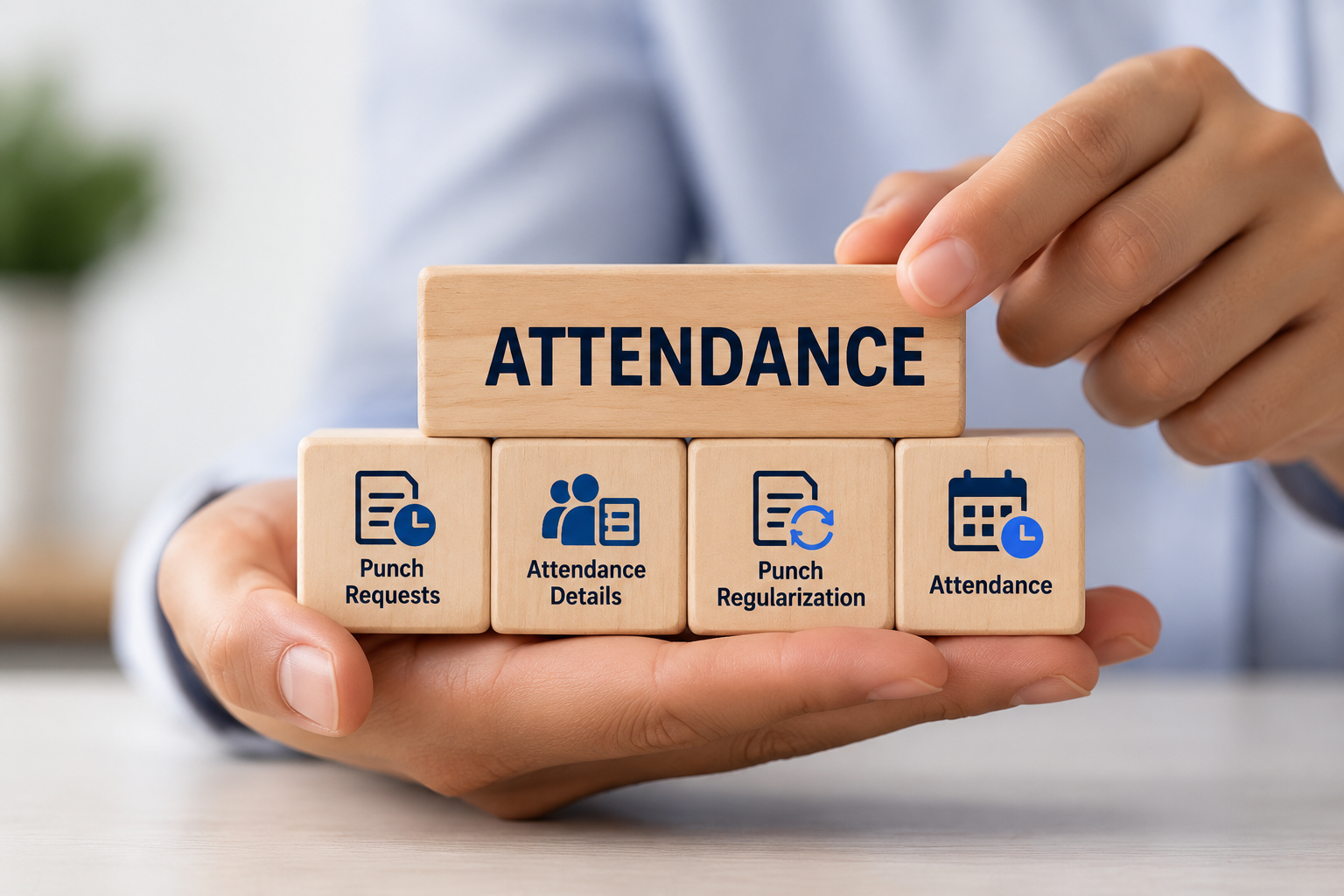
The Attendance section shown in the HR interface brings this process into a simple structure with four important areas: Punch Requests, Attendance Details, Punch Regularization and Attendance. Instead of treating every attendance problem as a separate manual activity, these options give HR a more organized way to manage the complete attendance process.
Punch Requests: Give HR a Place to Handle Attendance Requests
Punch Requests can become especially useful when employees need HR or their manager to review an attendance-related request. Rather than receiving a message saying, “I forgot to punch in today,” HR can have a defined place where such requests can be viewed and processed.
This creates a better flow for everyday attendance administration. A request can be reviewed against the employee's attendance record before any decision is made. The important part is not simply receiving the request; it is keeping the request connected to the employee's attendance information.
A structured request process can help HR keep track of:
- Which employee submitted the request
- Which attendance date is involved
- What change or action is being requested
- Whether the request is still pending
- Whether it has been approved or rejected
Attendance software commonly uses approval workflows for missed or incorrect punches so that corrections are reviewed instead of being changed informally.
Attendance Details: See What Actually Happened
Sometimes HR does not need to change anything. They simply need to see the attendance details.
This is where having a dedicated Attendance Details area becomes valuable. Instead of looking at a single total or a monthly number, HR can review the underlying attendance information and understand an employee's attendance pattern. Depending on the organization's configuration, this can include punch times, attendance status and other relevant details.
The benefit is simple: HR gets context before taking action. If an employee says that their attendance was marked incorrectly, HR can first check the available attendance details rather than relying only on the employee's explanation.
That small difference can make attendance administration more consistent. The system becomes the place where the record is reviewed, while conversations and explanations become supporting information rather than the main attendance record.
Punch Regularization: Handling the Days That Do Not Go as Planned
Punch Regularization is one of the most practical parts of attendance management because real workplaces are rarely perfect. Employees can miss a punch for many reasons, and an incorrect attendance record does not always mean that the employee was absent.
Regularization provides a structured way to address these situations. Instead of asking HR to manually edit attendance records whenever a problem occurs, the employee can raise a request and the responsible person can review it before the attendance record is updated.
This is particularly useful because the correction can remain connected to the original attendance issue. Modern attendance systems commonly use regularization requests with reasons, approval workflows and records of the action taken.
For HR, this can reduce repeated follow-ups such as:
- Did you forget to punch in?
- What time did you actually arrive?
- Has your manager approved the correction?
- Which date needs to be changed?
Instead, the information can move through a defined workflow.
Attendance: The Everyday View HR Actually Needs
The main Attendance section brings the daily picture together. This is where HR can work with attendance records as part of normal employee management rather than treating attendance as a separate administrative problem.
A useful attendance process should make it easier to understand who has recorded attendance, where attention may be required and which records need follow-up. For larger teams, filters and organized attendance views become particularly useful because HR may need to review employees by department, date, shift or other organizational information. Current attendance platforms commonly provide these kinds of views and filters for HR and managers.
This is also where the connection between attendance and other HR information becomes important. An employee already has a department, designation, location and working schedule. Attendance works better when those details are part of the same overall employee structure rather than being maintained independently.
Why a Software-Based Attendance Process Helps HR
The real value of attendance software is not simply replacing a paper register with a screen. The bigger change is that the process becomes organized. HR can have one place for requests, one place for attendance details, one workflow for punch corrections and one area for the overall attendance record.
That can make a noticeable difference during busy periods. Instead of HR spending time collecting attendance information from different sources, the software can provide a structured view that HR can work from. Attendance platforms also commonly connect approved attendance information with payroll-related processes, reducing the need to manually reconcile attendance information later.
The idea is straightforward: HR should spend less time chasing attendance information and more time managing the exceptions that actually need attention.
A Simpler Attendance Experience for HR
Good attendance management is not about making HR watch every punch throughout the day. It is about creating a process that works quietly in the background and gives HR the right information when something needs attention.
With areas such as Punch Requests, Attendance Details, Punch Regularization and Attendance, the workflow becomes easier to understand. Employees have a defined route for attendance issues, managers can review requests, and HR can maintain a clearer record without depending on scattered messages or manual corrections.
The biggest improvement may be the simplest one: attendance stops being a collection of small HR problems and becomes an organized part of everyday employee management.