Table of Contents
- Employee Management: The Core of Organized HR Operations
- Employee Management Starts With the Right Information
- Add Employee Is More Than Just Creating a Profile
- View Employee Makes Everyday HR Work Easier
- Employee Roles Give Structure to the Workforce
- Attendance Follow-Up Is About What Happens After Attendance
- Company Hierarchy Shows How People Connect
- The Employee Section Is the Foundation for Other HR Activities
- Why Employee Management Matters as a Business Grows
- A Better Way to Think About Employee Management
Employee Management: The Core of Organized HR Operations
When people think about HR, they often think about hiring, salaries, attendance or leave management. But before any of these activities can work properly, HR needs one basic thing: well-organized employee information.
Every employee has a different role, department, reporting relationship, attendance record and employment journey, and keeping all of this information clear becomes increasingly important as a business grows. This is where the Employee section of an HR system becomes useful. Instead of treating employee information as a simple list of names, businesses can use employee management to create profiles, define roles, understand reporting structures and follow up on attendance-related matters.
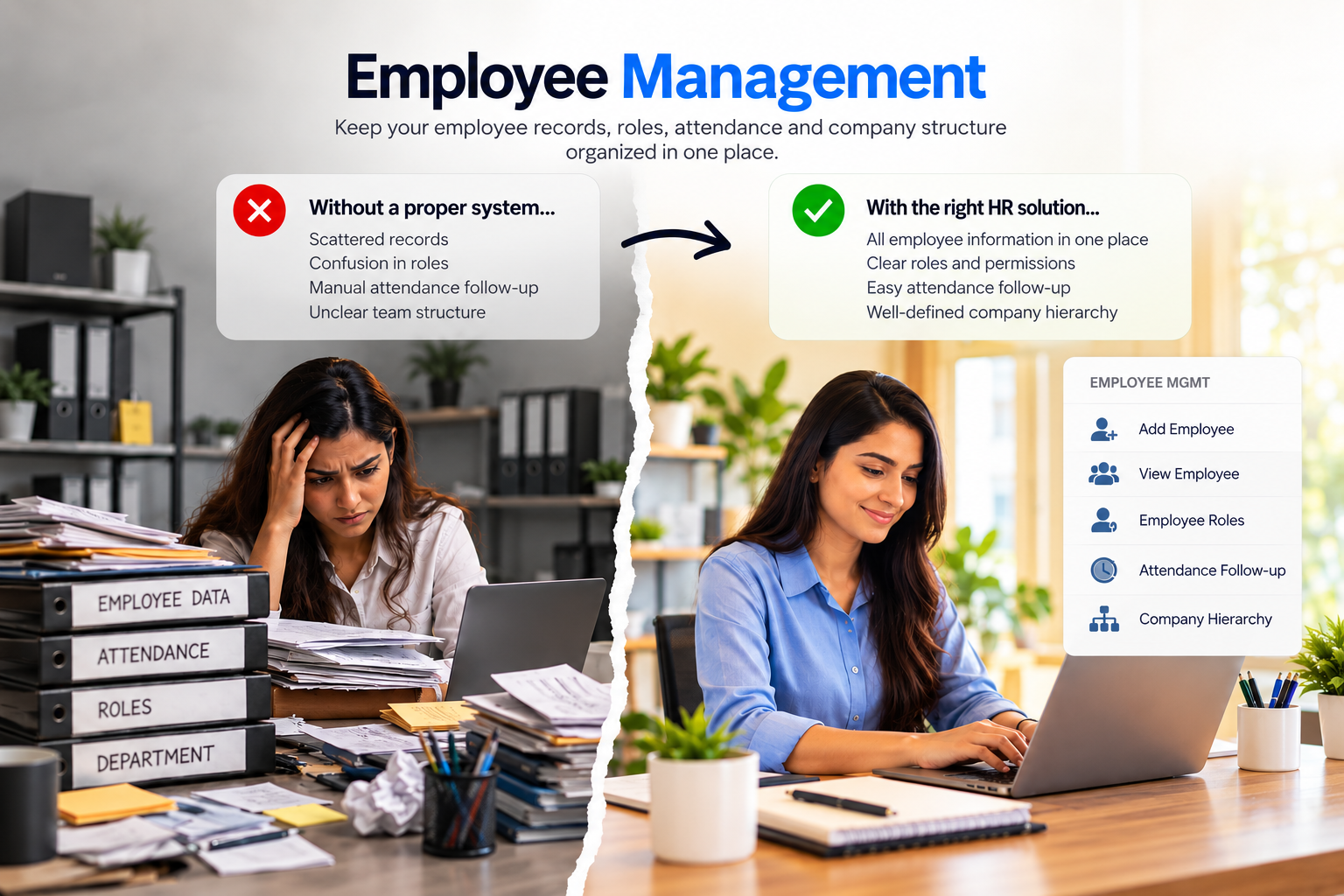
The employee area shown in the provided interface includes five practical functions — Add Employee, View Employee, Employee Roles, Attendance Follow-up and Company Hierarchy — and together they represent the basic structure HR needs to keep its workforce organised.
Employee Management Starts With the Right Information
A new employee does not simply become another name on a company list. HR needs to create a proper record that can be used throughout that person's time with the organisation. Joining information, employee details, department, designation, reporting manager and other relevant information need to be recorded in an organised way.
The Add Employee function is therefore more important than it may initially appear. It creates the employee's starting point inside the HR system and gives HR a structured record that can later connect with other activities.
A good employee record should not require HR to search through different spreadsheets whenever information is needed. Once an employee has been added, the record can become a reference point for attendance, roles, reporting relationships and other HR processes. This approach becomes especially useful when a company has dozens or hundreds of employees because maintaining information manually across different files becomes increasingly difficult. Modern employee management platforms are designed around this idea of centralised employee information and lifecycle management.
Add Employee Is More Than Just Creating a Profile
The first step in employee management is usually adding an employee, but the real purpose is to create a reliable foundation for everything that follows. When HR enters employee information in a structured format, the organisation has a clearer record of who the employee is and where that person belongs within the company.
For example, an employee record may need to connect with:
- Employee name and basic information
- Department and designation
- Joining and employment details
- Reporting manager
- Assigned role
- Attendance information
- Relevant employee documents
The important point is that employee information should not remain isolated. It should become useful information that HR can refer to whenever another employee-related process needs to be completed.
View Employee Makes Everyday HR Work Easier
After employees have been added, HR needs an easy way to find them. This is where View Employee becomes an everyday HR function rather than simply a database screen. HR teams may need to check an employee's department, role, reporting structure or other available information while handling routine requests. If that information is stored across multiple Excel files, folders or paper documents, even a simple search can become unnecessarily time-consuming.
A central employee view changes that experience. HR can open the employee record, review the available information and continue with the required task without repeatedly searching through different sources. It also gives HR a more consistent way to maintain employee information because the same employee record can be updated when details change.
This becomes particularly valuable when employees move between departments, receive new responsibilities or report to a different manager. Instead of creating another record or maintaining another spreadsheet, HR can update the existing employee information and keep the employee's record connected to the organisation.
Employee Roles Give Structure to the Workforce
A company can have many employees, but simply knowing who works there is not enough. HR also needs to understand what each employee does. This is why Employee Roles is an important part of employee management.
Roles help describe responsibilities and provide context around an employee's position in the organisation. A sales executive, HR manager, project manager and finance executive may all work for the same company, but their responsibilities and access requirements can be very different. Defining roles helps create a clearer structure around these differences.
Employee roles can also become useful when businesses manage permissions and approvals. Different users may need different levels of access depending on their responsibilities. Role-based access is a common part of modern business software, including i-Spur's HR platform.
Instead of thinking of roles as just a designation written beside an employee's name, HR can treat them as part of the organisation's overall structure — showing what an employee is responsible for and where that person fits into the business.
Attendance Follow-Up Is About What Happens After Attendance
Attendance management is often discussed as simply recording when employees arrive and leave. In real HR operations, however, the work does not stop after attendance is recorded. There can be missing punches, late arrivals, early departures, correction requests or other attendance situations that require attention.
This is where Attendance Follow-up becomes useful. Rather than allowing unusual attendance records to remain unnoticed, HR can review situations that need clarification or action. The purpose is not only to record attendance but to make sure attendance information remains usable and accurate.
For example, HR may need to follow up when an employee has a missing attendance entry or when a correction requires manager approval. Digital attendance systems can provide features such as punch tracking, regularisation requests and approval workflows, helping HR manage these situations in a more structured way.
The bigger benefit is visibility. HR does not have to wait until the end of the month to discover that several attendance records need correction. Regular follow-up can help keep employee attendance information cleaner throughout the working period.
Company Hierarchy Shows How People Connect
One employee may belong to a department, report to a manager, work with a team leader and be part of a larger organisational structure. When a company grows, understanding these relationships becomes increasingly important. This is the purpose behind Company Hierarchy.
A company hierarchy gives HR a visual and organisational understanding of how employees are connected. It can show departments, managers, teams and reporting relationships, making it easier to understand where an employee belongs and who is responsible for that employee's approvals or supervision.
This information can also support other HR activities. If an employee submits a request that requires manager approval, the organisation needs to know who the appropriate manager is. A clear reporting structure can make these processes easier to manage because responsibilities are already defined within the employee structure.
The Employee Section Is the Foundation for Other HR Activities
The interesting thing about these five functions is that none of them needs to work completely on its own. Add Employee creates the employee record. View Employee gives HR access to that record. Employee Roles define responsibilities. Attendance Follow-up keeps an eye on attendance-related situations. Company Hierarchy explains where the employee sits within the organisation.
Together, these functions create a connected employee management process:
Employee Added → Employee Information Maintained → Role Assigned → Reporting Structure Defined → Attendance Reviewed
This is why employee management should be considered one of the foundations of modern HR. When employee information is properly organised at the beginning, other HR activities have a clearer base to work from.
Why Employee Management Matters as a Business Grows
For a very small company, HR may remember most employee information without needing a structured system. But that changes quickly as the workforce expands. More employees mean more departments, more roles, more managers, more attendance records and more changes to employee information.
At that stage, the challenge is not simply storing more data. The challenge is keeping employee information organised while the organisation itself keeps changing.
A structured employee management approach can help HR maintain:
- A clearer employee database
- Better visibility into employee roles
- More organised reporting relationships
- Easier attendance follow-up
- More consistent employee information
- A stronger foundation for other HR processes
The objective is simple: HR should be able to understand its workforce without having to piece together information from different places.
A Better Way to Think About Employee Management
Employee management is sometimes treated as a basic administrative task, but it plays a much bigger role in how an organisation operates. Every department depends on knowing who its employees are, what responsibilities they have and where they fit into the organisation.
When employee records are organised, HR has a clearer starting point for managing people. When roles are defined, responsibilities become easier to understand. When hierarchy is maintained, reporting relationships become clearer. When attendance follow-up is handled regularly, employee time records are easier to manage.
That makes the Employee section more than just another part of an HR platform. It becomes the place where the organisation's people structure begins.