Table of Contents
- From Attendance to Payroll: Why Connected HR Systems Save Time
- Why HR Processes Become More Complex as Businesses Grow
- The Problem with Separate HR Systems
- Attendance Is the Foundation of Payroll
- Why Payroll Automation Matters
- Eliminating Manual Data Entry
- Leave Management Becomes Simple
- Better Employee Records Through HR Automation
- Faster Approvals Improve HR Efficiency
- Better Reporting for HR Leaders
- Supporting Compliance Requirements
- Improving Employee Experience
- Business Benefits of Connected HR Systems
- Preparing for the Future of HR
- Conclusion
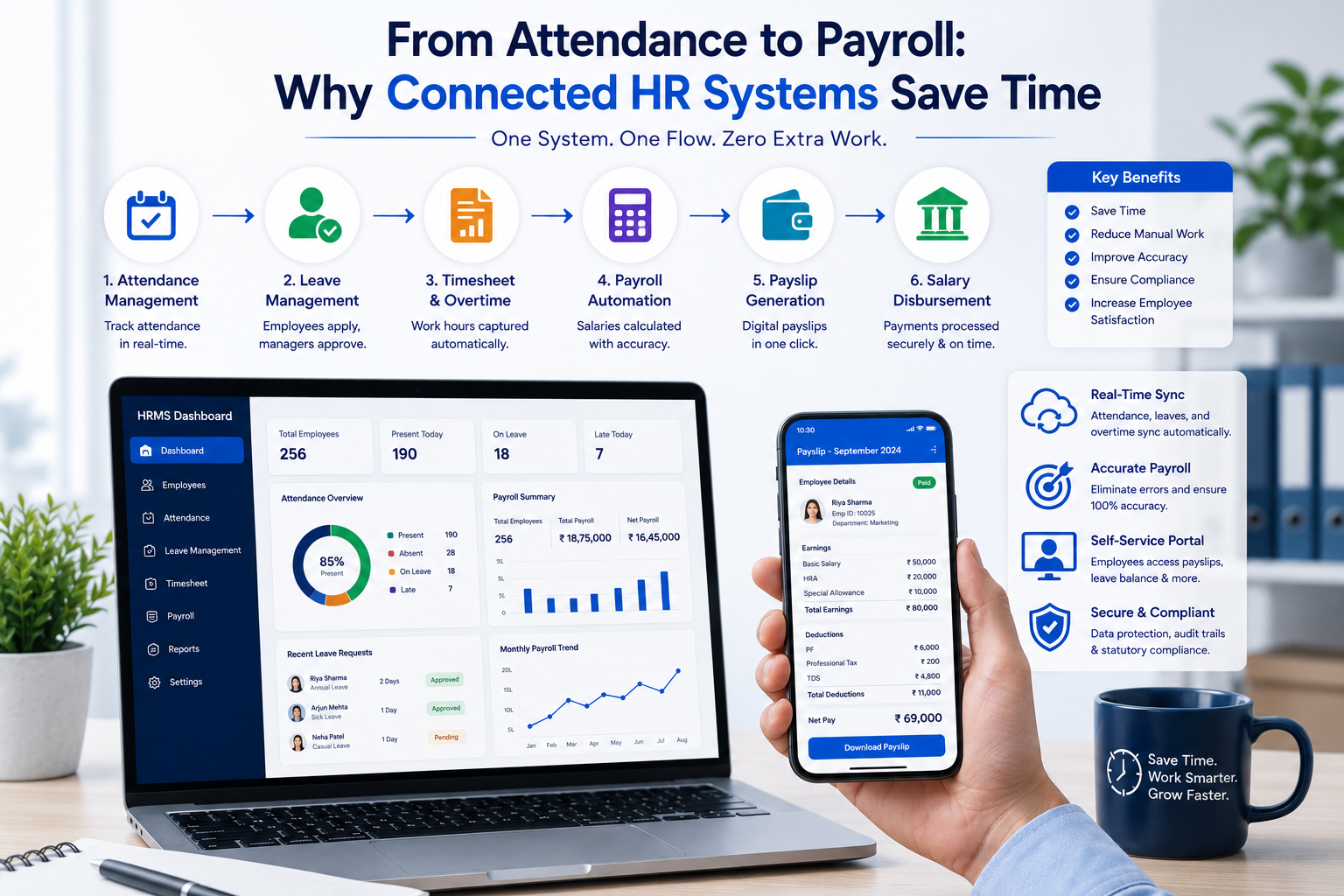
From Attendance to Payroll: Why Connected HR Systems Save Time
Managing employees is one of the most important responsibilities in every organization. From the day an employee joins the company until the day they leave, Human Resources handles numerous activities including attendance, leave management, payroll processing, performance tracking, employee records, statutory compliance, onboarding, and much more. While these tasks are essential for every business, they can also become time-consuming and complex, especially as the organization grows.
Many businesses still manage attendance using one application, payroll using another, leave requests through emails, employee records in spreadsheets, and approvals through messaging platforms. Although each system may perform its individual function effectively, the lack of integration often creates unnecessary work for HR teams. The same employee information has to be entered multiple times, attendance records need to be manually verified before payroll processing, leave balances require manual adjustments, and HR professionals spend countless hours reconciling data between different systems.
These repetitive tasks not only consume valuable time but also increase the possibility of human errors. A small mistake in attendance records can affect payroll calculations. Missing leave information can result in incorrect salary payments. Incorrect employee data may delay statutory filings or create compliance issues. As organizations expand, these challenges grow even larger.
Modern businesses are solving these problems by adopting connected HR systems through HRMS software. Instead of managing each HR function separately, an integrated HR system connects attendance management, leave management, payroll automation, employee records, timesheets, approvals, compliance, and reporting within a single platform.
When information flows automatically between HR processes, organizations save significant time, reduce administrative work, improve payroll accuracy, and allow HR professionals to focus on employee engagement and strategic workforce planning instead of manual data entry.
A connected HR system is no longer simply an HR tool—it has become an essential part of building a productive, efficient, and future-ready workplace.
Why HR Processes Become More Complex as Businesses Grow
Managing ten employees is very different from managing one hundred or one thousand employees.
As organizations expand, HR departments must handle increasing amounts of employee information every day.
Attendance records grow larger.Leave requests become more frequent.Payroll calculations become more complicated.Recruitment activities increase.
Compliance requirements become stricter.Performance reviews involve multiple managers.
Manual HR processes that worked for small businesses often become difficult to manage as employee numbers increase.
Without automation and integration, HR teams spend most of their time performing repetitive administrative work instead of supporting employees and organizational growth.
The Problem with Separate HR Systems
Many organizations use separate software for attendance, payroll, leave management, recruitment, and employee records.
Although each application performs its individual task, they rarely communicate with one another.This creates duplicate work.
When a new employee joins the company, HR enters employee information into multiple systems.
Attendance records must be exported before payroll processing.Leave balances are manually updated.
Managers approve requests through emails.Employee information becomes scattered across different applications.
Eventually, HR professionals spend more time maintaining software than managing people.Disconnected systems reduce productivity while increasing operational complexity.
Attendance Is the Foundation of Payroll
Attendance management plays a critical role in payroll processing.Every salary calculation depends on accurate attendance records.
Working days, overtime, late arrivals, holidays, paid leave, unpaid leave, shift schedules, and attendance corrections all influence payroll.
When attendance is managed manually, HR teams often verify records several times before payroll can be processed.
Errors become more likely because information is transferred manually.
Connected HR systems eliminate this challenge.Attendance information automatically updates payroll calculations.
HR professionals no longer need to copy data between applications.Payroll becomes faster, more accurate, and easier to manage.
Why Payroll Automation Matters
Payroll is one of the most sensitive responsibilities within any organization.Employees expect salaries to be processed accurately and on time every month.
Even small payroll errors can reduce employee satisfaction and create unnecessary administrative work.Payroll automation reduces these risks.
Instead of calculating salaries manually, HRMS software automatically processes payroll based on attendance, leave records, overtime, deductions, bonuses, tax rules, and company policies.
Automation ensures consistency while reducing human errors.HR teams gain confidence that payroll calculations are accurate before salaries are released.
Eliminating Manual Data Entry
One of the biggest advantages of connected HR systems is the elimination of duplicate data entry.Employee information only needs to be entered once.
After that, it becomes available across attendance management, payroll automation, leave management, recruitment, employee profiles, and reporting.This reduces administrative effort significantly.
HR professionals no longer spend time updating the same information in multiple systems.
Instead, they can focus on activities that create greater value for employees and the organization.
Leave Management Becomes Simple
Leave requests are an everyday part of HR operations.Employees request annual leave, sick leave, casual leave, maternity leave, and other leave types throughout the year.
Without automation, HR teams manually verify leave balances, update attendance records, notify managers, and adjust payroll calculations.This process becomes time-consuming.
Connected HR systems simplify leave management by automatically routing requests through approval workflows.Once approved, attendance records update automatically.
Payroll calculations reflect approved leave without manual intervention.Employees can also view leave balances in real time, reducing HR inquiries.
Better Employee Records Through HR Automation
Employee information changes frequently.Addresses, contact numbers, bank details, promotions, department transfers, reporting managers, certifications, and employment documents all require updates.Managing these records manually increases the risk of outdated information.
HR automation centralizes employee records within one secure platform.Whenever information changes, every connected HR process reflects the update automatically.
This improves data accuracy while reducing administrative effort.Organizations maintain complete employee profiles without duplicate work.
Faster Approvals Improve HR Efficiency
Approvals are essential for HR operations.Leave requests, attendance corrections, reimbursements, onboarding documents, promotions, transfers, and payroll adjustments often require approval from multiple stakeholders.
Manual approvals slow these processes.Employees send emails.Managers forget to respond.HR follows up repeatedly.
Connected HR systems automate approval workflows.Requests automatically reach the correct manager.
Notifications remind approvers about pending actions.Employees receive updates immediately.This creates faster workflows while improving transparency.
Better Reporting for HR Leaders
HR leaders rely on reports to monitor workforce performance.They need information about attendance trends, employee turnover, overtime, payroll expenses, recruitment progress, leave utilization, and workforce planning.
Disconnected systems require manual report preparation.Connected HRMS software generates reports automatically using real-time information.
Executives gain immediate visibility into workforce performance.Decisions become more informed because reports are accurate and always up to date.
Supporting Compliance Requirements
Labour laws and statutory regulations require organizations to maintain accurate employee records.
Payroll, attendance, tax deductions, PF, ESI, and other compliance activities depend on reliable information.
Manual processes increase compliance risks because records may become inconsistent.
Connected HR systems improve compliance by maintaining centralized employee information and automated audit trails.
Organizations can demonstrate accurate documentation whenever required.This reduces regulatory risks while simplifying audits.
Improving Employee Experience
Technology should improve employee experiences, not create frustration.
Connected HR systems provide employees with self-service access to attendance records, payslips, leave balances, tax documents, reimbursement status, and personal information.
Employees no longer need to contact HR for routine requests.Information becomes available instantly.
HR teams spend less time answering repetitive questions and more time supporting employee development.The workplace becomes more efficient for everyone.
Business Benefits of Connected HR Systems
Organizations implementing connected HRMS software experience improvements across multiple areas.
Some of the most important advantages include:
- Faster payroll processing with automated attendance integration.
- Reduced manual data entry and fewer payroll errors.
- Better employee record management and HR automation.
- Improved leave management and approval workflows.
- Stronger compliance with centralized employee information.
These improvements save time while helping HR departments operate more strategically.
Preparing for the Future of HR
The future of Human Resources is becoming increasingly digital.Artificial Intelligence, workforce analytics, predictive planning, automated recruitment, employee self-service, and intelligent HR automation all depend on connected systems.
Organizations relying on disconnected software will find it increasingly difficult to support these innovations.
Businesses investing in integrated HRMS software today are creating a stronger foundation for workforce management tomorrow.
Connected HR systems provide the flexibility needed for hybrid work, organizational growth, and evolving employee expectations.
Conclusion
https://i-spur.com/mail-lift-information Managing attendance, payroll, leave, employee records, approvals, and compliance separately may seem manageable for small organizations, but as businesses grow, disconnected HR processes quickly become inefficient. Manual data entry, duplicate records, payroll errors, delayed approvals, and scattered employee information consume valuable time that HR teams could spend supporting employees and driving business growth.
Connected HR systems solve these challenges by bringing attendance management, payroll automation, leave management, employee records, approvals, and reporting together in one integrated HRMS platform. Information flows automatically between processes, reducing administrative work while improving accuracy, transparency, and operational efficiency.
Rather than spending hours reconciling spreadsheets and correcting payroll mistakes, HR professionals can focus on workforce planning, employee engagement, and building a stronger organizational culture.
As businesses continue embracing digital transformation, connected HR systems are becoming more than just productivity tools. They are helping organizations create smarter, faster, and more employee-focused workplaces where technology supports both business success and employee satisfaction.
In today's competitive business environment, saving time is important—but building an efficient, connected, and reliable HR ecosystem is even more valuable for long-term growth.