Table of Contents
- How AI Is Changing Recruitment Beyond Resume Screening
- Recruitment Is Becoming More Complex Than Ever
- Moving Beyond Resume Screening
- Smarter Talent Acquisition Strategies
- Improving Candidate Sourcing
- Creating Better Candidate Experiences
- Intelligent Interview Scheduling
- Supporting Better Hiring Decisions
- Reducing Administrative Work for Recruiters
- Data-Driven Recruitment
- The Role of Recruitment Automation
- AI and the Future of Hiring Technology
- Benefits of AI Recruitment for Modern Organizations
- Conclusion
How AI Is Changing Recruitment Beyond Resume Screening
Recruitment has changed dramatically over the past decade. Not long ago, hiring was largely a manual process. Recruiters spent hours posting job openings, collecting resumes, reviewing applications one by one, scheduling interviews, following up with candidates, and maintaining spreadsheets to track hiring progress. While these methods worked for smaller hiring needs, they have become increasingly difficult to manage as businesses grow and the competition for skilled talent becomes more intense.
Today, organizations receive hundreds or even thousands of applications for a single position. Hiring managers are expected to fill roles faster while still finding candidates with the right skills, experience, and cultural fit. At the same time, candidates expect a smooth, transparent, and responsive hiring experience. These growing expectations have encouraged businesses to adopt smarter recruitment strategies that improve both efficiency and decision-making.
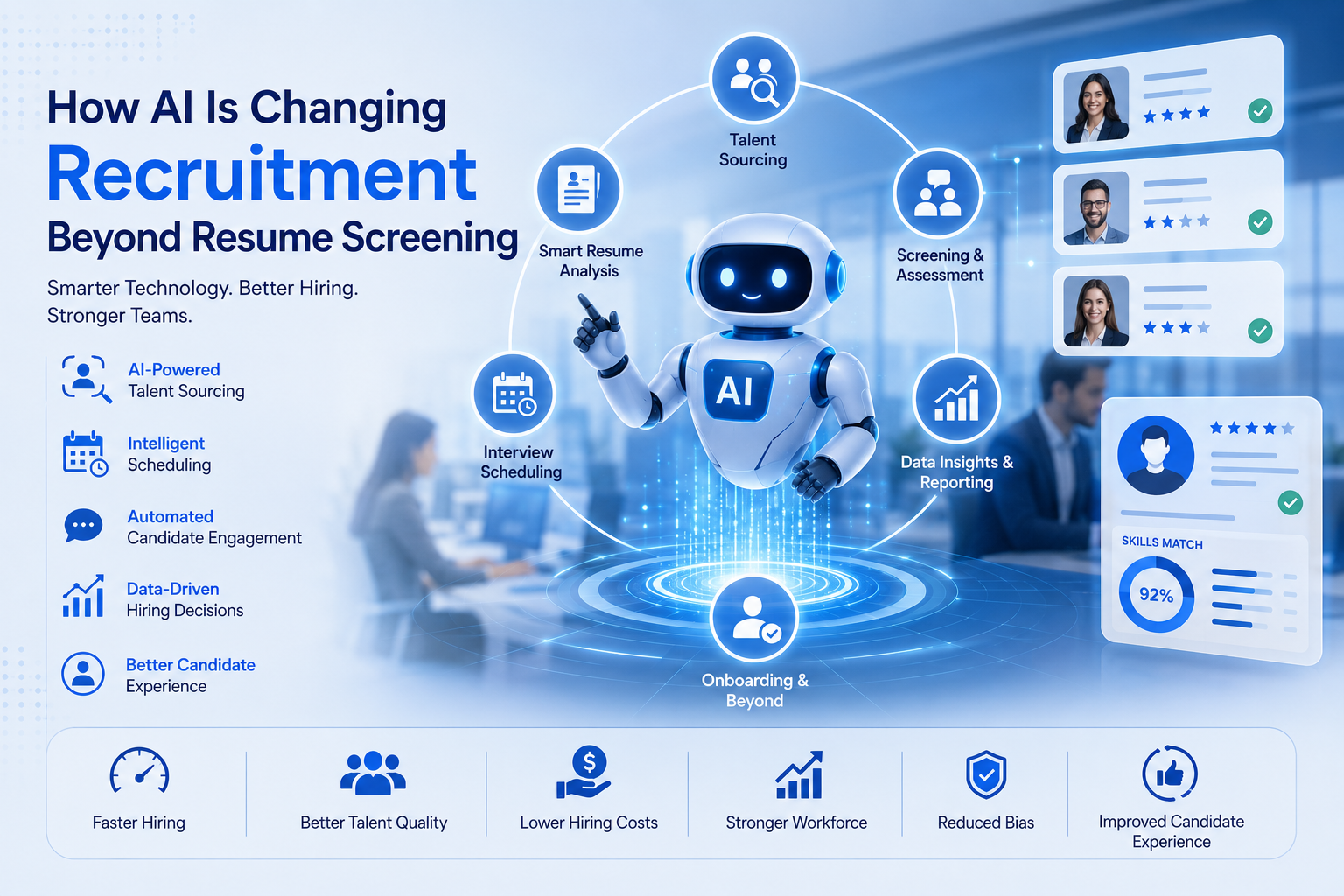
Artificial Intelligence (AI) is now playing a major role in transforming recruitment. However, many people still associate AI recruitment only with automated resume screening. While resume screening is certainly one of its applications, modern AI recruitment goes much further. AI is helping organizations improve every stage of the hiring journey, from workforce planning and candidate sourcing to interview scheduling, skill assessment, communication, onboarding, and long-term talent acquisition.
Rather than replacing recruiters, AI is becoming a powerful assistant that reduces repetitive administrative work and allows HR professionals to spend more time building relationships with candidates, understanding organizational needs, and making better hiring decisions.
The future of recruitment is not about replacing people with technology. It is about combining human expertise with intelligent hiring technology to create a faster, smarter, and more effective recruitment process.
Recruitment Is Becoming More Complex Than Ever
The modern job market is changing rapidly. New technologies are creating new job roles, employee expectations continue to evolve, and organizations are competing for talent on a global scale. Hiring is no longer simply about filling vacancies. It has become a strategic function that directly influences business growth, productivity, and innovation.
Recruiters must identify qualified candidates, communicate effectively, coordinate interviews with multiple stakeholders, evaluate technical and interpersonal skills, and ensure a positive candidate experience throughout the hiring process.
Managing all of these responsibilities manually is becoming increasingly difficult. As organizations scale, recruiters often spend more time handling administrative work than engaging with potential employees.
Artificial Intelligence helps solve this challenge by automating routine tasks while providing valuable insights that support better hiring decisions.
Moving Beyond Resume Screening
One of the first ways AI entered recruitment was through resume screening. AI systems can quickly analyze applications, identify relevant qualifications, and rank candidates based on predefined job requirements.
While this significantly reduces the time required to review applications, it represents only a small portion of what AI can achieve.Modern recruitment platforms use AI throughout the hiring process.
AI can analyze job descriptions and recommend improvements that attract stronger candidates. It can identify the most effective recruitment channels based on previous hiring campaigns. It can suggest suitable candidates from existing talent databases and even predict how well an applicant may match a specific role based on skills, experience, certifications, and career progression.
Instead of functioning as a simple filtering tool, AI is becoming an intelligent recruitment partner that supports recruiters from the moment a hiring need is identified until the candidate joins the organization.
Smarter Talent Acquisition Strategies
Talent acquisition is much broader than recruitment. Recruitment focuses on filling current vacancies, while talent acquisition is a long-term strategy for building a strong workforce.
Artificial Intelligence helps organizations adopt a more proactive approach to hiring.
Instead of waiting until a position becomes vacant, AI can analyze workforce trends, retirement forecasts, employee turnover, and future business growth to identify upcoming hiring needs.
This allows organizations to build talent pipelines well before vacancies arise.
Recruiters can maintain relationships with promising candidates, engage passive job seekers, and prepare for future workforce requirements instead of constantly reacting to immediate hiring demands.
This proactive approach improves hiring quality while reducing recruitment costs and delays.
Improving Candidate Sourcing
Finding qualified candidates has become one of the biggest challenges in recruitment.
Traditional sourcing methods often depend heavily on job portals and manual searches. While these methods remain useful, they can be time-consuming and may overlook highly qualified candidates.
AI helps recruiters search across multiple platforms, analyze professional profiles, and identify individuals whose skills closely match organizational requirements.
Instead of relying solely on keyword matching, AI can evaluate broader factors such as work history, certifications, technical expertise, career growth, and transferable skills.
This enables organizations to discover talented candidates who may otherwise remain unnoticed.Recruiters spend less time searching and more time engaging with suitable applicants.
Creating Better Candidate Experiences
Candidates today expect timely communication and a smooth hiring process.Unfortunately, many applicants experience long delays, inconsistent updates, or receive no feedback after submitting applications.
These experiences can negatively affect an organization's employer brand.AI helps improve communication throughout the recruitment process.
Candidates receive application confirmations, interview reminders, status updates, and answers to common questions without waiting for manual responses.This creates a more transparent and engaging hiring experience.
Recruiters also benefit because they spend less time managing repetitive communication and more time building meaningful relationships with candidates.
Positive candidate experiences often lead to stronger employer reputations and improved talent attraction.
Intelligent Interview Scheduling
Coordinating interviews can become surprisingly complex.Recruiters must match candidate availability with hiring managers, technical teams, and department heads.
Rescheduling interviews due to conflicts often creates unnecessary delays.AI-powered scheduling systems simplify this process.
They automatically identify available time slots, coordinate calendars, send invitations, and manage reminders.
If schedules change, the system can suggest alternative times without requiring extensive manual coordination.This reduces administrative work while accelerating the overall hiring process.
Organizations can move candidates through recruitment more efficiently and avoid losing talented individuals due to unnecessary delays.
Supporting Better Hiring Decisions
Successful hiring depends on more than technical qualifications.Organizations also consider communication skills, cultural alignment, adaptability, learning ability, and long-term potential.
AI helps recruiters analyze information from multiple sources rather than relying on resumes alone.
Interview feedback, assessments, previous experience, certifications, and performance indicators can all contribute to a more comprehensive evaluation.
Rather than making decisions based solely on intuition, hiring teams gain access to structured insights that support objective decision-making.
Human judgment remains essential, but AI provides additional information that helps reduce uncertainty.
Reducing Administrative Work for Recruiters
Recruitment involves numerous repetitive administrative activities.Recruiters update candidate records, organize interview schedules, send emails, prepare reports, and track recruitment progress.While these tasks are important, they consume valuable time that could be spent engaging with candidates and hiring managers.
Automation reduces this burden significantly.Routine processes happen automatically, allowing recruiters to focus on higher-value responsibilities such as workforce planning, employer branding, and relationship building.
The result is a more productive recruitment team and a faster hiring process.
Data-Driven Recruitment
Modern recruitment generates valuable data.Organizations can monitor application volumes, interview success rates, hiring timelines, recruitment costs, and candidate sources.
AI transforms this information into meaningful insights.Recruitment leaders can identify which sourcing channels deliver the best candidates, where delays occur, and which hiring strategies produce the strongest results.
These insights support continuous improvement and help organizations optimize future recruitment campaigns.
Recruitment becomes more strategic because decisions are supported by measurable information rather than assumptions.
The Role of Recruitment Automation
Recruitment automation is becoming an essential component of modern hiring.
Instead of managing every task manually, organizations automate repetitive workflows while maintaining full visibility into the hiring process.
Common areas where automation creates value include:
- Candidate communication and interview scheduling
- Application tracking, onboarding, and recruitment workflow management
By automating routine activities, organizations improve efficiency without sacrificing the personal interactions that remain essential during recruitment.
AI and the Future of Hiring Technology
Artificial Intelligence will continue transforming recruitment over the coming years.
Future hiring technology is expected to become even more intelligent through predictive analytics, skill-based matching, workforce forecasting, and personalized candidate engagement.
Organizations will increasingly focus on identifying potential rather than simply evaluating past experience.
AI will help businesses understand which candidates are most likely to succeed, remain engaged, and contribute to long-term organizational goals.
At the same time, recruiters will continue playing a central role in building trust, evaluating interpersonal qualities, and making final hiring decisions.Technology will enhance human expertise rather than replace it.
Benefits of AI Recruitment for Modern Organizations
Organizations adopting AI recruitment often experience measurable improvements across multiple areas.
Hiring becomes faster because repetitive administrative tasks are automated. Recruiters spend more time engaging with candidates instead of managing paperwork. Hiring managers receive better insights to support decision-making, while candidates enjoy a smoother and more transparent recruitment journey.
AI also improves operational efficiency by reducing delays, organizing recruitment workflows, and helping organizations identify the right talent more effectively.
The result is a recruitment process that is more efficient, consistent, and scalable as organizations continue to grow.
Conclusion
Recruitment is no longer simply about reviewing resumes and scheduling interviews. It has become a strategic business function that directly influences organizational success.
Artificial Intelligence is helping organizations move beyond traditional hiring methods by improving talent acquisition, automating repetitive tasks, supporting better decision-making, and creating stronger candidate experiences.
The most successful organizations will not rely solely on technology or human expertise. Instead, they will combine intelligent recruitment automation with experienced recruiters who understand people, culture, and business goals.
As hiring technology continues to evolve, organizations that embrace AI-powered recruitment will be better positioned to attract exceptional talent, improve hiring efficiency, and build stronger teams for the future.
The future of recruitment is not just faster—it is smarter, more connected, and focused on creating meaningful hiring experiences for both employers and candidates.