Table of Contents
- How Business Process Standardization Improves Operational Efficiency
- What Is Business Process Standardization?
- Why Businesses Need Standardized Processes
- The Connection Between Standardization and Operational Efficiency
- Reducing Confusion in Daily Operations
- Creating Consistency Across Departments
- Improving Employee Productivity
- Reducing Human Errors
- Making Business Workflows Easier to Understand
- Standardization Helps Businesses Scale
- Improving Accountability
- Making Approvals Faster
- The Role of Digital Workflows
- Standardization Does Not Mean Rigidity
- Making Processes Easier to Measure
- Improving Customer Service
- Preserving Organizational Knowledge
- How to Start Standardizing Business Processes
- Continuously Improving Standardized Processes
- Key Benefits of Process Standardization
- Building a More Efficient Digital Workplace
- Final Thoughts
How Business Process Standardization Improves Operational Efficiency
As a business grows, its operations naturally become more complicated. What may have worked well when a company had ten employees can become difficult to manage when the organization reaches fifty, one hundred, or several hundred employees. More people become involved in daily activities, more departments need to coordinate with each other, and more customers, projects, documents, approvals, and transactions need to be handled. Without a consistent way of doing things, businesses can quickly find themselves dealing with delays, repeated work, inconsistent results, and unnecessary confusion.
One of the most effective ways to manage this growing complexity is business process standardization. In simple terms, process standardization means creating a clear and consistent way for routine business activities to be completed. Instead of allowing every employee or department to follow its own approach, the organization establishes an agreed process that explains what needs to happen, who is responsible, what information is required, what approvals are needed, and what the expected outcome should be.
Standardization does not mean making every employee work in exactly the same way or removing flexibility from the organization. It means creating a reliable foundation for activities that happen repeatedly. When employees understand the expected process, they spend less time figuring out what to do next and more time completing their actual responsibilities.
This becomes particularly important when businesses operate across multiple departments. HR may have a process for employee onboarding, Finance may have a process for expense approvals, Procurement may follow a purchasing workflow, Projects may use a standard process for task approvals, and Management may follow a defined procedure for reviewing important business requests. If these processes are unclear or inconsistent, even simple activities can become unnecessarily complicated.
Operational efficiency is not achieved simply by asking employees to work faster. It comes from creating better systems that allow employees to complete their work with fewer unnecessary steps, fewer errors, and less repetition. Business process standardization provides that foundation.
What Is Business Process Standardization?
Business process standardization is the practice of defining and implementing consistent procedures for recurring business activities.
A standardized process clearly establishes how a particular task should move from beginning to completion. It identifies the steps involved, the people responsible, the information required, the approvals needed, and the expected result.
For example, imagine that an employee needs to request leave. In an unstructured workplace, the employee might send an email to the manager, message HR separately, and wait for someone to update the attendance records. Another employee might use a spreadsheet, while another may simply inform their manager verbally.A standardized workflow provides one clear process.
The employee submits the request, the manager receives it for approval, the relevant HR system records the decision, and the employee receives an update.
The process becomes easier to understand, easier to track, and easier to manage.This same principle can be applied to hundreds of business activities.
Why Businesses Need Standardized Processes
Businesses depend on repeated activities every day. Employees join and leave the organization, invoices are created, expenses are submitted, projects are updated, documents are approved, customers are contacted, purchases are requested, and reports are generated.
When these activities are handled differently every time, the organization becomes dependent on individual habits.
One employee may complete a task in five steps.Another maycomplete the same task in ten steps.
A third employee may forget an important approval.Over time, these differences create operational inconsistency.Standardized processes create a common way of working. Employees know what is expected, managers know how activities should progress, and departments can coordinate more effectively.
The Connection Between Standardization and Operational Efficiency
Operational efficiency means achieving business outcomes while using time, resources, and effort effectively.
Many businesses assume that efficiency means simply doing more work in less time. In reality, efficiency is more about removing unnecessary work.
If employees repeatedly search for information, enter the same data into different systems, follow up on approvals, correct mistakes, or recreate missing documents, the organization is using resources inefficiently.
Standardized business workflows help eliminate these unnecessary activities.When a process is clearly defined, employees do not have to constantly decide what to do next. The workflow provides direction.This saves time and reduces the mental effort required to manage routine tasks.
Reducing Confusion in Daily Operations
Unclear responsibilities are a common source of workplace confusion.An employee completes part of a task but does not know who should handle the next step. A manager receives a request but is unsure whether Finance or HR should approve it. A document moves between departments without a clear owner.
These situations create delays.Process standardization assigns responsibility at every stage.
Employees understand their role.Managers understand when their approval is required.
Departments know when they need to take action.The process continues without relying on informal communication.This clarity can make a significant difference to everyday operations.
Creating Consistency Across Departments
A growing organization may have multiple departments working toward the same business objectives.
However, each department may develop its own methods over time.Finance may use one approval method.HR may use another.Procurement may follow a completely different procedure.Projects may use separate documentation.
This creates an inconsistent working environment.Standardized business workflows help establish common principles across departments.Processes can still be customized based on the department's requirements, but the overall structure remains consistent.
This makes cross-department collaboration easier and reduces misunderstandings.
Improving Employee Productivity
Employees lose productivity when they spend too much time managing processes instead of performing their actual responsibilities.
For example, an employee may spend ten minutes searching for an approval email, another fifteen minutes checking whether a document has been updated, and another ten minutes asking a colleague for missing information.
These activities may not appear significant individually, but they can consume a large amount of time over weeks and months.Standardized workflows reduce this unnecessary administrative effort.
Employees know where to submit requests, where to find information, who needs to approve an activity, and what happens next.The result is more productive use of working hours.
Reducing Human Errors
Human error is a natural part of manual business operations.Employees can forget steps, enter incorrect information, send documents to the wrong person, or overlook an approval.
The more complicated a process becomes, the greater the opportunity for mistakes.Standardization reduces this risk by making important steps visible and repeatable.
A standardized workflow can ensure that required information is collected before a request moves forward.It can also ensure that the correct person receives an approval request.
This does not eliminate human error completely, but it significantly reduces avoidable mistakes.
Making Business Workflows Easier to Understand
A good business workflow should be understandable even to someone who is new to the organization.
This is important because employee turnover and new hiring are normal parts of business growth.
If processes exist only in the minds of experienced employees, new employees must learn them informally.
This can lead to inconsistent practices.Documented and standardized workflows provide a clear reference.
New employees can understand how common processes work without depending entirely on another employee's memory.This makes onboarding easier and helps organizations preserve operational knowledge.
Standardization Helps Businesses Scale
A process that works for a small team may not work when the company grows.When ten employees are involved, managers may be able to coordinate activities through direct communication.
When one hundred employees are involved, that approach becomes much harder.As the organization grows, processes must become more structured.Standardization allows businesses to scale without creating unnecessary operational chaos.
New employees can follow established procedures.New departments can adopt proven workflows.New locations can use the same operational standards.This creates consistency even as the organization becomes larger.
Improving Accountability
Every business process should have clear ownership.When responsibilities are unclear, employees may assume that someone else is handling a task.Eventually, an important activity gets delayed or forgotten.
Standardized workflows assign responsibility to specific roles.This makes accountability much clearer.Managers can see who is responsible for each stage of a process.Employees understand what they are expected to complete.
When something is delayed, the organization can identify where the problem occurred.This creates a more transparent working environment.
Making Approvals Faster
Approvals are part of almost every business.Purchase requests, expense claims, leave requests, invoices, contracts, project changes, documents, and recruitment decisions may all require approval.
In traditional organizations, approvals often depend on emails and manual follow-ups.An employee submits a request and waits.After some time, they send a reminder.
The manager may have missed the email.Another reminder is sent.This process can continue for days.A standardized approval workflow creates a clear path.
The request automatically moves to the appropriate person, the status can be tracked, and the next step becomes visible.This can significantly reduce approval delays.
The Role of Digital Workflows
Technology can make standardized processes even more effective.A digital workflow can automatically route requests, send notifications, record approvals, maintain documents, and update status information.For example, a purchase request can follow a defined workflow:
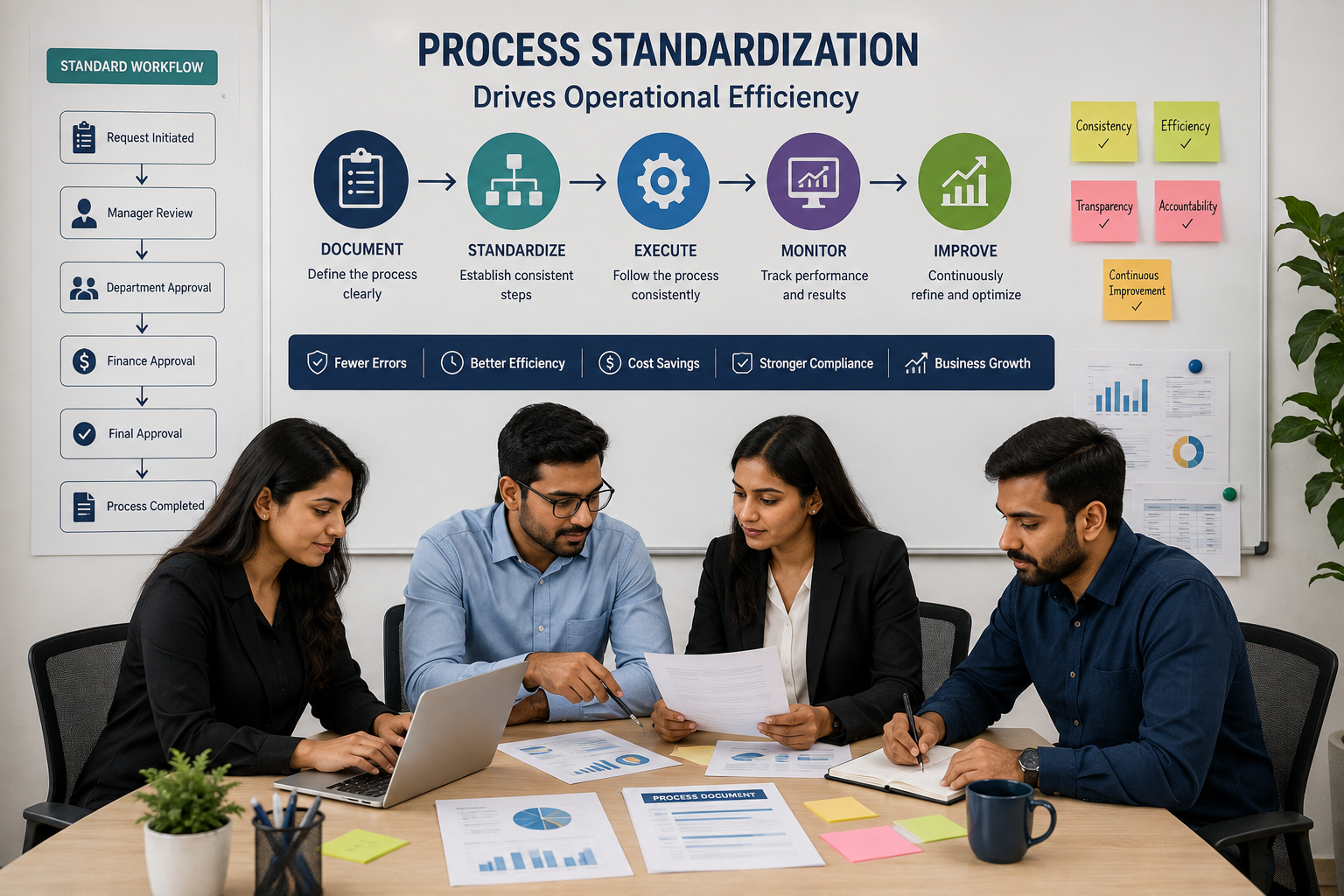
Request → Manager Review → Department Approval → Finance Review → Final Approval → Completion
Employees do not need to manually determine the next step.The system manages the movement of the request according to the organization's defined process.This creates consistency while reducing administrative work.
Standardization Does Not Mean Rigidity
One common misunderstanding is that standardization prevents flexibility.That is not the goal.
Businesses operate in changing environments, and employees sometimes need to respond to unusual situations.
A good standardized process should provide a clear default workflow while allowing appropriate exceptions.
For example, a normal purchase may follow the standard approval process, while an urgent business requirement may have a separate escalation path.
Standardization creates structure without preventing reasonable flexibility.
Making Processes Easier to Measure
A major advantage of standardized workflows is that businesses can measure performance.
When everyone follows the same process, organizations can compare results more accurately.
They can measure:
- Average processing time
- Approval turnaround time
- Number of errors
- Number of incomplete requests
- Process bottlenecks
- Employee workload
- Number of requests completed
These measurements provide valuable insight into operational efficiency.
Businesses can identify which processes are performing well and which ones require improvement.
Improving Customer Service
Operational efficiency eventually affects customers.When internal processes are slow, customers may experience delayed responses, incorrect information, missed deadlines, or inconsistent service.Standardized processes help employees deliver more predictable results.
Customer requests can follow defined workflows.Complaints can be assigned to the appropriate department.
Important information can be shared between teams.Tasks can be tracked from beginning to completion.This creates a more consistent customer experience.
Preserving Organizational Knowledge
Employees leave organizations.When an experienced employee leaves, businesses sometimes lose valuable knowledge about how important processes work.
If processes are informal, the organization may struggle to transfer that knowledge to new employees.Standardized workflows help preserve this operational knowledge.The process becomes part of the organization rather than remaining inside one person's memory.This makes the business more resilient.
How to Start Standardizing Business Processes
Businesses do not need to standardize every process at once.A practical approach is to begin with repetitive activities that create frequent delays or errors.
Start by identifying processes that:
- Occur frequently.
- Involve multiple departments.
- Require several approvals.
- Frequently create errors or delays.
- Depend heavily on manual follow-ups.
- Require employees to enter the same information repeatedly.
Once these processes are identified, document how they currently work.Then remove unnecessary steps and create a clearer workflow.
Continuously Improving Standardized Processes
Standardization should not be a one-time activity.Businesses change.Customer expectations change.Technology changes.
Employees discover better ways of working.A process that works well today may become inefficient in the future.Organizations should regularly review their workflows and ask whether each step still provides value.
If a step is unnecessary, remove it.If an approval is creating unnecessary delays, reconsider it.If technology can automate a repetitive task, explore automation.This creates a culture of continuous improvement.
Key Benefits of Process Standardization
A well-designed process standardization strategy can provide significant benefits across an organization:
- Improved operational efficiency by reducing unnecessary steps and repetitive work.
- Greater consistency because employees follow clearly defined procedures.
- Fewer errors through structured workflows and required information.
- Faster approvals through clearly assigned responsibilities.
- Better accountability because every process has defined ownership.
- Easier employee onboarding because processes are documented and understandable.
- Better scalability because new employees and departments can follow established workflows.
- Stronger process management through measurable and trackable workflows.
- Better collaboration because departments understand how their responsibilities connect.
- A foundation for automation because standardized processes are easier to digitize.
Building a More Efficient Digital Workplace
Modern businesses are moving toward connected digital workplaces where information, employees, workflows, and applications work together.
In such an environment, process standardization becomes especially valuable.HR processes can connect with employee records.Finance workflows can connect with approvals.
Project workflows can connect with documents and task management.Procurement processes can connect with budgets and vendor information.
When these workflows are standardized and digitally connected, businesses gain greater visibility into how work moves through the organization.
Employees no longer need to rely entirely on email, spreadsheets, or informal communication.Instead, processes become structured, visible, and easier to manage.
Final Thoughts
Business growth should create new opportunities, not unnecessary operational complexity. As organizations expand, the number of employees, departments, customers, projects, documents, approvals, and daily transactions increases. Without consistent processes, this growth can lead to confusion, delays, duplicated work, and avoidable errors.
Business process standardization provides a practical solution by creating clear and repeatable ways of working. Employees know what needs to happen, managers understand their responsibilities, and departments can coordinate more effectively. Instead of relying on individual habits or informal communication, the organization operates through defined business workflows.
The benefits extend far beyond simply making processes look organized. Standardization improves operational efficiency, reduces human errors, strengthens accountability, speeds up approvals, simplifies employee onboarding, and creates a strong foundation for automation. It also helps businesses preserve knowledge and maintain consistency as they grow.
The most effective organizations understand that efficiency does not come from asking employees to work harder. It comes from giving them better processes, better information, and better tools.
When routine activities are standardized, employees spend less time figuring out how work should be done and more time actually doing valuable work. Managers gain greater visibility, departments collaborate more smoothly, and leadership can identify opportunities for improvement.
Ultimately, process standardization is about creating a business that can operate consistently even as it becomes larger and more complex.