How Centralized Business Data Improves Executive Decision-Making
Every successful business decision begins with accurate information. Whether a company is planning its next expansion, hiring new employees, launching a product, approving budgets, or evaluating overall performance, leaders depend on reliable data to make informed choices. In today's fast-moving business environment, decisions need to be made quickly, but speed without accurate information often leads to costly mistakes.
Many organizations still struggle with scattered information. Human Resources maintain employee records in one system, Finance stores financial reports in another, Projects are tracked separately, customer information exists in different databases, and important business documents are spread across emails, spreadsheets, and cloud folders. Each department has access to only part of the picture, making it difficult for executives to understand the complete state of the business.
When information is fragmented, leaders spend more time collecting reports than making strategic decisions. Meetings are delayed because departments provide different numbers. Managers question which report is the most recent. Employees manually combine spreadsheets from different teams, increasing the chances of errors. As businesses continue to grow, these disconnected systems become one of the biggest barriers to effective leadership.
This is why centralized business data has become one of the most important priorities for modern organizations.
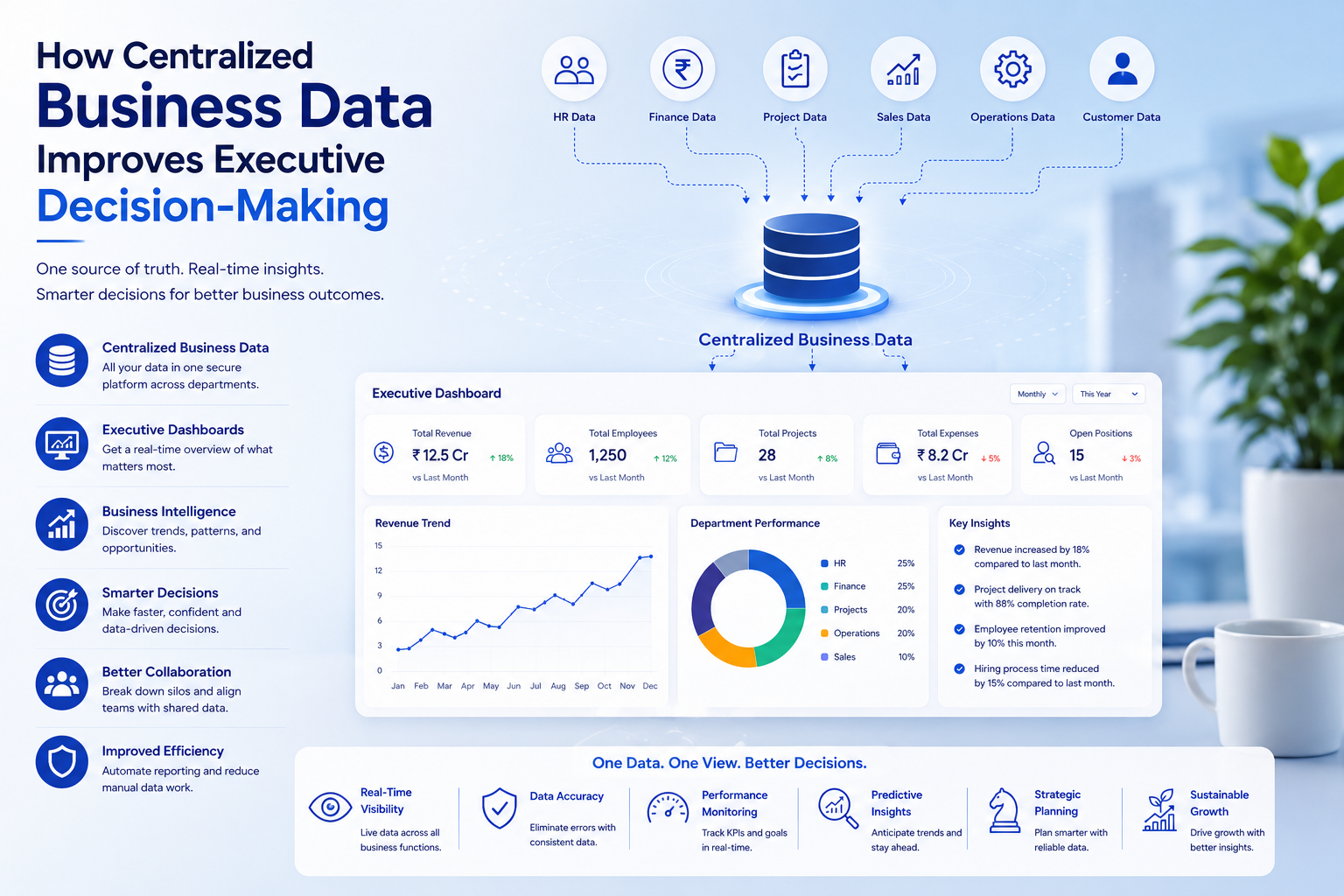
Centralized business data means bringing information from different departments into one connected system where it is accurate, secure, and accessible to authorized users. Instead of searching through multiple applications or requesting reports from different teams, executives can access a complete view of business operations in one place. Combined with business intelligence and executive dashboards, centralized data enables leaders to identify trends, monitor performance, solve problems faster, and make decisions with greater confidence.
Today's most successful organizations are no longer making decisions based on assumptions or outdated reports. They are building connected workplaces where information flows automatically between departments, providing executives with real-time insights that support smarter business decisions.
The Growing Importance of Data in Modern Business
Every department generates valuable information throughout the day. HR records employee attendance, Finance tracks expenses and revenue, Recruitment manages candidate pipelines, Projects monitor progress, Operations oversee workflows, and Customer Service collects client feedback. Individually, this information is useful. When connected, it becomes one of the organization's most valuable assets.
Modern businesses operate in highly competitive environments where even small delays in decision-making can affect profitability, customer satisfaction, and operational efficiency. Leaders cannot afford to rely on incomplete information or outdated reports. They need access to accurate, real-time business data that reflects what is happening across the organization.
Data has become the foundation of business strategy. It helps organizations understand where they are performing well, where improvements are needed, and what actions should be taken next. However, data only becomes valuable when it is organized, accessible, and connected.
The Challenge of Scattered Business Information
Many businesses adopt software gradually as they grow. HR may implement one application, Finance another, while individual departments continue managing information in spreadsheets or standalone tools. Over time, the organization ends up with multiple disconnected systems that rarely communicate with each other.
Executives often receive different reports from different departments, making it difficult to determine which information is correct. Managers spend hours requesting updates instead of focusing on strategic planning. Employees manually transfer information between systems, increasing the likelihood of duplicate entries and errors.
Imagine preparing for a leadership meeting where HR reports 245 active employees while Finance reports payroll for 238 employees. Projects indicate that resource shortages are delaying delivery, but Recruitment has no visibility into future staffing requirements. Each department is working efficiently within its own system, yet the organization lacks a unified understanding of business operations.
Without centralized business data, executives are forced to make decisions based on fragmented information rather than a complete picture of the business.
What Is Centralized Business Data?
Centralized business data refers to storing and managing critical business information in one connected environment where different departments contribute to and access the same trusted source of information.
Instead of maintaining isolated records, organizations integrate their systems so that employee information, financial records, project updates, recruitment activities, customer interactions, and operational data work together.
This creates what many organizations call a "single source of truth."Rather than asking multiple departments for separate reports, executives can access consolidated information through one platform.
Every department continues performing its own responsibilities, but information flows automatically across the organization.This improves consistency while reducing administrative work.
Why Executives Need a Single Source of Truth
Business leaders make decisions every day that influence the direction of the organization.
These decisions include:
- Approving budgets and investments.
- Planning workforce growth.
- Launching new products or services.
When decisions rely on incomplete or conflicting information, organizations face unnecessary risks.A centralized data system ensures everyone works from the same information.
Executives no longer need to question which spreadsheet is current or whether reports from different departments match.Instead, they gain confidence because information is updated automatically and shared consistently across the organization.
A single source of truth eliminates uncertainty and allows leadership teams to focus on strategic planning rather than data verification.
Executive Dashboards Turn Data into Action
Collecting data is only the first step.Executives also need a simple way to understand what the information means.
This is where executive dashboards become valuable.Executive dashboards present key business metrics in an easy-to-understand format, allowing leaders to monitor organizational performance at a glance.
Instead of reviewing dozens of reports, executives can immediately see workforce trends, financial performance, project progress, recruitment activity, operational efficiency, and business goals.
Dashboards transform raw information into meaningful insights.
This improves decision-making because leaders spend less time searching for information and more time evaluating opportunities.
Business Intelligence Helps Leaders See Beyond Numbers
Business intelligence is much more than reporting.It involves analyzing business data to identify patterns, trends, and opportunities that may not be immediately visible.
For example, business intelligence can reveal that employee turnover is increasing in one department, project delays are affecting profitability, or recruitment campaigns are taking longer than expected.
These insights allow executives to address issues before they become major problems.Rather than reacting after challenges occur, organizations become proactive.
Business intelligence helps leaders ask better questions, identify root causes, and make informed decisions based on facts rather than assumptions.
Faster Decisions Create Competitive Advantages
Business opportunities often depend on timing.Whether negotiating with clients, responding to market changes, approving investments, or expanding operations, delays can reduce competitive advantages.
When executives must wait several days for reports from multiple departments, valuable opportunities may be lost.Centralized business data eliminates these delays.
Information is available whenever leaders need it.Real-time visibility allows organizations to respond quickly to changing business conditions.
The faster executives receive reliable information, the faster they can make strategic decisions.
Breaking Down Departmental Barriers
Departments should work together rather than independently.Unfortunately, many organizations still operate with isolated information.
HR, Finance, Projects, Procurement, and Operations often maintain separate databases that do not communicate.This creates information silos.
Centralized data helps break these barriers.When systems are connected, departments gain visibility into how their activities affect the rest of the organization.
Cross-functional collaboration improves naturally because everyone shares consistent information.Teams become better aligned, and communication becomes more effective.
Better Data Management Reduces Errors
Poor data management creates numerous operational problems.Duplicate records, outdated files, inconsistent reporting, and missing information reduce confidence in business decisions.
Centralized data management improves quality by ensuring information is entered once and shared automatically where needed.Organizations reduce manual data entry while improving accuracy.
Employees spend less time correcting mistakes and more time focusing on productive work.Reliable data creates reliable decisions.
Real-Time Visibility Supports Better Leadership
Modern executives need real-time information rather than monthly reports.Business conditions change every day.
Employee attendance, project milestones, customer requests, financial transactions, and operational activities all evolve continuously.
Real-time visibility enables leaders to monitor performance as events happen.Instead of discovering problems weeks later, executives can respond immediately.
This improves operational efficiency while reducing business risks.Organizations become more agile because leadership always has access to current information.
Business Benefits of Centralized Data
Organizations adopting centralized business data often experience improvements across multiple areas.
Some of the most significant advantages include:
- Faster executive decision-making with accurate, real-time information.
- Better collaboration between HR, Finance, Projects, Operations, and Recruitment.
- Improved reporting accuracy and reduced duplicate data.
- Higher productivity through connected business processes.
These improvements create a stronger foundation for long-term business growth.
Preparing for the Future
As organizations continue adopting digital transformation initiatives, centralized business data will become even more important.
Artificial Intelligence, predictive analytics, workflow automation, and advanced business intelligence all depend on reliable information.Without centralized data, these technologies cannot deliver their full value.
Businesses investing in connected data management today are preparing themselves for future innovation.
The organizations that succeed tomorrow will be those that manage information as a strategic business asset rather than simply storing it in disconnected systems.
Conclusion
https://i-spur.com/hrms-system Data has become one of the most valuable resources in every organization, but its true value depends on how effectively it is managed. Scattered spreadsheets, disconnected applications, and isolated departmental systems make it difficult for executives to gain the complete visibility needed for confident decision-making.
Centralized business data solves this challenge by creating a single source of truth where information flows seamlessly across every department. Combined with executive dashboards and business intelligence, leaders gain real-time insights into workforce performance, financial health, operational efficiency, projects, and organizational growth.
Rather than spending valuable time gathering reports, executives can focus on planning, innovation, and strategic leadership.
Organizations that embrace centralized business data are not simply improving reporting. They are building a smarter, more connected, and more agile business capable of making faster decisions, adapting to change, and achieving sustainable long-term success.
In the modern business world, better decisions begin with better data—and centralized business data provides the foundation for every successful decision an organization makes.