Table of Contents
- How Connected Business Platforms Reduce Operational Complexity
- What Is a Connected Business Platform?
- Why Operational Complexity Increases as Businesses Grow
- The Hidden Cost of Using Too Many Disconnected Systems
- Reducing Application Switching
- Making Information Easier to Access
- Improving Communication Between Departments
- Creating Connected Business Workflows
- Reducing Duplicate Data Entry
- Improving Operational Visibility
- Supporting Better Decision-Making
- Improving Employee Productivity
- Making Approvals Easier to Track
- Supporting Document Management
- Connecting HR and Employee Processes
- Connecting Finance With Other Business Functions
- Supporting a More Efficient Digital Workplace
- Improving Business Scalability
- Reducing Human Errors
- Making Business Processes More Consistent
- The Importance of Integration
- How to Start Reducing Operational Complexity
- Connected Platforms and Long-Term Business Growth
- Conclusion
How Connected Business Platforms Reduce Operational Complexity
As a business grows, its daily operations naturally become more complicated. A small organization may begin with a few basic tools for communication, documents, employee management, accounting, projects, and customer-related activities. In the beginning, using separate applications may not seem like a problem because only a few people are involved and the amount of information being handled is relatively small. But as the company expands, more employees join, more departments become involved, more customers are added, and more business processes need to be managed at the same time. Suddenly, employees are moving between multiple applications throughout the day, copying information from one system to another, searching for documents, requesting updates from other departments, and trying to understand which information is current. What started as a collection of useful tools can gradually become a complicated working environment.
This is where a connected business platform can make a significant difference. Instead of treating every business function as a completely separate activity, a connected platform brings important functions, information, workflows, and users into a more coordinated digital environment. The purpose is not simply to replace every application with one piece of software. The real goal is to reduce unnecessary movement between systems and make it easier for employees to complete their work using connected information and processes. When business functions are connected, information can move more naturally between departments, employees can access the records they need, and managers can gain better visibility into what is happening across the organization.
Operational complexity is not always caused by the amount of work a business has. In many cases, it is caused by how that work is organized. A company may have capable employees and good software, yet still lose time because employees have to perform the same actions repeatedly. They may download a document from one application, attach it to an email, enter information into another system, wait for an approval, and then manually update a spreadsheet. Each individual step may seem manageable, but when these steps happen hundreds or thousands of times, they create significant operational friction. A connected digital environment can reduce this friction by bringing information and workflows closer together.
What Is a Connected Business Platform?
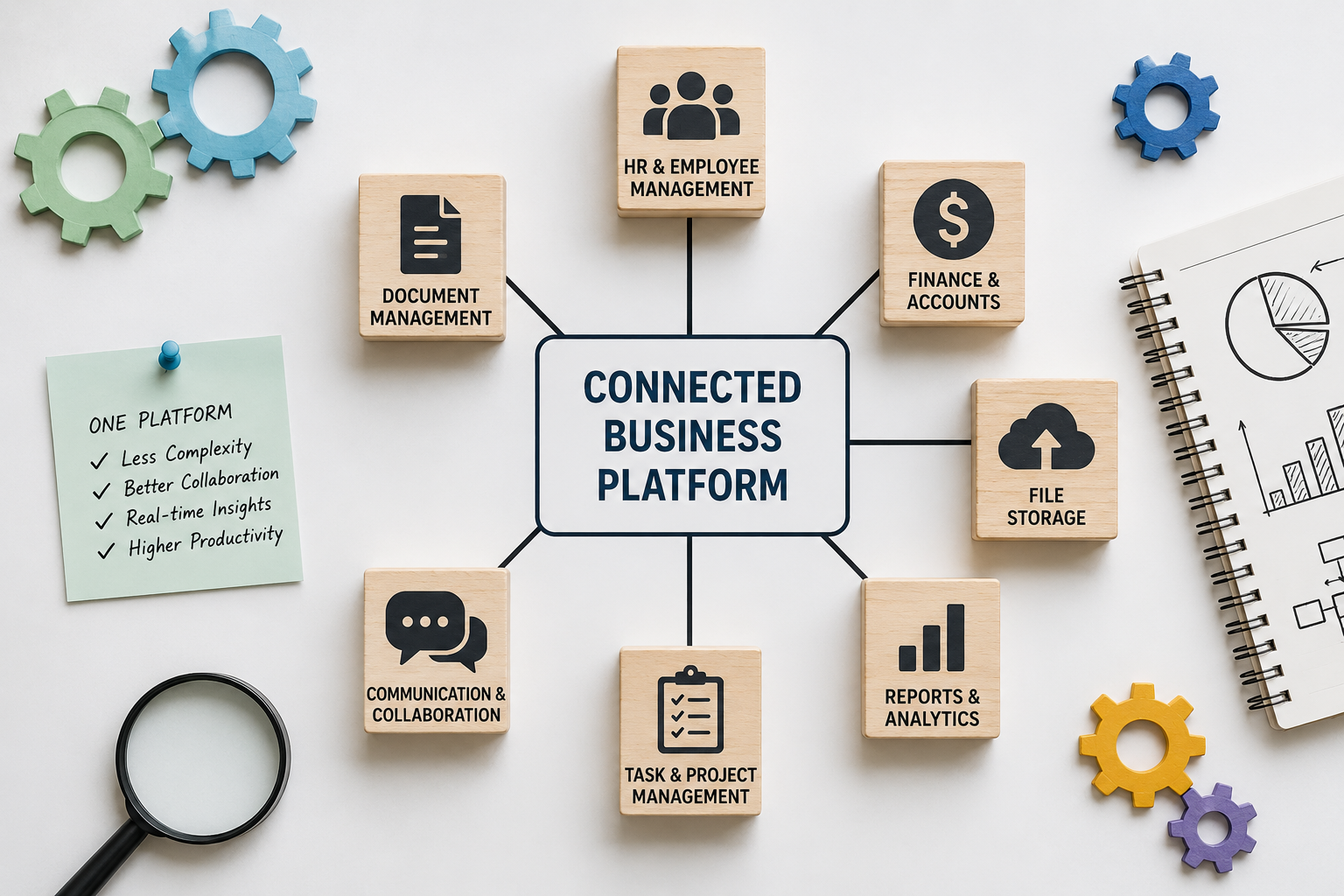
A connected business platform is a digital environment that brings multiple business functions, information sources, and workflows together so that they can work more efficiently as part of the same overall workplace.
Different organizations may connect different functions depending on their needs. HR, payroll, recruitment, documents, projects, communication, accounting, file storage, approvals, and other business activities may all form part of a connected environment.The important idea is that employees should not have to treat every business activity as an isolated process.
For example, an employee may need to submit a leave request, update an employee document, communicate with a manager, access a company file, and check a project task during the same working day. If every activity requires a completely separate process, the employee spends time navigating between systems. A connected platform can make these activities easier to manage by providing a more unified working environment.The objective is simple: connect the work so employees can focus on the work itself.
Why Operational Complexity Increases as Businesses Grow
Business complexity usually increases gradually. A company hires more employees, creates more departments, takes on more customers, manages more projects, and generates more information. Each new requirement may result in another application or another manual process.
At first, adding a new application may appear to solve a problem. The HR team gets an HR system. Finance gets accounting software. Project teams use project management software. Employees communicate through another application. Documents are stored somewhere else. Files may be shared through another platform.Each application may be useful individually.The problem appears when employees need to move information between them.
A project manager may need financial information. Finance may need project details. HR may need employee information for payroll. Management may need reports from several departments. Employees may need documents stored in another system.
As the number of connections increases, the organization can become harder to manage.This is sometimes called application fragmentation—where useful tools exist, but they do not create a smooth overall working environment.
The Hidden Cost of Using Too Many Disconnected Systems
The cost of disconnected software is not limited to subscription fees.The larger cost can come from the time employees spend switching between systems, entering information repeatedly, searching for documents, checking different versions of records, and communicating manually between departments.
Imagine an employee completing a process that requires information from four different applications. The employee opens the first application, copies information, opens the second, pastes the information, downloads a document, sends it through email, waits for approval, and finally updates another record.The business may consider this a normal process because it has been happening for months.
But every step represents operational effort.When multiplied across an entire organization, these small inefficiencies can become significant.A connected business platform aims to reduce these unnecessary movements.
Reducing Application Switching
One of the most noticeable benefits of connected software is reducing the need to constantly switch between applications.Employees often work with several systems at the same time. They may have one application for communication, another for documents, another for projects, another for HR, and another for finance.
Switching between applications may only take a few seconds, but the interruption can be larger than the actual time spent clicking between windows.Employees have to remember where information is stored, determine which application they should use, and sometimes log in or search again.
A connected digital workplace provides a more consistent environment.Employees can access relevant functions and information through a coordinated platform rather than treating every task as a separate digital experience.
Making Information Easier to Access
Information is one of the biggest sources of operational complexity.A business may have employee information in one system, project information in another, documents in shared folders, and approvals in email conversations.When employees need information, they may have to search multiple locations.A connected platform creates a clearer information structure.
Employees can find the information relevant to their responsibilities without repeatedly asking other departments for basic updates.This improves productivity while also reducing the risk of employees using outdated or incomplete information.
Improving Communication Between Departments
Departments depend on one another.HR may need Finance to process payroll-related information.Projects may need Procurement to complete purchases.Finance may need project information before approving expenses.Management may need information from every department to make decisions.
When systems are disconnected, communication becomes the bridge between them.Employees send emails, messages, attachments, and reminders to move information from one department to another.
A connected platform can reduce some of this manual coordination by allowing information and workflows to move through defined processes.This does not eliminate communication. Instead, it makes communication more focused because employees spend less time exchanging information that could already be available through the system.
Creating Connected Business Workflows
A business process often involves several people.Consider a purchase request. An employee submits the request, a manager reviews it, Finance may check the budget, Procurement may process the purchase, and management may provide final approval depending on the amount.If every step is handled through separate emails and spreadsheets, tracking the request can become difficult.
A connected workflow can provide a structured path:
Request → Review → Approval → Processing → Completion
Each stage has a clear responsibility, and information can remain connected to the request.This improves visibility and reduces the need for employees to manually ask where the request currently stands.
Reducing Duplicate Data Entry
One of the biggest problems with disconnected systems is repeated data entry.Employees may enter the same customer information into multiple applications. Employee details may need to be copied between systems. Project information may be manually entered into reports.Every time information is copied, there is a possibility of an error.An employee may type the wrong number, forget to update another system, or accidentally use an old version.
Connected integrated software can reduce this duplication by allowing information to be shared between related processes where appropriate.This saves time and improves consistency.
Improving Operational Visibility
Managers need visibility into business operations.They need to know whether projects are progressing, whether approvals are delayed, whether employees have completed important tasks, and whether departments are meeting expectations.
When information is scattered, managers may need to request separate reports from each department.
This creates delays and may produce inconsistent information.A connected platform can provide a more unified view of business activity.
Instead of collecting information manually, management can work with information that is already maintained within connected business processes.This makes it easier to identify bottlenecks and areas requiring attention.
Supporting Better Decision-Making
Good decisions depend on good information.When business information is spread across disconnected systems, management may have difficulty understanding the complete situation.
For example, a project may appear to be progressing well when looking only at project tasks, but Finance may have information showing that the project is exceeding its budget.
A connected business environment can bring different types of information together.This gives decision-makers a broader understanding of what is happening.
They can consider operational, financial, project, employee, and document-related information when appropriate.This supports more informed decisions.
Improving Employee Productivity
Employees should spend their time creating value rather than managing unnecessary administrative complexity.Disconnected software can create many small tasks that employees perform repeatedly.
They search for files.They copy information.They send reminders.They update spreadsheets.They check approval status.They request information from colleagues.These activities may not appear important individually, but they consume time.A connected platform can simplify these activities by reducing unnecessary manual steps.Employees can spend more time on their actual responsibilities.
Making Approvals Easier to Track
Approvals are present in almost every business.Leave requests, expense claims, purchases, invoices, documents, contracts, project changes, and many other activities may require approval.
When approvals happen through scattered email conversations, employees may not know whether a request has been reviewed.A connected workflow can show the status of the request.
Employees can see whether it is:
Submitted → Under Review → Approved → Completed
This creates transparency and reduces unnecessary follow-ups.
Supporting Document Management
Documents are another major source of operational complexity.Employees create contracts, reports, proposals, policies, employee records, invoices, project documents, and many other files.
If these documents are stored across different locations, employees may struggle to find the correct version.A connected platform can provide centralized document management alongside business workflows.Documents can remain connected to the processes that use them.
For example, a contract can be associated with an approval process, a project document can remain connected to a project, and an employee document can remain associated with the relevant employee record.This creates a more organized digital workplace.
Connecting HR and Employee Processes
HR is responsible for a wide range of information and processes.Employee onboarding, attendance, leave, payroll, employee records, recruitment, and internal communication can all involve different stages of an employee's journey.
When these processes are disconnected, HR teams may need to enter or update information repeatedly.A connected business platform can bring related employee processes into a more coordinated environment.This can reduce administrative effort and provide employees and managers with clearer access to relevant information.
Connecting Finance With Other Business Functions
Finance does not operate independently from the rest of the organization.Expenses come from employees.Purchases come from departments.Project budgets depend on project activities.
Invoices may be connected to customers or vendors.Approvals may involve managers and procurement teams.
A connected platform can make these relationships easier to manage.Instead of treating financial information as completely separate from operational activities, businesses can connect relevant processes so that information moves more efficiently.
Supporting a More Efficient Digital Workplace
A digital workplace should make work easier, not simply make it digital.Adding more software does not automatically create a better workplace.
A digital workplace becomes useful when employees can access the information, communication, documents, and workflows they need without unnecessary complexity.Connected platforms help create this environment.
Employees can work within a more consistent structure while departments maintain their specific responsibilities.This makes the digital workplace easier to navigate and easier to scale.
Improving Business Scalability
A process that works for a small company may not work for a large organization.When there are only a few employees, managers can personally coordinate many activities.As the business grows, this becomes impossible.The organization needs systems that can handle increasing numbers of employees, documents, projects, approvals, and transactions.
Connected software creates a more scalable foundation.Instead of adding a new manual process every time the business grows, organizations can expand existing workflows and systems.This allows growth without creating the same level of operational complexity.
Reducing Human Errors
Manual data movement creates opportunities for mistakes.An employee may copy incorrect information.A document may be attached to the wrong email.An approval may be missed.A spreadsheet may not be updated.
A task may be marked complete in one system but remain open in another.Connected workflows can reduce some of these risks by keeping information and processes together.Automation can also help with repetitive activities such as notifications, routing, status updates, and approvals.This allows employees to focus on activities that require human judgment.
Making Business Processes More Consistent
Disconnected systems often encourage different departments to develop different ways of working.One department may use spreadsheets.Another may rely on email.Another may use a specialized application.This creates inconsistency.A connected platform can help businesses establish standardized workflows.
Employees understand what needs to happen, who is responsible, and what information is required.This creates a more predictable operational environment.
The Importance of Integration
Integration is an important part of connected business software.Businesses may still need specialized applications for certain functions. The goal is not always to eliminate those systems.Instead, organizations can focus on making the systems work together where it provides value.For example, information from one business process may be used by another process without requiring employees to manually re-enter it.
This reduces duplication and creates a more connected flow of information.Good integration should simplify work rather than add another layer of technical complexity.
How to Start Reducing Operational Complexity
Businesses do not need to connect everything at once.A practical approach is to begin with processes that create the most friction.
Look for activities where employees frequently:
- Switch between multiple applications.
- Enter the same information more than once.
- Search for documents.
- Send repeated follow-up messages.
- Wait for manual approvals.
- Create duplicate reports.
- Request information from other departments.
These areas can provide a good starting point for improvement.Once the organization identifies the biggest sources of complexity, it can determine which processes should be standardized, integrated, or automated.
Connected Platforms and Long-Term Business Growth
Operational efficiency becomes increasingly important as businesses grow.A company cannot scale successfully if every new customer, employee, project, or transaction creates additional manual work.Connected platforms help organizations build systems that can support growth.Employees can work from standardized processes.
Departments can share information more effectively.Management can gain greater visibility.Documents can be organized.
Approvals can be tracked.Routine activities can be automated.Together, these improvements create an organization that is easier to manage as it becomes larger.
Conclusion
Business complexity is unavoidable as organizations grow, but unnecessary operational complexity does not have to be. A growing company will naturally have more employees, customers, projects, documents, transactions, approvals, and business processes. The challenge is making sure that this growth does not create an equally large increase in administrative work, application switching, duplicated information, and communication gaps.
A connected business platform provides a practical way to address this challenge. By bringing important business functions, information, and workflows into a more coordinated digital environment, organizations can reduce the amount of effort employees spend moving between disconnected systems. Instead of searching for information, copying data, sending repeated follow-ups, or manually checking the status of every request, employees can work through clearer and more connected processes.
The value of integrated software is therefore not simply that multiple features exist within a digital environment. The real value comes from how those features work together. HR information can support employee processes. Documents can remain connected to approvals. Projects can connect with financial information. Requests can move through defined workflows. Communication can happen alongside the information employees need to complete their work.
This creates a more effective digital workplace where employees spend less time managing technology and more time using technology to accomplish meaningful work.
Connected platforms can also improve accuracy. Every time employees manually copy information between systems, there is an opportunity for an error. When information can move through connected workflows, unnecessary data entry can be reduced. Approvals can be tracked more clearly, documents can remain associated with relevant processes, and employees can work from more consistent information.
Another important advantage is visibility. Managers do not need to rely entirely on separate departmental reports to understand what is happening. When business information is connected, they can gain a broader view of operations and identify delays, bottlenecks, and opportunities for improvement.
Most importantly, connected business platforms create a stronger foundation for growth. A business should not need to create a new manual workaround every time it adds employees, customers, projects, or departments. Its systems should be capable of supporting increasing complexity without making everyday work unnecessarily difficult.The goal is not to have more software.The goal is to have better-connected work.
When employees can access the right information, follow clear workflows, collaborate across departments, and complete tasks without unnecessary system switching, operational complexity begins to decrease. The organization becomes easier to manage, employees become more productive, and management gains better visibility into the business.
Ultimately, connected business platforms help transform a collection of separate business activities into a more coordinated operating environment. By connecting information, people, processes, and technology, businesses can reduce friction today while creating a stronger foundation for tomorrow's growth.