Table of Contents
- How Digital Workflows Help Businesses Stay Audit-Ready Every Day
- Understanding What It Means to Be Audit-Ready
- Why Traditional Record Management Creates Problems
- Why Audits Are Becoming More Important
- How Digital Workflows Change Everyday Operations
- Workflow Automation Creates Reliable Audit Trails
- Better Compliance Through Standardized Processes
- Business Process Management Improves Accountability
- Reducing Human Errors
- Supporting Multiple Departments
- Real-Time Visibility Improves Decision-Making
- Benefits of Digital Workflows for Audit Readiness
- Preparing for the Future
- Conclusion
How Digital Workflows Help Businesses Stay Audit-Ready Every Day
Every business, regardless of its size or industry, is responsible for maintaining accurate records, following regulations, and ensuring that daily operations are transparent and accountable. Whether it is an internal review, a financial audit, a compliance inspection, or a customer verification process, organizations are often required to provide evidence of their activities. This includes employee records, financial transactions, approvals, contracts, invoices, attendance logs, project documents, communication history, and many other business records.
For organizations that still rely on paper files, spreadsheets, emails, and manual approvals, preparing for an audit can become one of the most stressful periods of the year. Employees spend days—or sometimes weeks—searching through folders, collecting documents, verifying records, and trying to reconstruct the history of business transactions. Missing files, inconsistent data, outdated versions of documents, and incomplete approval records can create unnecessary pressure and increase the risk of compliance issues.
Many businesses view audits as occasional events that only require preparation once or twice a year. However, successful organizations take a different approach. Instead of preparing for audits when they happen, they build systems that keep them audit-ready every single day.
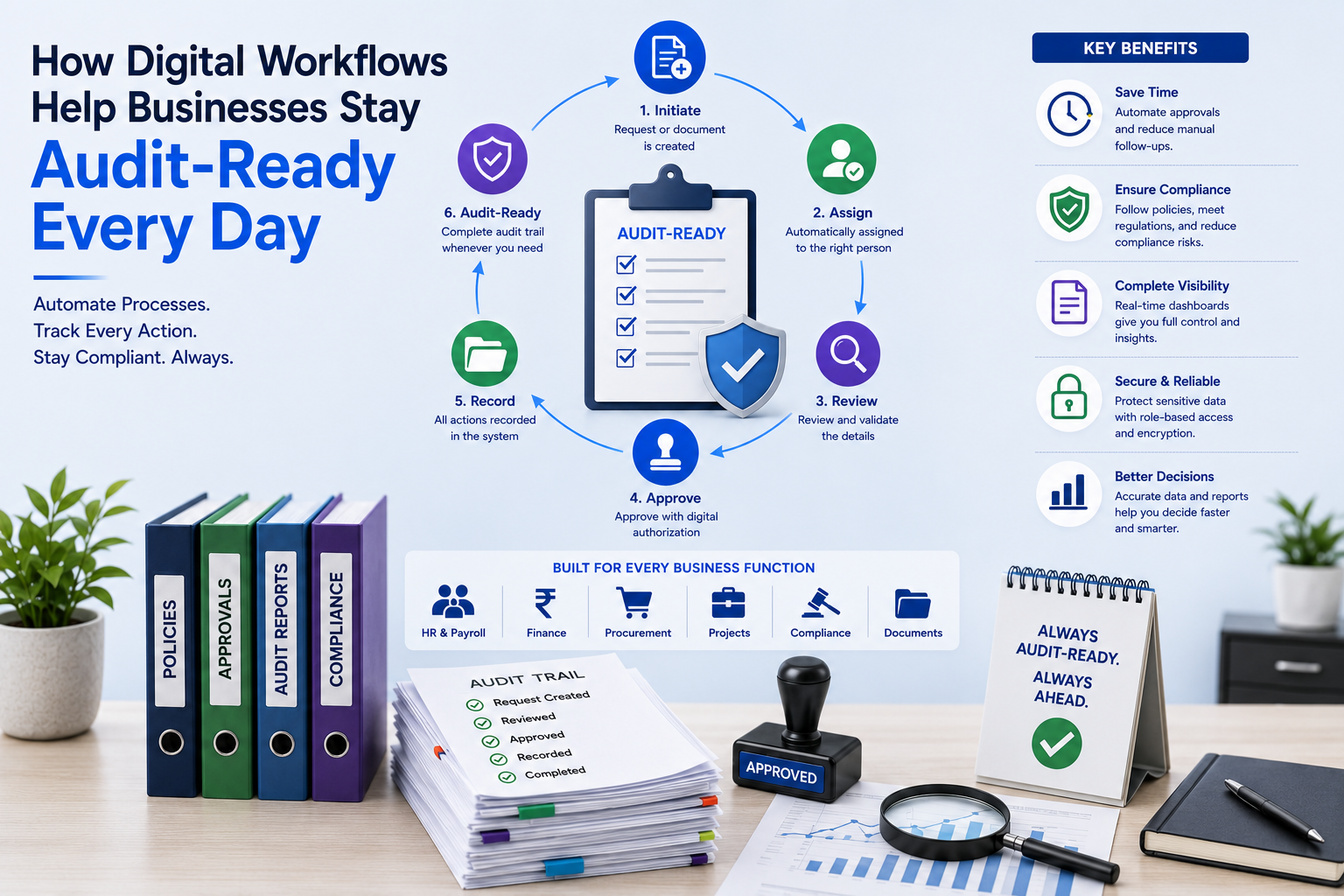
This is where digital workflows play an important role.Digital workflows automate the movement of information, approvals, and documents across the organization. Every action is recorded automatically, approvals follow predefined processes, documents remain securely stored, and every change is tracked from beginning to end. Rather than relying on manual record-keeping, businesses create structured processes that generate reliable audit trails as part of everyday operations.
Combined with workflow automation, compliance software, and business process management, digital workflows help organizations maintain transparency, improve accountability, reduce manual work, and ensure that important information is always available whenever it is needed.
An audit-ready business is not one that works harder before an inspection. It is one that builds efficient processes that maintain compliance every day, allowing employees to focus on growth rather than paperwork.
Understanding What It Means to Be Audit-Ready
Being audit-ready means that an organization can provide accurate, complete, and verifiable business information whenever it is requested.
This includes financial records, employee information, attendance logs, payroll reports, purchase approvals, contracts, compliance documents, customer agreements, project records, and communication history.
An audit-ready business does not need weeks of preparation before an audit.Instead, its information is already organized, accessible, and properly documented.
Every activity has supporting records.Every approval has a clear history.Every document can be located quickly.
This level of preparedness builds confidence not only during audits but also in everyday business operations.
Why Traditional Record Management Creates Problems
Many organizations still depend on manual methods for managing business information.Approvals are handled through emails.
Attendance is recorded separately from payroll.Documents are saved across multiple folders.Reports are created manually.Employees update spreadsheets throughout the month.
Although these methods may appear manageable, they often create significant challenges when information needs to be verified.Files become difficult to locate.
Different departments maintain different versions of the same documentApproval histories become incomplete.Manual updates introduce errors.
As businesses continue growing, these problems become more noticeable.Preparing for audits becomes increasingly difficult because information is scattered across multiple systems.
Why Audits Are Becoming More Important
Regulatory requirements continue evolving across industries.Organizations are expected to demonstrate transparency, protect sensitive information, maintain employee records, and comply with financial and legal regulations.
Customers, investors, business partners, and government authorities increasingly expect businesses to maintain accurate records.
Even organizations that are not subject to frequent external audits benefit from strong internal auditing practices.
Regular reviews help identify inefficiencies, reduce risks, improve accountability, and strengthen operational performance.
Businesses that maintain accurate documentation every day experience fewer disruptions when audits occur.
How Digital Workflows Change Everyday Operations
Digital workflows replace manual processes with structured, automated workflows.
Instead of relying on emails, printed forms, or spreadsheets, requests move automatically between employees according to predefined business rules.
For example, an expense reimbursement request follows a digital approval process.The employee submits the request.The manager reviews it.
Finance verifies the information.The payment is processed.Every action is recorded automatically.
The complete history remains available for future reference.Nothing depends on memory or manual filing.
This structured approach improves both operational efficiency and audit readiness.
Workflow Automation Creates Reliable Audit Trails
One of the biggest advantages of workflow automation is automatic audit trail generation.Every activity within the workflow is recorded.
The system captures:
- Who created the request.
- Who reviewed and approved it.
- When each action occurred.
- What changes were made.
- Whether any information was modified.
This information becomes available instantly whenever organizations need to verify business activities.
Employees no longer need to search through emails to reconstruct approval histories.The system maintains complete records automatically.
Better Compliance Through Standardized Processes
Compliance depends on consistency.If every employee follows different procedures, maintaining accurate records becomes extremely difficult.
Digital workflows standardize business processes.Every employee follows the same approval path.Documents are stored consistently.
Business rules are applied automatically.Organizations reduce variations in daily operations.This consistency improves compliance because required steps cannot easily be skipped.Policies become part of the workflow itself.
Business Process Management Improves Accountability
Business process management focuses on organizing and optimizing how work moves through an organization.
Digital workflows are an important part of this approach.Every business process—from employee onboarding to purchase approvals and document reviews—can be managed using predefined workflows.
Employees know their responsibilities.Managers understand approval requirements.Executives gain visibility into operational performance.
Because every step is documented, accountability improves naturally.Organizations always know who completed each activity and when it occurred.
Reducing Human Errors
Manual record management increases the likelihood of mistakes.Employees may forget approvals.Documents may be misplaced.
Data may be entered incorrectly.Important files may be saved in the wrong location.Digital workflows reduce these risks significantly.
Automation ensures that tasks move through the correct process.Mandatory information cannot be skipped.Notifications remind employees about pending actions.
The system reduces opportunities for human error while improving overall data quality.
Centralized Documentation Makes Audits Easier
One of the most time-consuming parts of an audit is locating documents.
Contracts, invoices, employee records, attendance reports, financial statements, and approval histories often exist across multiple departments.
Digital workflows connect these records through centralized document management.Authorized users can retrieve information quickly.Instead of searching through filing cabinets or email archives, documents become available within seconds.
Audit preparation becomes much simpler because information is already organized.
Supporting Multiple Departments
Digital workflows create value across every business department.Human Resources manages employee records, attendance approvals, leave requests, and payroll documentation.
Finance handles invoices, expenses, payments, and financial approvals.Projects maintain milestone approvals and resource planning.Procurement manages purchase requests and vendor approvals.Document management tracks contracts, policies, and operational procedures.
Although each department performs different activities, every workflow follows consistent documentation standards.This creates organization-wide audit readiness.
Real-Time Visibility Improves Decision-Making
Executives need visibility into business operations.Digital workflows provide dashboards that display workflow status, pending approvals, completed activities, compliance metrics, and operational performance.
Instead of waiting for monthly reports, leadership teams gain access to real-time information.
Potential issues can be identified before they become compliance problems.Organizations become proactive rather than reactive.
Benefits of Digital Workflows for Audit Readiness
Businesses implementing workflow automation often experience measurable improvements across multiple areas.
Some of the most valuable benefits include:
- Complete audit trails with automatic activity tracking.
- Faster approvals and standardized business processes.
- Improved compliance through consistent workflows.
- Better document organization and easier record retrieval.
- Reduced manual work and fewer administrative errors.
These improvements create a stronger operational foundation while simplifying future audits.
Preparing for the Future
Business regulations, security requirements, and customer expectations will continue evolving.
Organizations that continue relying on manual processes will find it increasingly difficult to maintain compliance.Digital transformation is no longer simply about improving productivity.
It is also about building reliable business processes that support transparency, accountability, and long-term growth.
Workflow automation, compliance software, and business process management will continue becoming essential components of every modern organization.
Businesses investing in these technologies today are preparing themselves for a future where information must be accurate, secure, and immediately accessible.
Conclusion
Many organizations treat audits as occasional events that require intensive preparation. In reality, the most successful businesses build processes that make audit readiness part of everyday operations.
Digital workflows help organizations achieve this by automating approvals, standardizing business processes, maintaining complete audit trails, and securely organizing important business information. Instead of searching for documents or reconstructing approval histories, employees can access reliable records whenever they are needed.
Workflow automation not only reduces administrative work but also improves transparency, accountability, and operational efficiency across every department. Combined with compliance software and effective business process management, digital workflows create a workplace where every action is documented, every approval is traceable, and every record supports confident decision-making.
As businesses continue embracing digital transformation, audit readiness will no longer depend on last-minute preparation. It will become the natural outcome of connected systems, structured workflows, and intelligent business processes that operate efficiently every day.
Organizations that invest in digital workflows today are building stronger, more compliant, and more resilient businesses for the future.