
Table of Contents
- How Smart Automation Reduces Human Errors in Business Operations
- Understanding Human Errors in Business Operations
- The Real Cost of Human Errors
- Why Manual Processes Create Risk
- What Makes Smart Automation Different?
- Reducing Data Entry Errors
- Improving Approval Workflows
- Enhancing Accuracy in Human Resource Processes
- Strengthening Financial Operations
- Improving Communication and Coordination
- Supporting Compliance and Accountability
- The Future of Error-Free Operations
- Conclusion
How Smart Automation Reduces Human Errors in Business Operations
In today's business environment, organizations are under constant pressure to improve efficiency, reduce costs, and deliver better results. As businesses grow, so do their operations. More employees, more customers, more documents, more transactions, and more daily activities mean more opportunities for mistakes. While human expertise remains essential in every organization, human errors continue to be one of the most common causes of operational inefficiencies, financial losses, compliance issues, and customer dissatisfaction.
From incorrect data entry and missed approvals to payroll mistakes and communication gaps, even small errors can have significant consequences. In many organizations, employees spend countless hours correcting mistakes that could have been prevented in the first place. This not only affects productivity but also impacts business performance and customer trust.
This is where smart automation is changing the way modern organizations operate.
Automation is no longer limited to manufacturing lines or repetitive factory tasks. Today, automation software is transforming every aspect of business operations. Human Resources, recruitment, finance, project management, communication, document management, and customer service processes can all benefit from intelligent automation. By reducing manual intervention and standardizing workflows, businesses can significantly reduce human errors while improving operational efficiency.
As organizations continue their digital transformation journeys, smart automation is becoming one of the most effective tools for creating more accurate, reliable, and productive workplaces.
Understanding Human Errors in Business Operations
Human errors occur in every workplace. Regardless of experience, training, or expertise, people can make mistakes. Employees may enter incorrect information, forget important tasks, approve the wrong document, miss deadlines, or accidentally share outdated information.
Many of these mistakes are not caused by negligence. They often occur because employees are handling large volumes of information, managing multiple responsibilities, and working under tight deadlines. As workloads increase, the likelihood of errors also rises.
In traditional business environments, many processes rely heavily on manual activities. Employees update spreadsheets, enter information into multiple systems, process documents, verify records, and generate reports manually. Each step introduces the possibility of error.
The challenge becomes even greater when different departments use disconnected systems. Information may need to be entered multiple times across different platforms, increasing the chances of inconsistencies and duplication.
While individual mistakes may seem minor, their cumulative impact can be substantial.
The Real Cost of Human Errors
Many organizations underestimate the true cost of human errors. The financial impact often extends far beyond the initial mistake.
Consider a payroll error that results in incorrect employee payments. The organization must spend time identifying the issue, correcting records, processing adjustments, and communicating with affected employees. Similarly, an incorrect invoice can delay payments, affect cash flow, and damage customer relationships.
Human errors can also impact compliance. In industries with strict regulatory requirements, inaccurate records or missed documentation can lead to audits, penalties, and reputational damage.
Beyond financial costs, errors can reduce employee morale. When teams spend significant time correcting mistakes, productivity suffers. Employees become frustrated, projects slow down, and operational efficiency declines.
Organizations that reduce errors often experience improvements in productivity, customer satisfaction, and overall business performance.
Why Manual Processes Create Risk
Many business processes still rely heavily on manual intervention.
Employees may manually enter attendance records, process leave requests, update customer information, create reports, manage project timelines, or maintain vendor records. Each manual action creates an opportunity for mistakes.
Manual processes also depend on consistency. Different employees may follow different procedures, interpret information differently, or overlook important details.
As organizations grow, maintaining consistency becomes increasingly difficult.
The problem is not necessarily the people performing the work. The problem is often the process itself.
When organizations depend heavily on repetitive manual activities, errors become inevitable.This is why many businesses are turning to automation.
What Makes Smart Automation Different?
Traditional automation focuses on repeating predefined tasks. Smart automation goes a step further.
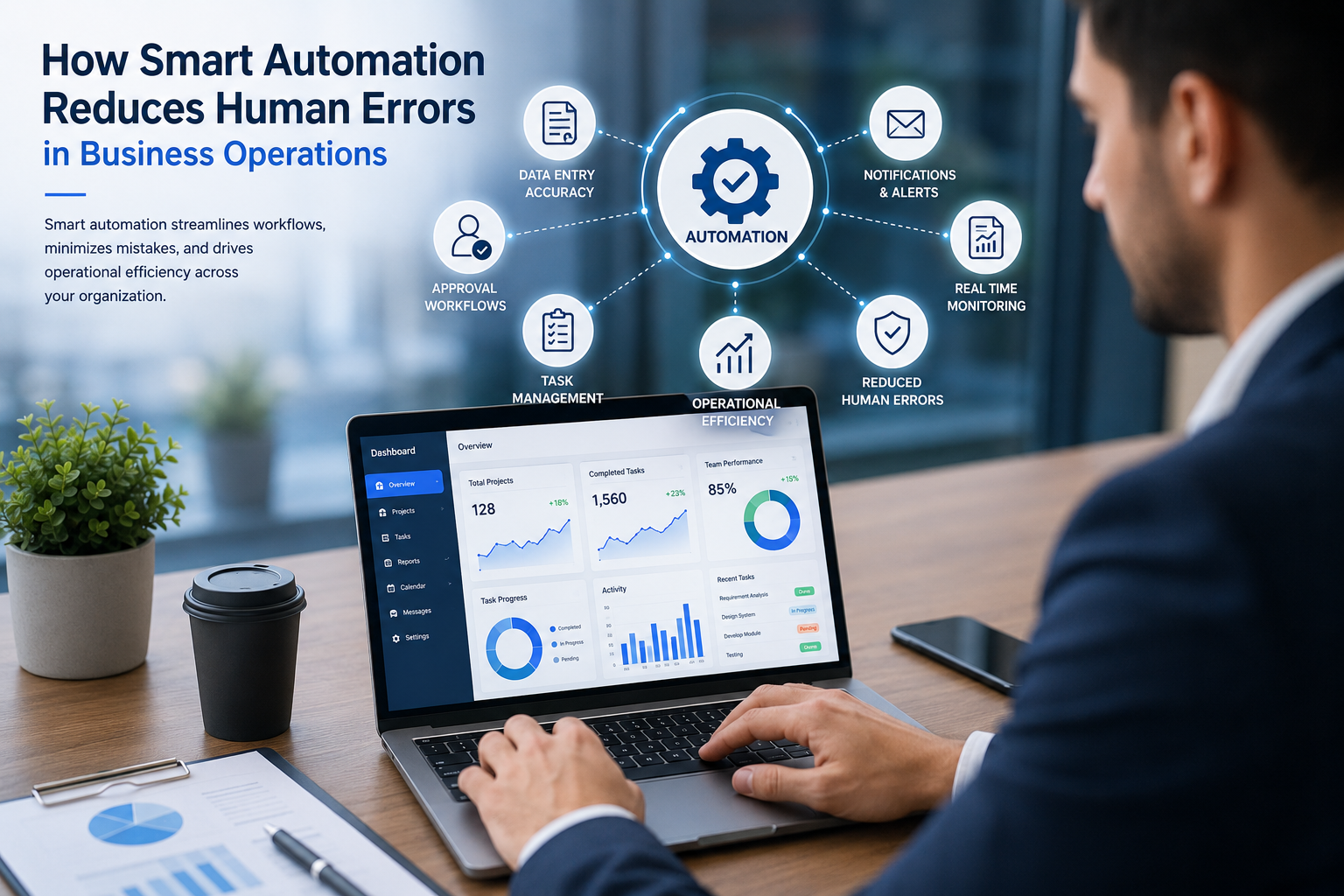
Smart automation combines workflow automation, intelligent decision-making, notifications, integrations, and real-time monitoring to create more efficient business processes.
Instead of simply automating individual tasks, smart automation helps entire workflows operate more effectively.
For example, when a leave request is submitted, the system can automatically route it to the appropriate manager, notify relevant departments, update employee records, and maintain a complete audit trail.
No manual follow-up is required.No information is lost.No approvals are forgotten.
The entire process becomes faster, more accurate, and easier to manage.
Reducing Data Entry Errors
Data entry remains one of the most common sources of business errors.
Organizations collect information from multiple sources including employees, customers, vendors, and partners. Manually entering this information into systems increases the likelihood of mistakes.
A single incorrect number, date, or email address can create significant problems.
Smart automation reduces these risks by eliminating unnecessary data entry and integrating systems so information flows automatically between departments.
When information only needs to be entered once, accuracy improves significantly.
Employees spend less time typing data and more time focusing on higher-value activities.
Improving Approval Workflows
Approval processes are essential for maintaining control and accountability within organizations.
However, manual approval workflows often create delays and inconsistencies.
Documents may sit in inboxes waiting for review. Managers may overlook requests. Employees may be uncertain about approval status.
Smart automation addresses these challenges by creating structured approval workflows.
Requests are automatically routed to the correct individuals. Notifications ensure that actions are completed promptly. Escalation rules prevent requests from being forgotten.
As a result, approvals become faster, more transparent, and less prone to error.
Enhancing Accuracy in Human Resource Processes
Human Resource departments manage large volumes of sensitive information.
Employee records, attendance data, leave requests, payroll information, and performance evaluations all require accuracy.
Manual HR processes often involve repetitive administrative tasks that consume significant time.
Automation helps streamline these activities while reducing the likelihood of mistakes.
Employee information can be updated automatically. Attendance data can be synchronized in real time. Payroll calculations can be processed consistently.
By reducing manual effort, HR teams can focus more on employee engagement and strategic workforce planning.
Strengthening Financial Operations
Financial accuracy is critical for every organization.
Errors in invoicing, expense management, payments, or reporting can create significant financial risks.
Automation improves financial operations by reducing manual calculations, ensuring consistency, and maintaining accurate records.
Invoices can be generated automatically. Approval workflows can be standardized. Financial reports can be updated in real time.
Organizations gain greater visibility into financial performance while reducing the risk of costly mistakes.
Financial teams can focus on analysis and planning rather than repetitive administrative work.
Improving Communication and Coordination
Communication failures are another common source of business errors.
Important updates may be overlooked. Teams may work with outdated information. Tasks may be delayed because employees are unaware of changes.
Smart automation helps improve communication by ensuring that relevant information reaches the right people at the right time.
Notifications, alerts, reminders, and workflow updates keep teams informed without requiring constant manual follow-up.
Better communication leads to better coordination and fewer operational mistakes.
Supporting Compliance and Accountability
Organizations must often demonstrate compliance with internal policies and external regulations.
Manual processes can make compliance difficult because actions are not always documented consistently.
Automation creates clear records of activities, approvals, and changes.This visibility improves accountability and simplifies audits.
Organizations gain confidence that processes are being followed correctly and consistently.
Compliance becomes easier because documentation is generated automatically rather than manually.
The Future of Error-Free Operations
As technology continues to evolve, automation will play an increasingly important role in business operations.
Artificial Intelligence, workflow automation, predictive analytics, and intelligent monitoring systems are making it possible to identify potential issues before they become problems.
Organizations are moving toward environments where routine tasks happen automatically, information flows seamlessly between systems, and employees can focus on innovation rather than administration.
The goal is not to eliminate human involvement.The goal is to eliminate unnecessary errors and allow people to contribute where they add the most value.
Businesses that embrace smart automation today are building more efficient, reliable, and scalable operations for the future.
Conclusion
Human errors will always be a part of business operations, but their impact can be significantly reduced through smart automation.
By automating repetitive tasks, improving workflow consistency, reducing manual data entry, and enhancing communication, organizations can improve operational efficiency while minimizing costly mistakes.
Smart automation is not simply a technology investment. It is an investment in accuracy, productivity, accountability, and long-term business success.
As organizations continue seeking ways to improve performance and remain competitive, automation software will play a critical role in creating more efficient and error-resistant workplaces.
The future of business operations is not just automated.It is intelligent, connected, and designed to help people perform at their best.