Table of Contents
- What Is Real-Time Business Data?
- Why Traditional Reporting Is No Longer Enough
- The Growing Importance of Operational Visibility
- Faster Decision-Making Creates Competitive Advantages
- Real-Time Data Improves Project Management
- Enhancing Workforce Management
- Better Recruitment Decisions Through Real-Time Insights
- Financial Visibility Supports Smarter Business Decisions
- Improving Customer Experiences
- The Role of Business Intelligence
- Reducing Operational Risks
- Supporting Data-Driven Decision Making
- Why Real-Time Analytics Matters
- Practical Steps to Build Real-Time Visibility
- Centralize Information
- Automate Data Collection
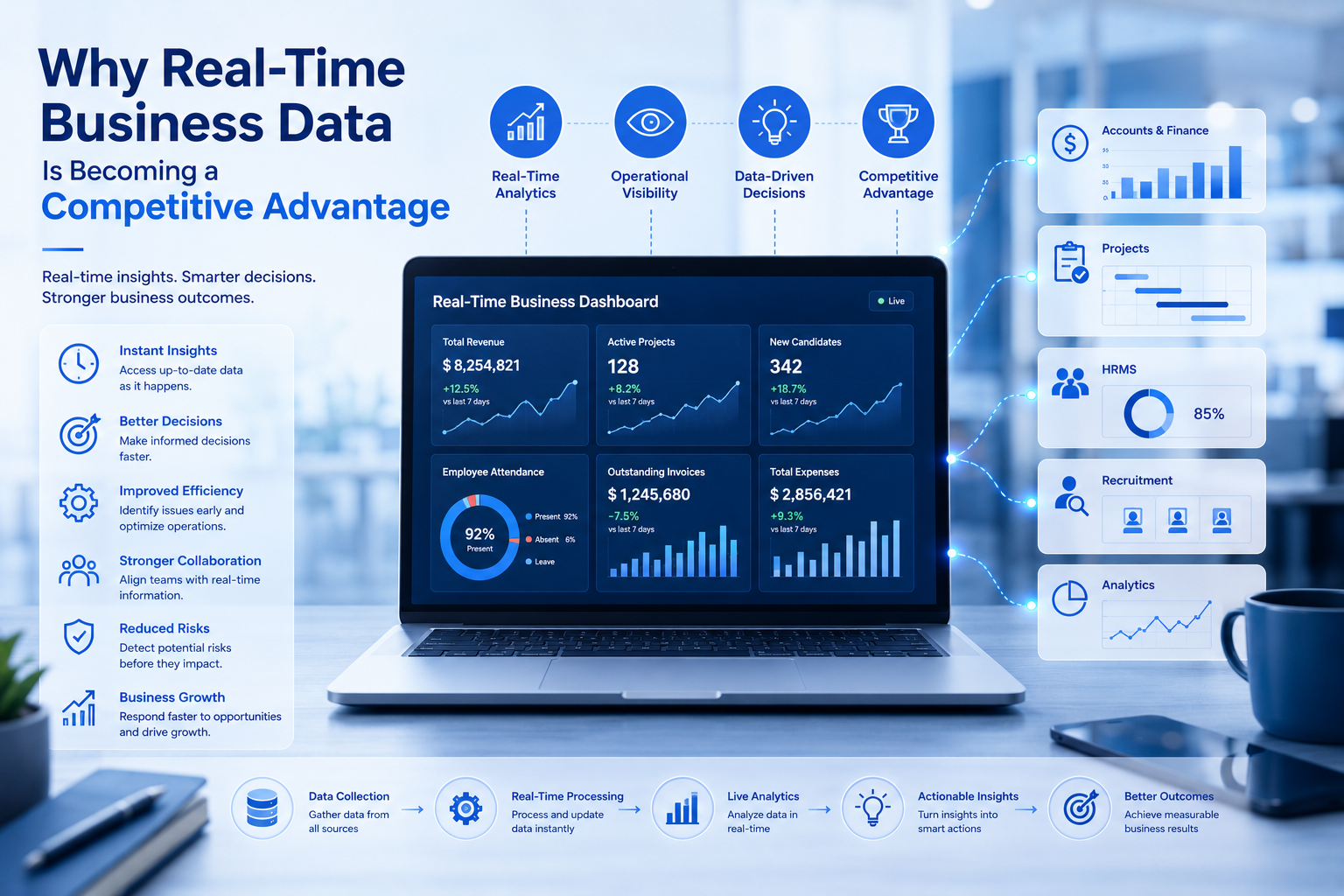
- Implement Real-Time Dashboards
- Encourage Data-Driven Culture
- Continuously Monitor Performance
- Conclusion
In today's fast-moving business environment, information is one of the most valuable assets an organization possesses. Every day, businesses generate enormous amounts of data through employee activities, customer interactions, financial transactions, projects, sales operations, vendor relationships, and internal communications.
However, collecting data is no longer enough,The real advantage comes from accessing and using that information in real time.
For many years, organizations relied on historical reports to make decisions. Managers reviewed weekly reports, monthly summaries, and quarterly performance metrics to understand how the business was performing. While these reports provided useful insights, they often reflected what had already happened rather than what was happening now.
Modern organizations can no longer afford to operate with delayed information.
Markets change rapidly. Customer expectations evolve constantly. Teams work across multiple locations. Projects move quickly. Opportunities and risks can emerge within hours rather than weeks.
This is why real-time business data is becoming one of the most powerful competitive advantages available to organizations today.
Businesses that can access accurate information instantly are often able to make faster decisions, respond to challenges more effectively, improve operational efficiency, and create better customer experiences.
As digital transformation continues across industries, real-time analytics, business intelligence, operational visibility, and data-driven decision-making are becoming essential components of modern business success.
What Is Real-Time Business Data?
Real-time business data refers to information that is collected, processed, and made available immediately or almost immediately after an event occurs.
Instead of waiting for end-of-day reports or monthly summaries, organizations gain access to current information as activities happen.
Examples include:
- Employee attendance updates
- Project progress tracking
- Sales transactions
- Recruitment pipeline activity
- Financial performance metrics
When information is updated instantly, organizations gain a much clearer understanding of current operations.
This visibility enables faster and more informed decision-making.
Real-time data transforms information from a historical record into a strategic business asset.
Why Traditional Reporting Is No Longer Enough
Traditional reporting has long been the foundation of business management.
Managers receive reports, review performance metrics, and make decisions based on historical information,While this approach remains valuable, it often has limitations.
By the time a report reaches decision-makers:
- Problems may have already escalated.
- Opportunities may have been missed.
- Customer expectations may have changed.
Business environments are becoming increasingly dynamic,Organizations need information that reflects current conditions rather than past events.
Real-time data helps bridge this gap by providing immediate visibility into operations.
Leaders gain the ability to respond quickly rather than react after problems occur.
The Growing Importance of Operational Visibility
Operational visibility refers to an organization's ability to see and understand what is happening across its operations at any given moment.
Without visibility, decision-making becomes difficult.
Managers may struggle to answer questions such as:
- Which projects are behind schedule?
- Which departments require additional resources?
- Which processes are causing delays?
- Where are operational bottlenecks occurring?
Real-time business data provides the visibility needed to answer these questions quickly.
Instead of relying on assumptions, leaders can access accurate information immediately.
Greater visibility often leads to better operational control and improved organizational performance.
Faster Decision-Making Creates Competitive Advantages
One of the most significant benefits of real-time business data is faster decision-making.
In many organizations, decisions are delayed because information is difficult to obtain.
Managers may spend hours or even days gathering information from multiple departments before making decisions.
This delay can reduce agility and create missed opportunities,Real-time data changes this dynamic.
Decision-makers gain immediate access to relevant information.
Benefits include:
- Faster responses to challenges
- Quicker resource allocation
- Improved strategic planning
Organizations that make informed decisions quickly often outperform competitors that rely on delayed information,Speed has become a critical factor in business success.
Real-Time Data Improves Project Management
Projects involve numerous moving parts,Teams must coordinate activities, monitor progress, manage deadlines, and allocate resources effectively.
Without visibility, project risks can go unnoticed until they become major problems.
Real-time project data helps organizations monitor:
- Task completion
- Team performance
- Resource utilization
Managers can identify delays early and take corrective action before project timelines are affected.
This proactive approach improves project outcomes and reduces operational disruptions.
Real-time project visibility is becoming increasingly important as organizations manage more complex initiatives.
Enhancing Workforce Management
Employees play a central role in organizational success,Managing workforce activities effectively requires access to current information.
Real-time workforce data can provide insights into:
- Attendance
- Leave requests
- Productivity trends
Managers can identify staffing challenges, monitor workloads, and make informed decisions regarding resource allocation.
Benefits include:
- Improved scheduling
- Better workforce planning
- Enhanced employee experiences
Organizations gain a more accurate understanding of workforce dynamics.
This visibility supports both operational efficiency and employee satisfaction.
Better Recruitment Decisions Through Real-Time Insights
Recruitment is becoming increasingly competitive,Organizations need efficient hiring processes to attract and secure top talent.
Real-time recruitment data provides visibility into every stage of the hiring journey.
Recruiters can monitor:
- Application volumes
- Candidate progress
- Interview scheduling
Immediate access to this information helps hiring teams respond quickly and reduce delays.
Organizations can improve candidate experiences while making faster hiring decisions,In competitive talent markets, speed often determines success.
Financial Visibility Supports Smarter Business Decisions
Financial performance influences nearly every business decision.
Organizations need accurate and current financial information to manage budgets, expenses, revenue, and profitability.
Traditional financial reporting often relies on periodic updates.
Real-time financial data provides a more dynamic view.
Leaders can monitor:
- Cash flow
- Outstanding payments
- Expense trends
This visibility supports more proactive financial management.
Organizations can identify risks earlier and make adjustments before problems grow larger.
Real-time financial intelligence strengthens overall business resilience.
Improving Customer Experiences
Customer expectations continue to increase,Organizations must respond quickly and consistently to customer needs.
Real-time data helps businesses understand customer interactions as they occur.
Benefits include:
- Faster issue resolution
- Personalized experiences
- Improved responsiveness
Organizations can identify customer concerns immediately and take action before dissatisfaction increases.
Real-time visibility often translates directly into stronger customer relationships.
Customer experience is becoming one of the most important competitive differentiators in modern business.
The Role of Business Intelligence
Business intelligence transforms raw data into meaningful insights.
When combined with real-time information, business intelligence becomes even more powerful.
Organizations can:
- Monitor performance continuously
- Identify emerging trends
- Detect operational risks
Instead of waiting for reports, leaders gain access to live dashboards and actionable insights.
Business intelligence helps organizations move beyond data collection and focus on decision-making.
The value lies not in the information itself but in the ability to act on it.
Reducing Operational Risks
Many operational risks develop gradually.
Without visibility, organizations may not recognize warning signs until significant problems emerge.
Real-time monitoring helps identify:
- Workflow bottlenecks
- Resource shortages
- Performance declines
Early detection allows organizations to respond proactively.
Risk management becomes more effective because decisions are based on current information.
Organizations can prevent minor issues from becoming major disruptions.
Supporting Data-Driven Decision Making
Successful organizations increasingly rely on data-driven decisions rather than assumptions.
Data-driven decision-making involves using accurate information to guide actions and strategies.
Real-time data strengthens this approach by providing current insights.
Benefits include:
- Greater accuracy
- Improved confidence
- Better outcomes
When decision-makers have access to relevant information, they are better equipped to evaluate options and choose effective solutions.
Data becomes a strategic asset rather than a passive resource.
Why Real-Time Analytics Matters
Analytics helps organizations understand patterns and performance trends,Real-time analytics takes this capability a step further.
Instead of analyzing historical information alone, organizations can monitor events as they occur.
This capability provides advantages such as:
- Immediate visibility
- Faster responses
- Improved forecasting
Organizations gain a clearer understanding of current conditions while preparing for future opportunities.
Real-time analytics supports both operational efficiency and strategic planning.
Practical Steps to Build Real-Time Visibility
Organizations seeking greater operational visibility should focus on several key areas.
Centralize Information
Ensure critical business information is accessible from a single source.
Automate Data Collection
Reduce manual updates and improve accuracy.
Implement Real-Time Dashboards
Provide visibility across departments and processes.
Encourage Data-Driven Culture
Help employees understand the value of information-based decision-making.
Continuously Monitor Performance
Track key metrics and respond proactively,Small improvements can create significant long-term benefits.
Conclusion
In a world where speed, agility, and informed decision-making determine success, real-time business data has become far more than a reporting tool,It is now a competitive advantage.
Organizations that gain immediate visibility into their operations can respond faster, manage resources more effectively, improve customer experiences, and identify opportunities before competitors do.
As business environments continue to evolve, real-time analytics, operational visibility, business intelligence, and data-driven decision-making will play an increasingly important role in organizational success.
The future belongs to businesses that do not simply collect data but use it intelligently and instantly.
Those organizations will be better prepared to adapt, grow, and thrive in an increasingly connected and data-driven world.