Table of Contents
- The Future of Work: How AI and IoT Are Reshaping Modern Organizations
- Understanding AI and IoT
- Why the Workplace Is Changing
- The Rise of Smart Workplaces
- AI-Powered Decision Making
- Real-Time Visibility Through IoT
- Transforming Workforce Management
- Improving Operational Efficiency
- Predictive Analytics and Business Intelligence
- Enhancing Customer Experiences
- Strengthening Security and Compliance
- Supporting Digital Transformation
- Challenges Organizations Must Consider
- Practical Steps Toward an AI and IoT Future
- Identify Operational Challenges
- Improve Data Quality
- Invest in Connected Infrastructure
- Train Employees
- Start Small and Scale
- Frequently Asked Questions
- What is the difference between AI and IoT?
- How do AI and IoT work together?
- Which industries benefit from AI and IoT?
- Are AI and IoT only for large organizations?
- Why are AI and IoT important for the future of work?
- Conclusion
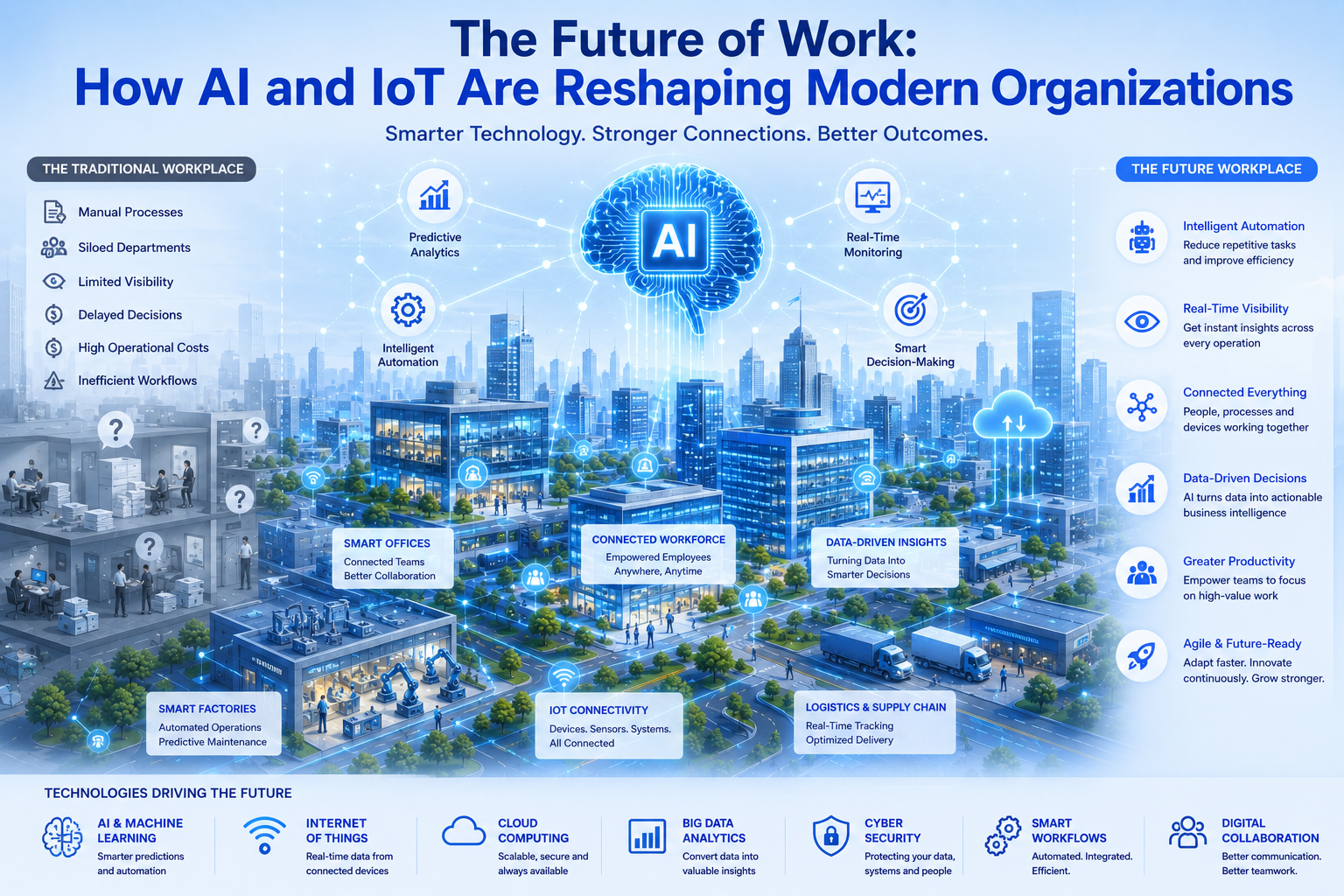
The Future of Work: How AI and IoT Are Reshaping Modern Organizations
The workplace is undergoing one of the biggest transformations in modern history. Advances in technology, changing workforce expectations, increasing competition, and the demand for faster decision-making are forcing organizations to rethink how they operate. Businesses are no longer focused solely on digitizing processes. They are now exploring how intelligent technologies can help them work smarter, respond faster, and achieve greater efficiency.
At the center of this transformation are two powerful technologies: Artificial Intelligence (AI) and the Internet of Things (IoT).
Individually, these technologies are already creating significant changes across industries. Together, they are reshaping how organizations manage employees, monitor operations, analyze information, improve customer experiences, and make strategic decisions.
The future workplace will not simply be digital. It will be intelligent, connected, and highly responsive.
Organizations that embrace AI and IoT are discovering new opportunities to automate routine tasks, improve visibility, increase productivity, and create more agile business environments. As these technologies continue to evolve, they will play an even larger role in determining which organizations succeed in an increasingly competitive world.
The future of work is arriving faster than many businesses expected, and AI and IoT are leading the way.
Understanding AI and IoT
Before exploring their impact on modern organizations, it is important to understand what AI and IoT actually mean.
Artificial Intelligence refers to technology that can analyze information, identify patterns, learn from data, and make recommendations or decisions with minimal human intervention.
Examples include:
- Intelligent automation
- Predictive analytics
- Smart recommendations
- AI-powered assistants
The Internet of Things refers to a network of connected devices that collect and share information in real time.
Examples include:
- Smart sensors
- Connected equipment
- Tracking devices
- Monitoring systems
When AI and IoT work together, organizations gain the ability to collect information automatically and use intelligent systems to analyze that information instantly.
This combination creates powerful opportunities for automation and decision-making.
Why the Workplace Is Changing
For decades, organizations relied on manual processes, paper-based systems, and traditional workflows.
Employees spent significant amounts of time:
- Entering data
- Generating reports
- Monitoring equipment
- Managing repetitive tasks
While these methods worked in the past, they struggle to meet the demands of modern business environments.
Today's organizations need:
- Faster decisions
- Greater visibility
- Improved efficiency
- Better customer experiences
AI and IoT provide solutions to these challenges.
Instead of waiting for problems to occur, organizations can identify issues in real time and respond proactively.
The workplace is becoming more connected, intelligent, and data-driven than ever before.
The Rise of Smart Workplaces
One of the most visible impacts of AI and IoT is the emergence of smart workplaces.
A smart workplace uses connected devices, automation, and intelligent analytics to improve how people and systems interact.
In a smart workplace:
- Sensors monitor environments
- Systems automate routine tasks
- Information flows automatically
Employees gain access to real-time insights that help them work more effectively.
Managers can make decisions based on current data rather than outdated reports.
The result is a workplace that is more responsive, efficient, and productive.
Smart workplaces are rapidly becoming the standard for forward-thinking organizations.
AI-Powered Decision Making
Modern organizations generate enormous amounts of information every day.
Financial data, employee records, project updates, customer interactions, and operational metrics all contribute to decision-making.
The challenge is not collecting information,The challenge is understanding it.
AI helps organizations analyze large volumes of data quickly and accurately.
AI can identify:
- Trends
- Risks
- Opportunities
that may not be immediately visible to humans.
For example, AI can help managers predict staffing needs, forecast demand, identify workflow bottlenecks, and improve resource allocation.
Organizations that leverage AI-driven insights often make better decisions and respond more effectively to changing conditions.
Real-Time Visibility Through IoT
Visibility has become a critical requirement for modern businesses.
Leaders need to understand what is happening across operations at any given moment.
IoT devices provide this visibility by continuously collecting information from connected systems and environments.
Examples include:
- Asset tracking
- Equipment monitoring
- Occupancy management
- Environmental monitoring
Instead of relying on manual inspections or delayed reports, organizations can access real-time information instantly.
This visibility improves operational control and helps organizations respond more quickly to emerging issues.
Real-time monitoring is becoming one of the most valuable benefits of IoT technology.
Transforming Workforce Management
Workforce management is another area being transformed by AI and IoT.
Organizations need efficient ways to manage attendance, scheduling, productivity, and employee experiences.
AI can help automate administrative activities such as:
- Scheduling
- Leave approvals
- Performance analysis
IoT technologies can support workforce tracking through smart access systems, attendance devices, and workplace monitoring tools.
These technologies reduce administrative burdens while improving accuracy and visibility.
Employees benefit from streamlined processes, while organizations gain better workforce insights.
The future of workforce management is increasingly intelligent and automated.
Improving Operational Efficiency
Every organization seeks ways to improve efficiency.
Inefficient processes increase costs, create delays, and reduce productivity.
AI and IoT help organizations identify inefficiencies and optimize operations.
Benefits include:
- Automated workflows
- Predictive maintenance
- Resource optimization
Connected devices provide information about equipment performance, while AI analyzes that information to recommend improvements.
Organizations can reduce downtime, improve resource utilization, and operate more effectively.
Operational efficiency becomes easier to achieve when information and intelligence work together.
Predictive Analytics and Business Intelligence
Traditional reporting focuses on what has already happened,AI introduces a more proactive approach.
Predictive analytics uses historical and real-time information to forecast future outcomes.
Organizations can anticipate:
- Customer demand
- Equipment failures
- Staffing requirements
- Operational risks
This foresight allows businesses to make proactive decisions rather than reactive ones.
Combined with IoT-generated data, predictive analytics becomes even more powerful.
Organizations gain deeper visibility into future opportunities and challenges.
The ability to predict outcomes is becoming a significant competitive advantage.
Enhancing Customer Experiences
Customer expectations continue to evolve.
Organizations must deliver faster, more personalized, and more consistent experiences.
AI helps organizations understand customer preferences, automate support interactions, and deliver relevant recommendations.
IoT contributes by providing additional insights into customer behavior and product usage.
Together, these technologies help organizations create more responsive customer experiences.
Benefits often include:
- Faster service
- Improved satisfaction
- Stronger customer loyalty
Customer experience is becoming one of the most important areas where AI and IoT create value.
Strengthening Security and Compliance
Security remains a top concern for organizations adopting new technologies.
Fortunately, AI and IoT can also improve security.
AI helps identify unusual activity, detect threats, and automate responses to security incidents.
IoT devices provide visibility into facilities, equipment, and operational environments.
Combined, these technologies strengthen organizational security and improve risk management.
Organizations can monitor activities more effectively while maintaining compliance with regulatory requirements.
Security becomes smarter and more proactive.
Supporting Digital Transformation
Digital transformation is no longer just about moving from paper to digital systems.
Today, organizations are focused on becoming intelligent enterprises.
AI and IoT accelerate digital transformation by connecting people, processes, and information.
Benefits include:
- Better collaboration
- Faster decision-making
- Improved operational visibility
Organizations that successfully integrate AI and IoT often gain significant advantages in agility and innovation.
Digital transformation becomes more meaningful when it delivers measurable business outcomes.
Challenges Organizations Must Consider
While the benefits are significant, AI and IoT adoption also presents challenges.
Organizations must address areas such as:
- Data security
- Employee training
- Technology integration
Successful implementation requires careful planning and clear objectives.
Businesses should focus on solving real operational challenges rather than adopting technology simply because it is available.
The most successful organizations align technology initiatives with business goals.
Practical Steps Toward an AI and IoT Future
Organizations looking to embrace AI and IoT can begin with a few practical steps.
Identify Operational Challenges
Focus on processes that could benefit from automation or better visibility.
Improve Data Quality
Accurate information is essential for effective AI analysis.
Invest in Connected Infrastructure
Implement devices and systems that support real-time monitoring.
Train Employees
Help teams understand how technology supports their work.
Start Small and Scale
Begin with targeted projects and expand based on results.
These steps help organizations build confidence while creating measurable value.
Frequently Asked Questions
What is the difference between AI and IoT?
AI analyzes information and makes intelligent recommendations, while IoT collects information through connected devices and sensors.
How do AI and IoT work together?
IoT devices collect real-time data, and AI analyzes that data to generate insights, predictions, and automated actions.
Which industries benefit from AI and IoT?
Manufacturing, healthcare, logistics, retail, finance, education, technology, and many other industries benefit from these technologies.
Are AI and IoT only for large organizations?
No. Modern solutions are increasingly accessible to small and medium-sized organizations as well.
Why are AI and IoT important for the future of work?
They improve efficiency, automate repetitive tasks, provide real-time visibility, and support better decision-making.
Conclusion
The future of work is being shaped by technologies that enable organizations to become more intelligent, connected, and efficient.
Artificial Intelligence and the Internet of Things are no longer emerging trends. They are becoming essential tools for organizations seeking to improve productivity, strengthen decision-making, enhance customer experiences, and drive innovation.
As AI and IoT continue to evolve, businesses that embrace these technologies will be better positioned to adapt, compete, and grow.
The workplace of the future will not simply rely on technology.
It will use technology intelligently to create smarter operations, more informed decisions, and better outcomes for employees, customers, and organizations alike.
The future of work has already begun, and AI and IoT are leading the transformation.