
Table of Contents
- How Standard Operating Procedures (SOPs) Improve Business Consistency
- What Are Standard Operating Procedures?
- Why Growing Businesses Need SOPs
- Creating Consistency Across Every Department
- Reducing Human Errors
- Faster Employee Training and Onboarding
- Supporting Better SOP Management
- Improving Business Processes
- Strengthening Operational Consistency
- Supporting Compliance Requirements
- Encouraging Continuous Improvement
- Better Collaboration Through Shared Processes
- Digital SOP Management Improves Accessibility
- Business Benefits of Standard Operating Procedures
- Preparing for the Future
- Final Thoughts
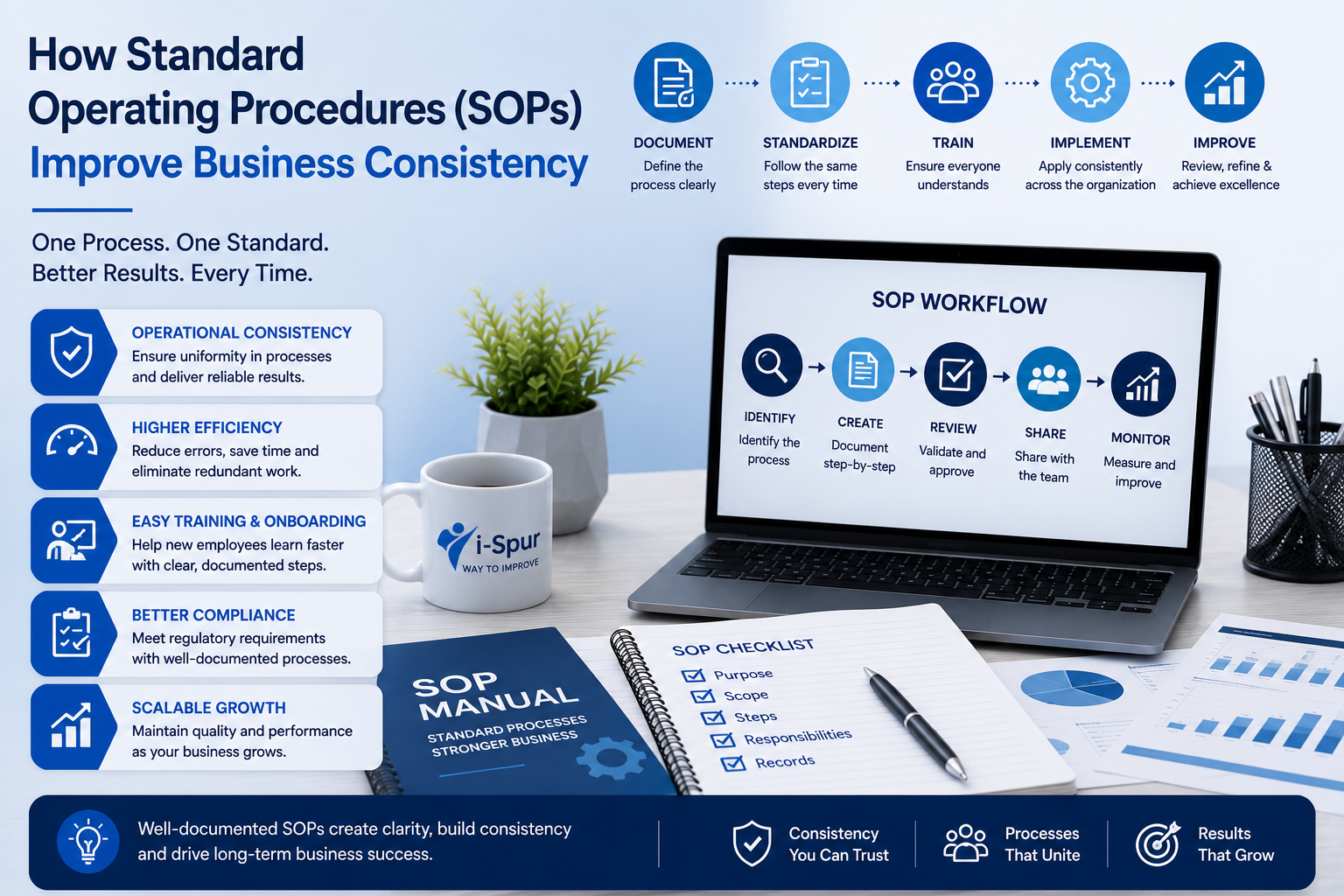
How Standard Operating Procedures (SOPs) Improve Business Consistency
Every successful business depends on consistency. Customers expect the same quality every time they purchase a product or service. Employees need clear instructions to perform their work correctly. Managers rely on predictable processes to monitor performance, while business leaders need confidence that operations will continue smoothly regardless of who is performing a particular task. Achieving this level of consistency is not simply a matter of hiring talented employees—it requires well-defined processes that everyone understands and follows.
Many growing businesses begin with informal ways of working. Team members learn tasks directly from colleagues, managers explain processes verbally, and important steps are often remembered through experience rather than written down. While this approach may work in a small team, it becomes increasingly difficult to manage as the organization expands. New employees receive different training from different managers, departments develop their own working methods, and routine tasks start producing different results. Over time, this inconsistency affects productivity, customer satisfaction, operational efficiency, and overall business performance.
One of the most effective ways to solve this challenge is through Standard Operating Procedures, commonly known as SOPs. An SOP is a documented set of step-by-step instructions that explains how a specific task or business process should be completed. Rather than leaving important activities open to interpretation, SOPs provide a clear and consistent method that employees can follow every time.
Standard Operating Procedures are not only useful for manufacturing or highly regulated industries. Every modern organization, regardless of its size or sector, benefits from documented processes. Human Resources can use SOPs for employee onboarding, Finance for invoice approvals, Operations for daily workflows, Customer Support for handling service requests, and Projects for managing delivery milestones. Every department can improve efficiency by following standardized procedures.
Modern businesses are also combining SOP management with digital document management systems and workflow automation. Instead of storing procedures in paper manuals or scattered files, organizations maintain a centralized digital knowledge base where employees can easily access, update, and follow approved processes. This ensures that everyone works from the latest version of every procedure while reducing confusion and improving collaboration.
Business consistency does not happen by chance. It is built through clear processes, shared knowledge, and continuous improvement. Standard Operating Procedures provide the structure that allows organizations to deliver reliable results every day, regardless of how quickly they grow.
What Are Standard Operating Procedures?
Standard Operating Procedures are documented instructions that explain exactly how specific business tasks should be completed. They establish a consistent approach for routine activities, ensuring that employees perform work using the same approved method.
An SOP may describe how to process employee onboarding, approve purchase requests, prepare payroll, respond to customer enquiries, organize business documents, conduct quality checks, or manage project handovers.
Rather than relying on memory or verbal instructions, employees follow written procedures that clearly outline each step of the process.
This creates consistency throughout the organization while reducing uncertainty and improving confidence.
Why Growing Businesses Need SOPs
As businesses expand, daily operations naturally become more complex.More employees join the organization.
New departments are created.Additional customers, vendors, and projects require attention.Without documented procedures, each team may develop its own way of completing similar tasks.
For example, one department may approve purchase requests differently from another. Customer enquiries may receive different responses depending on who handles them. Employee onboarding may vary from one HR executive to another.
Although these differences may seem minor, they gradually create inconsistencies that affect quality and efficiency.
Standard Operating Procedures provide a common framework that allows everyone to work in the same way, regardless of department or location.
Creating Consistency Across Every Department
Consistency is one of the greatest strengths of any successful organization.Customers appreciate predictable service.Employees understand expectations.Managers evaluate performance more fairly.Leadership gains confidence that business operations follow approved standards.
SOPs help achieve this consistency by documenting the best method for completing recurring tasks.
Whether someone works in Human Resources, Finance, Projects, Procurement, Operations, or Customer Support, they follow the same documented process.This reduces variation while improving reliability across the business.
Reducing Human Errors
Many workplace mistakes occur because employees rely on memory or incomplete instructions.
Small differences in how tasks are performed can lead to incorrect information, delayed approvals, duplicated work, or compliance issues.
Standard Operating Procedures reduce these risks by providing detailed guidance.
Employees know exactly what needs to be done, when it should be done, and how each step connects to the overall process.
As a result, organizations experience fewer operational errors and better overall quality.
Faster Employee Training and Onboarding
Training new employees can become one of the most time-consuming responsibilities for growing organizations.
Without documented procedures, experienced employees must repeatedly explain the same tasks to every new team member.
This creates inconsistencies because each trainer may explain the process differently.
SOPs simplify onboarding by giving new employees structured documentation from the beginning.
Instead of depending entirely on verbal training, employees can study approved procedures, understand workflows, and become productive more quickly.
Experienced staff spend less time repeating instructions, allowing them to focus on higher-value work.
Supporting Better SOP Management
Creating SOPs is only the first step.Organizations must also ensure that procedures remain accurate, accessible, and up to date.This is where SOP management becomes essential.
A structured SOP management process includes reviewing procedures regularly, updating documentation whenever business processes change, maintaining version history, and ensuring employees always access the latest approved instructions.
Digital document management systems make this process much easier by storing SOPs in one centralized location.Employees no longer need to search through emails or outdated files to find the correct procedure.
Improving Business Processes
Every organization wants its business processes to become faster, more efficient, and easier to manage.
However, improving processes is difficult if no one knows exactly how the current process works.Documented SOPs create visibility.
Managers can review workflows, identify unnecessary steps, eliminate bottlenecks, and introduce improvements without disrupting daily operations.
Because procedures are documented, changes can be implemented consistently across the organization.Business process improvement becomes structured rather than reactive.
Strengthening Operational Consistency
Operational consistency means achieving reliable results regardless of who performs the work.
This becomes particularly important when businesses operate across multiple teams, branches, or locations.Without SOPs, one office may follow completely different procedures from another.
Customers receive inconsistent experiences.Reporting becomes unreliable.Quality varies between departments.
Standard Operating Procedures establish one approved method that everyone follows.Operational consistency improves because every employee works according to the same documented standards.
Supporting Compliance Requirements
Many organizations must comply with industry regulations, quality standards, and internal governance policies.
Auditors often review how business processes are performed and whether employees follow approved procedures.
SOPs provide documented evidence that organizations have established consistent operational standards.Employees understand their responsibilities.Managers verify compliance more easily.
Organizations reduce risks associated with undocumented or inconsistent processes.Compliance becomes part of everyday operations rather than a last-minute preparation effort.
Encouraging Continuous Improvement
Business environments constantly evolve.Customer expectations change.Technology advances.Regulations are updated.Organizations introduce new products and services.
As these changes occur, Standard Operating Procedures should evolve as well.Regularly reviewing SOPs allows businesses to identify opportunities for improvement.Employees can recommend better methods based on practical experience.
Managers can simplify workflows.Leadership can align procedures with changing business objectives.Rather than remaining static documents, SOPs become living resources that continuously support organizational growth.
Better Collaboration Through Shared Processes
Business success depends on departments working together effectively.Human Resources collaborates with Finance.Projects coordinate with Operations.Customer Support communicates with Sales.Procurement works alongside multiple departments.
Shared SOPs improve collaboration because everyone understands how processes connect.Responsibilities become clear.Handoffs between departments become smoother.
Communication improves because employees follow the same documented workflows.This reduces confusion while strengthening teamwork.
Digital SOP Management Improves Accessibility
Traditional paper manuals or locally stored documents are difficult to maintain.Employees may unknowingly follow outdated procedures.
Different versions circulate across departments.Finding the correct document takes unnecessary time.Modern organizations increasingly manage SOPs through digital knowledge bases and document management systems.
Employees can quickly search for procedures, access the latest approved version, and follow standardized workflows from any authorized location.Digital accessibility ensures that business knowledge remains available whenever it is needed.
Business Benefits of Standard Operating Procedures
Organizations that implement effective SOP management often experience measurable improvements throughout their operations.
Some of the most important benefits include:
- Faster employee onboarding and consistent training.
- Improved business processes with fewer operational errors.
- Better collaboration through standardized workflows.
- Stronger operational consistency across departments.
- Easier compliance with documented procedures.
- More efficient knowledge sharing through centralized SOP management.
These improvements help organizations become more reliable, productive, and prepared for future growth.
Preparing for the Future
As businesses continue adopting digital transformation, workflow automation, Artificial Intelligence, and integrated enterprise platforms, standardized processes become even more important.
Technology performs best when business processes are clearly defined.Well-documented SOPs provide the foundation for automation because workflows become predictable and repeatable.
Organizations that invest in SOP management today are preparing themselves for future innovation.Rather than depending on individual knowledge, they create scalable systems that support sustainable growth.
Final Thoughts
Every growing business reaches a stage where informal ways of working are no longer enough. As teams expand, customers increase, and operations become more complex, consistency becomes one of the most important factors influencing long-term success.
Standard Operating Procedures provide the structure businesses need to achieve that consistency. By documenting business processes, organizations reduce uncertainty, improve training, strengthen collaboration, minimize errors, and ensure that every employee follows the same proven approach. Combined with effective SOP management and digital document systems, these procedures become valuable organizational assets that support both daily operations and future growth.
Businesses that invest in Standard Operating Procedures are not creating unnecessary paperwork. They are building a foundation for operational consistency, knowledge sharing, better decision-making, and continuous improvement. Employees become more confident, managers gain better visibility, and customers receive a more reliable experience.
In today's competitive business environment, consistency is more than a goal—it is a competitive advantage. Standard Operating Procedures help organizations deliver that consistency every day, creating stronger processes, more efficient teams, and a business that is ready to grow with confidence.