
Table of Contents
- What Is an Audit Trail?
- Why Audit Trails Matter More Than Ever
- Supporting Accountability Across the Organization
- Improving Information Accuracy
- Strengthening Security and Risk Management
- Supporting Regulatory Compliance
- Enhancing Financial Transparency
- Investigating Problems More Efficiently
- Building Trust Within the Organization
- Supporting Digital Transformation Initiatives
- Protecting Organizational Knowledge
- The Role of Audit Trails in Workflow Management
- Reducing Human Errors
- Practical Benefits of Audit Trails
- How Businesses Can Improve Audit Trail Management
- Centralize Information
- Automate Activity Logging
- Define Access Controls
- Conduct Regular Reviews
- Train Employees
- The Future of Audit Trails
- Frequently Asked Questions
- What is an audit trail?
- Why are audit trails important?
- How do audit trails improve security?
- What information does an audit trail typically contain?
- Which industries benefit from audit trails?
- Conclusion
- Explore Smarter Business Operations
In today's fast-paced business environment, organizations generate, process, and store vast amounts of information every day. From employee records and financial transactions to customer data, contracts, approvals, and operational reports, businesses rely heavily on information to function effectively. As organizations become more digital and interconnected, ensuring transparency, accountability, and security has become more important than ever.
One concept that is gaining significant attention across industries is the audit trail.
For many years, audit trails were primarily associated with accounting and financial compliance. However, modern organizations now recognize that audit trails play a much broader role. They help businesses monitor activities, maintain accountability, improve security, support compliance, investigate issues, and strengthen decision-making.
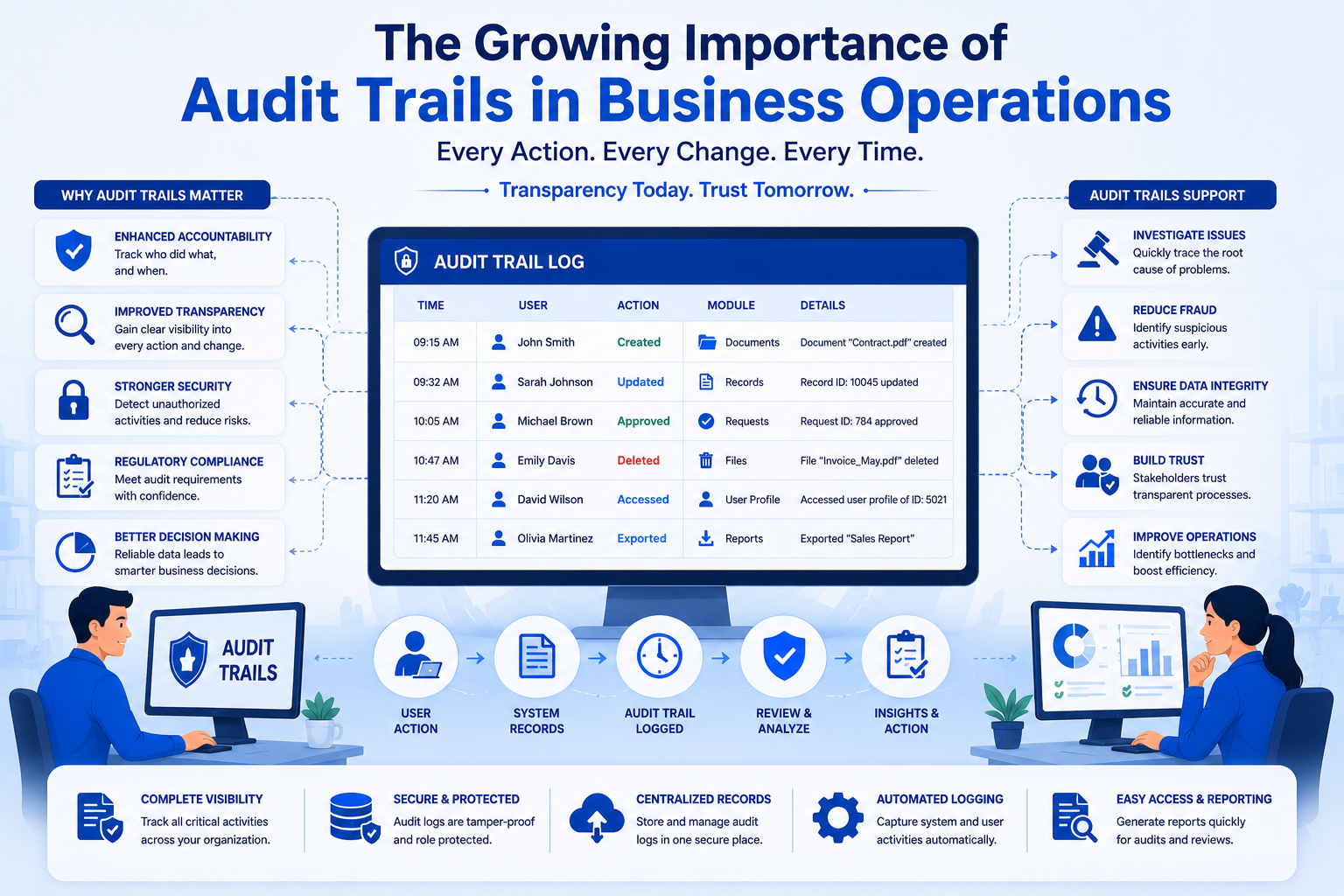
In simple terms, an audit trail is a chronological record of activities, actions, and changes that occur within a system or process. It provides visibility into who performed an action, what was changed, when it happened, and sometimes even why it occurred.
As organizations continue to embrace digital transformation, audit trails are becoming an essential component of effective business operations.
Companies that prioritize audit trail management gain greater visibility into their processes, reduce operational risks, and build stronger foundations for growth and compliance.
What Is an Audit Trail?
An audit trail is a detailed record that documents activities and transactions within an organization.
It acts as a digital footprint that tracks actions performed by users, systems, or processes.
An audit trail typically records:
- Who performed an action
- What action was performed
- When the action occurred
- Which data or document was affected
For example, if an employee updates a customer record, the audit trail can show exactly who made the change and when it happened.
Similarly, if a manager approves an expense request, the audit trail creates a record of that approval.
These records create transparency and provide a reliable history of business activities.
Why Audit Trails Matter More Than Ever
Modern organizations operate in increasingly complex environments.
Employees work across multiple locations, departments use various software systems, and business processes involve numerous stakeholders.
With so many activities occurring daily, maintaining visibility becomes challenging.
Without audit trails, organizations may struggle to answer important questions such as:
- Who changed this information?
- When was this document modified?
- Who approved this transaction?
- Why did this process fail?
Audit trails help organizations answer these questions quickly and accurately.
As businesses continue adopting digital systems, the need for visibility and accountability continues to grow.
Supporting Accountability Across the Organization
Accountability is a critical component of effective business operations.
Employees, managers, and departments must understand their responsibilities and be accountable for their actions.
Audit trails help establish accountability by creating a clear record of activities.
When actions are documented, employees are more likely to follow established procedures and organizational policies.
This transparency helps reduce misunderstandings and promotes responsible behavior.
Accountability benefits everyone within the organization.
Managers gain visibility into workflows, employees receive recognition for completed tasks, and organizations reduce uncertainty regarding operational activities.
Improving Information Accuracy
Accurate information is essential for effective decision-making.
Organizations rely on data to manage operations, serve customers, and plan for the future.
However, information changes frequently.
Documents are updated, records are modified, and transactions are processed daily.
Without visibility into these changes, organizations may struggle to determine which information is accurate.
Audit trails provide a historical record of modifications, making it easier to verify information and identify errors.
Benefits include:
- Improved data accuracy
- Easier error identification
- Greater confidence in reporting
Organizations that maintain accurate records are better positioned to make informed decisions.
Strengthening Security and Risk Management
Cybersecurity and data protection have become major priorities for businesses worldwide.
Organizations face increasing risks from:
- Unauthorized access
- Internal misuse
- Cyberattacks
- Data breaches
Audit trails provide an additional layer of security by monitoring user activity and recording system events.
This visibility helps organizations detect unusual behavior and investigate security incidents.
For example, if sensitive information is accessed unexpectedly, audit logs can reveal who accessed the data and when.
This capability improves incident response and supports stronger security practices.
Organizations that prioritize audit trails often gain greater control over their information assets.
Supporting Regulatory Compliance
Many industries operate under strict compliance and regulatory requirements.
Organizations may be required to maintain records related to:
- Financial transactions
- Employee information
- Customer data
- Operational processes
Regulatory audits often require organizations to demonstrate accountability and transparency.
Audit trails provide evidence that activities were performed according to established policies and procedures.
Without proper audit records, compliance efforts become significantly more difficult.
Organizations that maintain detailed audit trails are often better prepared for regulatory reviews and external audits.
Enhancing Financial Transparency
Financial operations involve numerous transactions, approvals, and reporting activities.
Maintaining transparency is essential for preventing errors and ensuring accountability.
Audit trails help organizations track:
- Expense approvals
- Invoice processing
- Payment activities
- Financial adjustments
These records create visibility throughout financial workflows.
When discrepancies occur, organizations can investigate quickly and determine the source of the issue.
Financial transparency supports better governance and strengthens stakeholder confidence.
Investigating Problems More Efficiently
Every organization encounters occasional issues.
Projects may be delayed. Transactions may fail. Information may be changed incorrectly.
Without audit trails, identifying the root cause of these problems can be difficult.
Employees may spend hours reviewing records, comparing documents, and reconstructing events.
Audit trails simplify investigations by providing detailed historical information.
Organizations can quickly identify:
- What happened
- When it happened
- Who was involved
Faster investigations reduce downtime and support more effective problem resolution.
Building Trust Within the Organization
Trust plays an important role in business success.
Employees, customers, partners, and stakeholders all rely on organizations to manage information responsibly.
Audit trails contribute to trust by promoting transparency and accountability.
When activities are documented and traceable, stakeholders gain confidence in organizational processes.
This transparency helps demonstrate that decisions and actions are supported by accurate information.
Trust is particularly important in environments where multiple departments collaborate and share responsibilities.
Supporting Digital Transformation Initiatives
Organizations continue to invest in digital transformation to improve efficiency and competitiveness.
As manual processes become automated, maintaining visibility becomes increasingly important.
Digital systems process large volumes of information quickly, making it difficult to monitor activities manually.
Audit trails provide the oversight needed to manage digital operations effectively.
They help organizations maintain control while benefiting from automation and technology.
Digital transformation and audit trail management often work together to create more transparent and efficient business processes.
Protecting Organizational Knowledge
Business operations generate valuable knowledge over time.
Approvals, decisions, changes, and communications all contribute to organizational history.
Audit trails preserve this information.
When employees leave or responsibilities change, historical records remain available.
This continuity helps organizations maintain knowledge and avoid losing important context.
Access to historical information supports training, decision-making, and operational consistency.
Knowledge preservation is an often-overlooked benefit of audit trail management.
The Role of Audit Trails in Workflow Management
Modern workflows often involve multiple stages, approvals, and participants.
Organizations need visibility into how work progresses through these processes.
Audit trails help track workflow activities such as:
- Request submissions
- Manager approvals
- Status changes
- Task completions
This visibility helps managers identify delays, bottlenecks, and opportunities for improvement.
Workflow transparency supports greater operational efficiency.
Organizations can optimize processes based on actual activity data rather than assumptions.
Reducing Human Errors
Human errors are inevitable in any workplace.
Employees may accidentally enter incorrect information, modify the wrong record, or approve the wrong request.
Audit trails help organizations identify and correct these mistakes.
Because changes are recorded, previous information can often be reviewed and verified.
This capability reduces the impact of errors and improves operational accuracy.
Organizations that maintain detailed records are better equipped to manage mistakes effectively.
Practical Benefits of Audit Trails
Businesses that implement strong audit trail practices often experience several important advantages.
Some of the most significant benefits include:
- Improved accountability
- Better security monitoring
- Faster investigations
Additional benefits include:
- Enhanced compliance readiness
- Stronger operational transparency
- Improved decision-making
These advantages contribute directly to organizational resilience and long-term success.
How Businesses Can Improve Audit Trail Management
Organizations seeking stronger audit trail capabilities should focus on several key practices.
Centralize Information
Store records in systems that provide consistent visibility and tracking.
Automate Activity Logging
Reduce manual effort by automatically recording user activities and system events.
Define Access Controls
Ensure that audit records are protected and accessible only to authorized personnel.
Conduct Regular Reviews
Periodically analyze audit logs to identify risks, trends, and improvement opportunities.
Train Employees
Help staff understand the importance of accountability and proper system usage.
Small improvements in these areas can significantly strengthen operational oversight.
The Future of Audit Trails
As organizations become more digital, audit trails will continue to grow in importance.
Emerging technologies such as:
- Artificial intelligence
- Workflow automation
- Cloud platforms
will generate even larger volumes of activity data.
Organizations will increasingly rely on audit trails to maintain transparency, security, and compliance.
The future workplace will demand greater visibility into how information is accessed, modified, and shared.
Businesses that invest in audit trail management today will be better prepared for tomorrow's challenges.
Frequently Asked Questions
What is an audit trail?
An audit trail is a chronological record of activities, changes, and transactions within a system or process.
Why are audit trails important?
They improve accountability, security, transparency, and compliance while helping organizations investigate issues and track activities.
How do audit trails improve security?
They record user activities and system events, helping organizations detect unusual behavior and investigate incidents.
What information does an audit trail typically contain?
Audit trails usually include details about who performed an action, what was changed, and when the activity occurred.
Which industries benefit from audit trails?
Almost every industry benefits, including finance, healthcare, manufacturing, education, government, technology, and professional services.
Conclusion
As organizations continue navigating increasingly complex business environments, transparency and accountability have become essential for success.
Audit trails provide the visibility needed to understand activities, monitor processes, investigate issues, and maintain trust.
From improving security and compliance to supporting decision-making and operational efficiency, audit trails offer benefits that extend far beyond traditional record-keeping.
Businesses that embrace audit trail management are not simply tracking activities. They are building stronger, more transparent, and more resilient organizations prepared for future growth and success.
Explore Smarter Business Operations
https://i-spur.com/projects Looking for better ways to improve accountability, strengthen compliance, and gain visibility into workplace activities?
Discover modern business solutions designed to provide transparency, audit readiness, workflow visibility, and operational control across your organization.