
Table of Contents
- Why Business Knowledge Should Never Live Only in Employees' Minds
- Why Knowledge Is One of a Business's Greatest Assets
- The Hidden Risk of Employee-Dependent Knowledge
- Why Business Documentation Matters
- Knowledge Management Creates Long-Term Stability
- The Role of a Digital Knowledge Base
- Faster Employee Onboarding
- Better Collaboration Across Departments
- Reducing Errors Through Standardized Knowledge
- Supporting Business Growth
- Protecting Organizational Knowledge
- Creating a Culture of Knowledge Sharing
- Business Benefits of Knowledge Management
- Preparing for the Future
- Final Thoughts
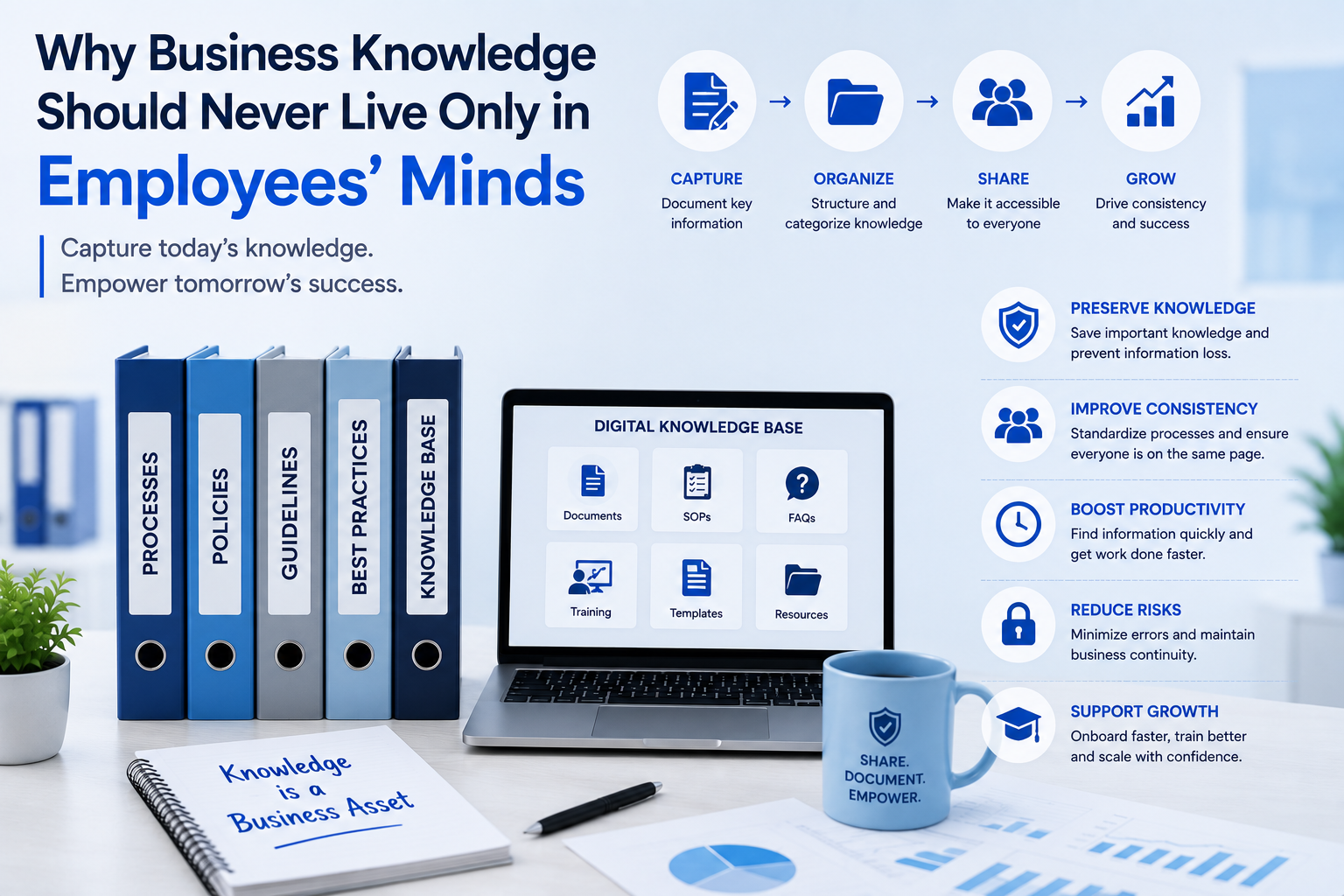
Why Business Knowledge Should Never Live Only in Employees' Minds
Every successful business is built on knowledge. From the way employees complete daily tasks to the methods used for serving customers, managing projects, processing payroll, handling vendors, maintaining compliance, and making strategic decisions, every activity depends on information that has been developed through experience. This knowledge is one of the most valuable assets any organization possesses. However, many businesses unknowingly store this valuable asset in the least reliable place possible—the minds of individual employees.
In many organizations, there is always someone who "knows how everything works." It may be an HR executive who understands every payroll process, an accounts manager who remembers every vendor procedure, a project manager who knows every client requirement, or an operations employee who has handled business processes for years. Their experience becomes essential to the organization, and colleagues naturally depend on them whenever questions arise. While experienced employees are valuable, relying entirely on their personal knowledge creates significant risks for the business.
The problem becomes obvious when these employees go on leave, transfer to another department, retire, or leave the organization altogether. Suddenly, important information disappears with them. Employees struggle to locate documents, understand procedures, or continue projects because the knowledge was never documented. Work slows down, mistakes increase, customers experience delays, and managers spend valuable time trying to recover information that should have been available from the beginning.
As organizations grow, this challenge becomes even more serious. New employees require longer training periods because there are no documented processes to follow. Different departments begin working in different ways because procedures exist only through verbal communication. Decision-making becomes inconsistent, collaboration becomes difficult, and productivity suffers because information is scattered among individuals instead of being available to the organization as a whole.
This is why modern businesses are investing in knowledge management, business documentation, and digital knowledge bases. Rather than depending on individual memory, they create systems where organizational knowledge is documented, organized, updated, and shared securely. These systems ensure that critical business information remains available regardless of employee changes, helping organizations maintain consistency, improve collaboration, and support long-term growth.
Knowledge should never belong to one employee alone. It should become an organizational asset that benefits every team, every department, and every future employee.
Why Knowledge Is One of a Business's Greatest Assets
Every business creates knowledge every single day. Employees discover better ways to complete tasks, managers develop efficient workflows, customer service teams learn how to resolve recurring issues, and project teams gain experience from completed assignments. Over time, these insights become valuable intellectual assets that help the organization operate more effectively.
Unlike equipment or office space, knowledge grows when it is shared. Every documented lesson, successful process, and best practice strengthens the organization's ability to solve problems and improve performance. Companies that actively preserve and share knowledge create a strong foundation for continuous improvement.
However, when this information remains only in the minds of employees, the organization becomes vulnerable. Valuable experience is difficult to transfer, difficult to scale, and impossible to protect if it is never documented.
The Hidden Risk of Employee-Dependent Knowledge
Many organizations unknowingly become dependent on specific employees. These individuals know where important files are stored, how reports are prepared, how approvals are managed, and how customer issues are resolved. They become the first point of contact whenever questions arise.
Although this may seem efficient, it creates a single point of failure.If that employee is unavailable, daily operations may slow down. If they leave the company, years of experience may disappear overnight. Teams spend weeks trying to understand undocumented processes, often making mistakes while rebuilding lost knowledge.
This dependence affects business continuity, employee productivity, and customer satisfaction.Organizations should value experienced employees, but they should never allow essential knowledge to exist only in one person's memory.
Why Business Documentation Matters
Business documentation transforms personal knowledge into organizational knowledge.
Instead of relying on verbal explanations or memory, businesses document important procedures, workflows, policies, instructions, templates, and operational guidelines. This documentation creates consistency because everyone follows the same process.
Business documentation may include employee onboarding procedures, payroll workflows, recruitment guidelines, project methodologies, customer service standards, procurement processes, financial approvals, compliance requirements, and internal policies.
When these documents are well organized and regularly updated, employees spend less time asking questions and more time completing meaningful work.
Documentation also reduces confusion because everyone has access to the same information.
Knowledge Management Creates Long-Term Stability
Knowledge management is the structured process of collecting, organizing, maintaining, and sharing business knowledge throughout the organization.
Rather than storing information across emails, notebooks, spreadsheets, or individual computers, businesses create systems that preserve valuable knowledge in one centralized location.
Knowledge management ensures that important information remains available regardless of staff changes.
It allows organizations to retain expertise developed over many years while making it accessible to future employees.
This creates long-term stability because business success no longer depends entirely on specific individuals.
The Role of a Digital Knowledge Base
A digital knowledge base acts as a central library for organizational information.
Instead of searching through multiple folders or asking experienced colleagues for help, employees can quickly access documented procedures, frequently asked questions, training materials, policies, process guides, templates, and operational instructions.
A well-maintained digital knowledge base becomes an everyday resource that supports employees across every department.
Whether someone works in Human Resources, Finance, Projects, Customer Support, Operations, or Administration, they can access the information needed to perform their responsibilities efficiently.
As organizations grow, a digital knowledge base becomes increasingly valuable because it supports both experienced employees and new team members.
Faster Employee Onboarding
One of the biggest benefits of documented knowledge is improved onboarding.
New employees often spend weeks learning processes through observation or repeated questions. Without clear documentation, training depends heavily on experienced colleagues who may already have demanding workloads.
A digital knowledge base changes this experience.New employees can access structured learning materials, process guides, company policies, and standard operating procedures from their first day.
This allows them to become productive more quickly while reducing the burden on existing employees.Organizations save time while improving the consistency of employee training.
Better Collaboration Across Departments
Business success depends on collaboration.Departments frequently work together on shared projects, customer requests, financial approvals, recruitment activities, and operational improvements.
When each department follows undocumented practices, collaboration becomes difficult.Different teams interpret processes differently.Communication gaps appear.Tasks become duplicated.
Knowledge management creates a shared understanding across the organization.Employees access the same documented procedures, reducing misunderstandings and improving teamwork.Everyone works from the same source of information.
Reducing Errors Through Standardized Knowledge
Mistakes often occur because employees rely on assumptions or incomplete information.Different people may complete the same task in different ways, leading to inconsistent results.
Business documentation reduces these variations.When processes are clearly documented, employees know exactly how work should be completed.
Consistency improves.Errors decrease.Quality becomes easier to maintain across departments.Organizations also spend less time correcting mistakes because employees follow standardized procedures from the beginning.
Supporting Business Growth
Growing businesses face increasing operational complexity.More employees join the organization.New departments are created.
Additional products and services are introduced.Customer expectations continue increasing.Without structured knowledge management, this growth can create confusion.
Processes become inconsistent because different teams develop different ways of working.A digital knowledge base provides scalability.
New employees quickly understand company processes.Managers maintain consistency across multiple locations or departments.The organization grows without losing operational control.
Protecting Organizational Knowledge
Employee turnover is a natural part of business.People retire, accept new opportunities, or move into different roles.Organizations cannot prevent these changes, but they can protect themselves by ensuring that valuable knowledge remains within the company.
Knowledge management transforms individual experience into organizational assets.
Instead of losing expertise when employees leave, businesses retain documented procedures, lessons learned, best practices, and operational insights.
This protects years of business experience while reducing disruption during transitions.
Creating a Culture of Knowledge Sharing
Knowledge management is not only about technology.It is also about organizational culture.Businesses should encourage employees to document successful practices, share lessons learned, improve existing documentation, and contribute new ideas.
When knowledge sharing becomes part of everyday work, organizations continue improving naturally.
Employees collaborate more openly because valuable information benefits everyone rather than remaining with individuals.This creates stronger teams while supporting innovation.
Business Benefits of Knowledge Management
Organizations that invest in knowledge management and business documentation often experience significant long-term improvements.
Some of the most valuable benefits include:
- Faster employee onboarding and reduced training time.
- Better collaboration through centralized business documentation.
- Reduced dependency on individual employees.
- Improved consistency across departments and business processes.
- Stronger business continuity when employees change roles or leave.
- Easier access to organizational knowledge through a digital knowledge base.
These benefits help organizations become more resilient, productive, and scalable.
Preparing for the Future
Modern businesses are becoming increasingly digital. Artificial Intelligence, workflow automation, document management systems, and enterprise collaboration platforms all depend on accurate, organized information.
Businesses that fail to preserve organizational knowledge may struggle to benefit from these technologies because valuable information remains scattered across individual employees instead of being accessible to the organization.
By investing in knowledge management today, organizations create a strong foundation for future innovation. Every documented process, policy, and best practice becomes a resource that supports continuous improvement and long-term business success.
Knowledge becomes easier to search, easier to update, and easier to share across the entire organization.
Final Thoughts
Every organization depends on knowledge, but knowledge only creates lasting value when it is shared, documented, and preserved. Relying on individual employees to remember important processes may work for a short time, but it creates unnecessary risks as businesses grow. Valuable experience can disappear unexpectedly, slowing operations, increasing errors, and making it difficult for teams to maintain consistency.
Knowledge management provides a better approach by transforming personal experience into organizational assets. Through business documentation and a centralized digital knowledge base, companies ensure that important information remains available to everyone who needs it. Employees collaborate more effectively, new team members learn faster, managers make better decisions, and business operations continue smoothly even during periods of change.
Ultimately, successful organizations recognize that their greatest strength is not simply the knowledge held by individual employees but the knowledge shared across the entire business. By protecting, organizing, and continuously improving organizational knowledge, businesses build stronger teams, improve operational efficiency, and create a foundation for sustainable long-term growth.
In today's competitive business environment, knowledge should never disappear when an employee leaves. It should remain a permanent asset that empowers every employee, supports every department, and helps the organization continue growing with confidence.