Table of Contents
- The Hidden Cost of Switching Between Multiple Business Apps
- The Modern Workplace Runs on Software
- Why Businesses End Up Using Multiple Applications
- The Productivity Cost of Constant App Switching
- Information Becomes Scattered Across the Organization
- Duplicate Data Creates Bigger Problems
- Communication Becomes Less Efficient
- Multiple Logins Create Unnecessary Frustration
- Higher Software Costs Affect Business Growth
- Why an Integrated Workplace Makes a Difference
- Better Collaboration Across Teams
- Improved Decision-Making Through Connected Data
- Supporting Digital Workplace Transformation
- Benefits of Integrated Business Software
- Preparing for the Future
- Conclusion
The Hidden Cost of Switching Between Multiple Business Apps
Modern businesses rely on technology more than ever before. From managing employees and projects to handling customer relationships, financial records, communication, recruitment, and document storage, software has become an essential part of daily business operations. Over the years, companies have adopted different applications to solve different business challenges. One platform manages HR, another handles accounting, a separate application stores documents, another tracks projects, while team communication happens through yet another tool.
At first, using multiple business applications seems like a practical solution. Every department gets software designed for its specific needs, and each team works independently with the tools they prefer. However, as businesses continue to grow, this collection of disconnected applications often creates more problems than it solves.
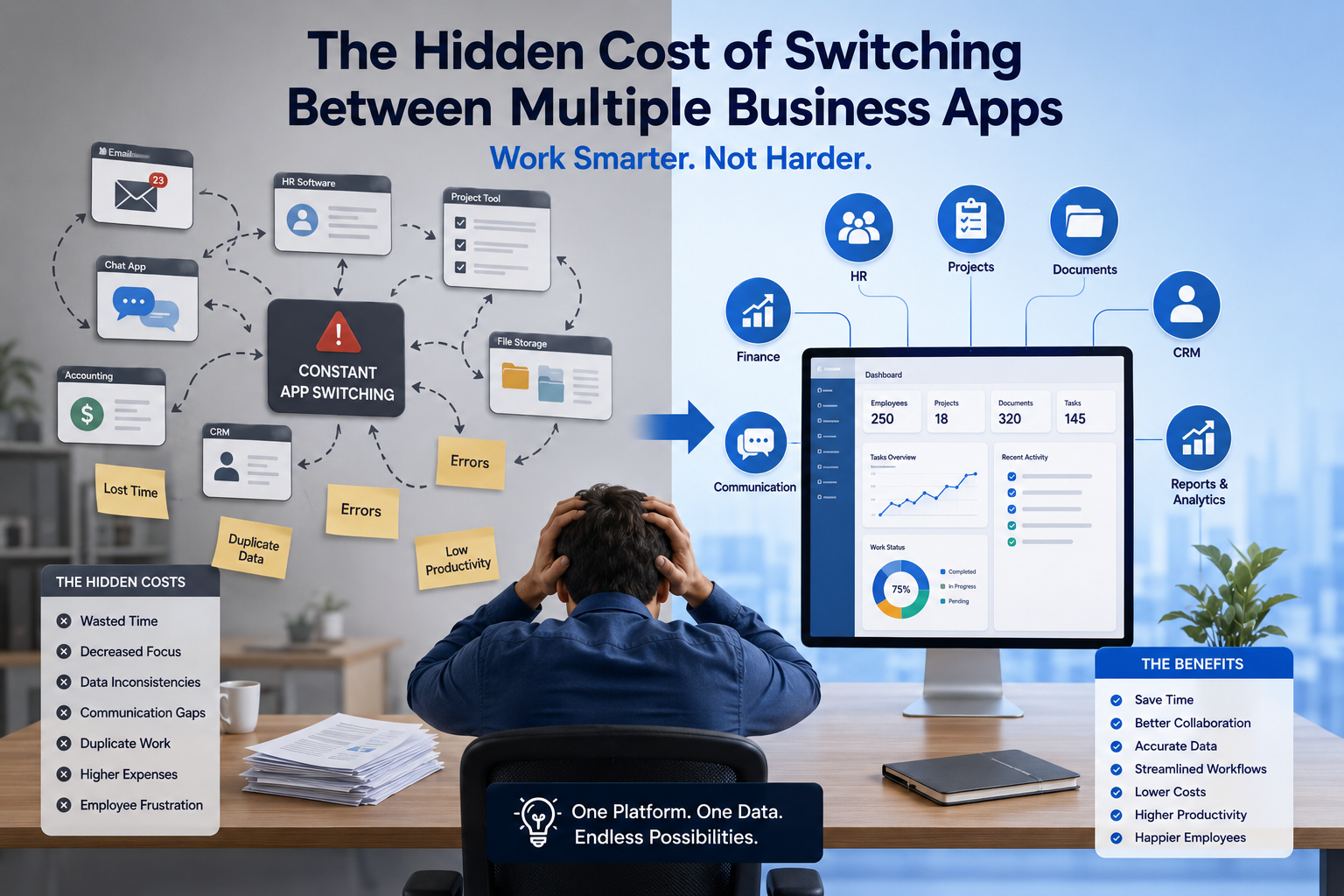
Employees spend their day switching between different screens, remembering multiple passwords, copying information from one application to another, downloading files from one system only to upload them into another, and searching across several platforms just to complete a single task. Instead of making work easier, technology sometimes becomes another obstacle to productivity.
Many organizations fail to recognize how much time is lost because of this constant switching between applications. While moving from one system to another may only take a few seconds each time, these interruptions occur hundreds of times every day across the organization. Over weeks, months, and years, the lost productivity becomes significant.
Beyond time, disconnected software creates data inconsistencies, communication gaps, duplicate work, delayed decision-making, and unnecessary operational costs. Employees become frustrated because information is scattered, managers struggle to gain visibility across departments, and executives find it difficult to make informed decisions based on complete business data.
This is why many organizations are moving toward integrated workplace solutions. Instead of relying on numerous disconnected applications, businesses are adopting unified business software platforms where employees can manage HR, finance, projects, communication, documents, recruitment, and other operations from one centralized environment.
An integrated digital workplace not only improves productivity but also simplifies collaboration, strengthens data accuracy, and helps organizations operate more efficiently in an increasingly competitive business landscape.
The Modern Workplace Runs on Software
Almost every business activity today depends on software.Employees use applications to communicate with colleagues, track attendance, manage payroll, create invoices, approve expenses, store documents, monitor projects, schedule meetings, recruit new employees, and generate reports.
Technology has undoubtedly transformed the workplace for the better.However, as businesses adopt more software solutions over time, they often create a technology ecosystem that is difficult to manage.
Each application performs one specific function, but very few communicate effectively with one another.Instead of creating efficiency, the workplace becomes increasingly fragmented.
Why Businesses End Up Using Multiple Applications
Most organizations do not intentionally create disconnected systems.It usually happens gradually.A business may first purchase accounting software.Later, it adopts HR software.
Then it implements project management tools.Eventually, communication platforms, cloud storage, recruitment software, and document management systems are added.
Each solution addresses an individual problem.However, because these systems were not designed to work together, employees must manually connect the information between them.
Over time, businesses find themselves managing six, eight, or even ten different applications every day.
The Productivity Cost of Constant App Switching
Switching between applications may seem insignificant.Opening another browser tab or logging into another system only takes a few seconds.
However, research consistently shows that changing focus interrupts concentration.Employees must stop thinking about one task, locate information in another application, then return to their original work.
This process repeats dozens of times throughout the day.Gradually, these interruptions reduce focus, slow productivity, and increase mental fatigue.
Instead of completing meaningful work, employees spend valuable time navigating between software platforms.Small interruptions eventually become significant productivity losses.
Information Becomes Scattered Across the Organization
One of the biggest disadvantages of multiple business applications is fragmented information.Employee information exists in HR software.
Invoices remain inside accounting software.Project updates appear elsewhere.Customer communication is stored in another platform.Business documents are saved on cloud drives.
Executives often need information from all these systems before making decisions.Unfortunately, collecting this information becomes a manual process.
Employees export reports, combine spreadsheets, compare numbers, and verify data before leadership meetings.Instead of having immediate access to reliable information, organizations spend hours preparing reports.This slows decision-making while increasing the risk of human error.
Duplicate Data Creates Bigger Problems
Disconnected software often requires employees to enter the same information multiple times.For example, when a new employee joins the organization, HR enters the employee's information into the HR system.
Finance then enters the same information into payroll software.IT creates accounts in communication platforms.Project managers update resource planning tools.
Operations maintain separate employee records.Each manual entry creates opportunities for mistakes.
If one department updates employee information while another forgets, inconsistent records begin appearing across the organization.Duplicate data gradually reduces confidence in business information.
Communication Becomes Less Efficient
Communication is another area affected by disconnected software.Employees receive notifications from multiple applications throughout the day.Approvals arrive by email.
Project updates appear in collaboration software.Payroll announcements are shared elsewhere.Documents require review through another platform.
Important information can easily be overlooked.Employees spend more time checking notifications than completing productive work.
An integrated workplace centralizes communication, making it easier for teams to stay informed without constantly switching platforms.
Multiple Logins Create Unnecessary Frustration
Every application usually requires separate login credentials.Employees must remember usernames, passwords, and authentication procedures for multiple systems.
Password resets become common.IT departments spend valuable time resolving access issues.As the number of applications increases, user frustration also increases.
Single sign-on and integrated business software eliminate many of these challenges by providing one secure access point for multiple business functions.
Higher Software Costs Affect Business Growth
Businesses often underestimate the financial impact of maintaining multiple applications.
Each software solution requires subscription fees, implementation costs, user training, support contracts, maintenance, and administrative oversight.
When several platforms perform similar functions, organizations may unknowingly pay for duplicate capabilities.
Additional costs include:
- Multiple software subscriptions and user licenses.
- Separate maintenance, training, and technical support.
- Increased IT administration and software management.
Over time, these expenses become significant.Integrated business software reduces these costs by consolidating multiple business functions into one platform.
Why an Integrated Workplace Makes a Difference
An integrated workplace connects departments, employees, and business processes through one centralized system.Instead of moving between multiple applications, employees complete their work from one environment.HR information connects directly with payroll.
Projects connect with timesheets.Recruitment connects with employee onboarding.Documents connect with approvals.Finance connects with operational reporting.
Information flows automatically across departments.Employees no longer spend time manually transferring information.Business processes become faster and more consistent.
Better Collaboration Across Teams
Collaboration becomes much easier when everyone works within the same business software environment.Departments no longer operate independently.
Information is shared automatically.Managers gain visibility across teams.Employees access current information without requesting updates from multiple departments.
This creates stronger collaboration while reducing unnecessary communication delays.A connected workplace encourages teamwork because everyone works with the same information.
Improved Decision-Making Through Connected Data
Executives need complete information to make confident decisions.When business data is spread across multiple systems, leadership teams spend valuable time gathering reports.Integrated business software eliminates this problem.
Data from HR, Finance, Projects, Recruitment, Documents, and Operations becomes connected.Executives access dashboards that provide real-time visibility into organizational performance.
Decisions become faster because information is immediately available.Leaders spend less time collecting data and more time planning future growth.
Supporting Digital Workplace Transformation
The concept of a digital workplace extends beyond technology.It focuses on creating an environment where employees can work efficiently, collaborate effectively, and access the information they need without unnecessary barriers.
Integrated business software supports this vision by simplifying daily operations.
Employees work from one platform instead of many.Information remains connected.Processes become automated.Business operations become more efficient.
Organizations gain the flexibility needed to support remote work, hybrid teams, and future business growth.
Benefits of Integrated Business Software
Organizations that replace disconnected applications with integrated business software often experience measurable improvements.
Some of the biggest advantages include:
- Faster workflows and reduced time spent switching between applications.
- Better collaboration across departments with connected business data.
- Lower software management costs and fewer duplicate systems.
- Improved reporting, visibility, and executive decision-making.
- Stronger employee productivity through simplified daily operations.
These improvements create a more efficient workplace where technology supports employees instead of slowing them down.
Preparing for the Future
Technology will continue evolving.Artificial Intelligence, workflow automation, predictive analytics, business intelligence, and cloud collaboration all depend on connected information.
Organizations relying on isolated software platforms will find it increasingly difficult to benefit from these innovations.
Businesses investing in integrated workplace solutions today are building a stronger foundation for future growth.
Connected systems provide the flexibility needed to adapt quickly to changing business requirements.
Conclusion
Technology should simplify business operations, not make them more complicated. Yet many organizations unknowingly lose valuable time, money, and productivity because employees spend their days moving between disconnected applications, re-entering information, managing duplicate records, and searching for data spread across multiple platforms.
The hidden cost of switching between multiple business apps extends beyond lost time. It affects collaboration, decision-making, employee satisfaction, operational efficiency, and long-term business growth.
An integrated workplace built on connected business software eliminates these challenges by bringing people, processes, and information together in one centralized environment. Employees work more efficiently, managers gain better visibility, executives make faster decisions, and organizations operate with greater confidence.
As businesses continue their digital transformation journey, success will depend not only on adopting technology but on choosing technology that works together. An integrated digital workplace is no longer a luxury—it is becoming an essential foundation for building a productive, connected, and future-ready organization.