Table of Contents
- The Importance of Version Control in Business Documents
- What Is Version Control?
- Why Version Control Matters for Business Documents
- Improving Document Collaboration
- Preventing Employees From Using Outdated Information
- Supporting Better Approvals
- Reducing Errors and Rework
- Version Control Saves Employee Time
- Supporting Remote and Hybrid Teams
- Improving Cross-Department Collaboration
- Protecting Important Business Information
- Making Audits Easier
- Version Control and Business Continuity
- Supporting Organizational Knowledge
- The Role of Digital Document Management
- Best Practices for Document Version Management
- Preparing Businesses for Future Growth
- Final Thoughts
The Importance of Version Control in Business Documents
Business documents are at the center of almost every organization. Contracts, proposals, invoices, employee records, project reports, policies, presentations, purchase documents, financial statements, customer information, and internal reports are created and updated every day. As a company grows, the number of documents increases rapidly, and so does the number of people who need to work with them. What appears to be a simple document can pass through several employees, departments, managers, clients, and approval stages before it is finally completed. During this process, one small problem can create a surprisingly large amount of confusion: which version of the document is the correct one?
This is where version control becomes important. Version control is the practice of managing different versions of a document so that employees can clearly understand which version is current, what has changed, who made the changes, and when those changes were made. It may sound like a technical concept, but its importance is very practical. Without proper document version management, employees can accidentally edit old files, send outdated information to customers, approve incorrect documents, or spend valuable time comparing multiple copies to determine which one should be used.
Consider a simple example. A project team creates a proposal and sends it to Finance for review. Finance makes some changes and sends it back. The project manager then makes additional changes and saves another copy. Later, a manager forwards an earlier version to the client because the file name looks similar to the latest version. Suddenly, the business is discussing two different documents. One person is working from an old price, another is using an updated scope, and the client has received information that the internal team no longer considers correct. The problem is not that the employees were careless. The problem is that the organization did not have a reliable way to manage document versions.
As businesses become increasingly digital, document collaboration is becoming more common. Employees can work on documents from different departments, locations, and even different time zones. This makes effective version control more important than ever. A strong document management approach ensures that employees can access the latest approved information while maintaining a clear history of previous changes.
Version control is therefore not simply about keeping files organized. It is about maintaining accuracy, accountability, collaboration, security, and continuity across the organization.
What Is Version Control?
Version control is a structured method of managing changes made to a business document over time. Instead of allowing employees to create unlimited copies of the same document, a version-controlled system maintains a clear history of the document and its revisions.
For example, a document might progress through several stages:
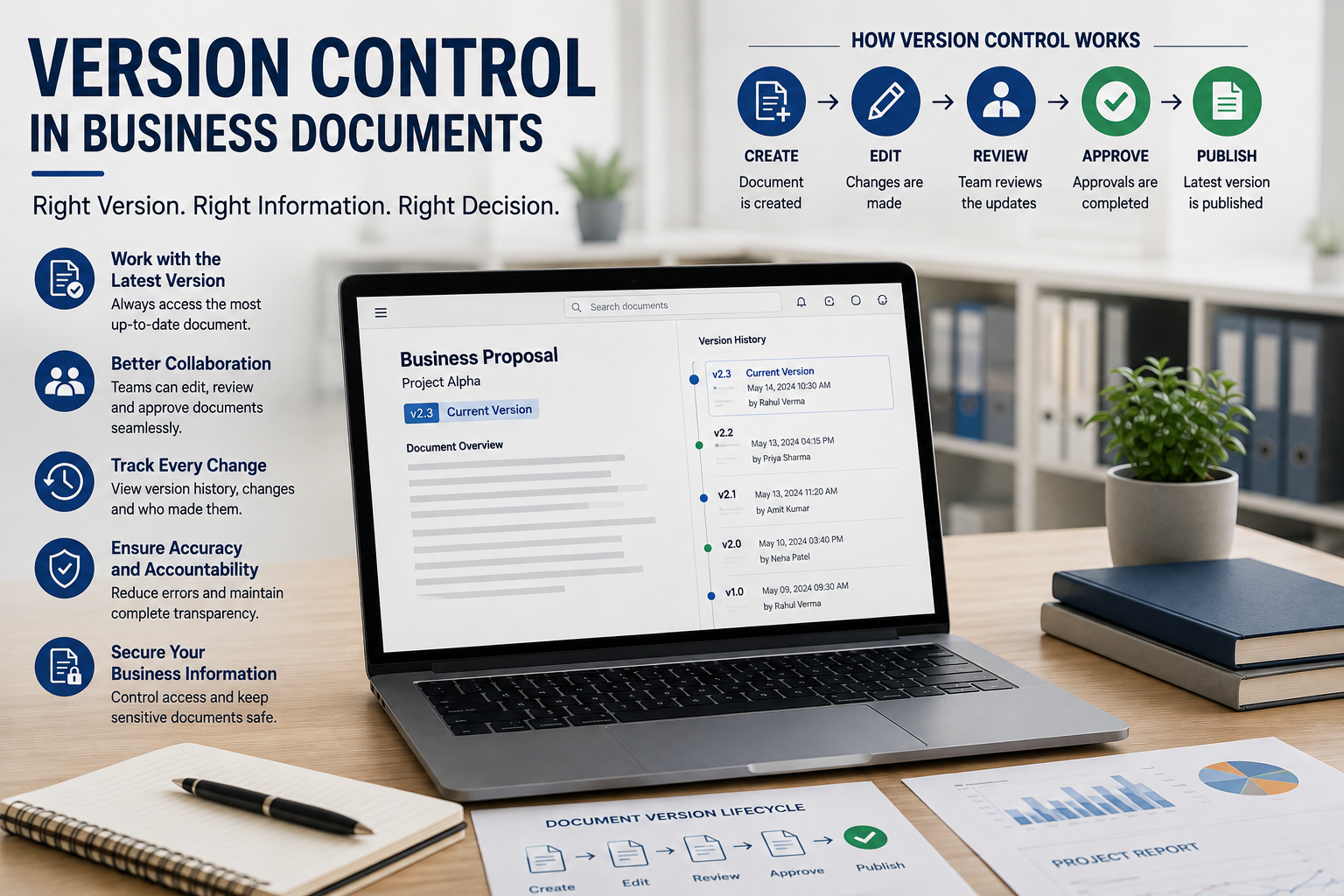
Version 1.0 → Version 1.1 → Version 1.2 → Version 2.0 → Final Approved Version
Each version represents a stage in the document's development. Employees can understand what changed and identify which version should currently be used.
In a modern business environment, version control can be managed through document management systems and digital collaboration platforms. These systems can record changes automatically, maintain previous versions, and provide authorized users with access to the latest document.
The goal is simple: everyone should know which document is current and trustworthy.
Why Version Control Matters for Business Documents
Business documents are rarely created by one person and forgotten. Most important documents go through a process of creation, review, editing, approval, and distribution.
A contract may be prepared by one employee, reviewed by Legal, modified by Management, approved by a senior executive, and then shared with a client. A project report may be prepared by the project team, reviewed by Finance, updated by Operations, and finally approved by management.
Every additional person creates another opportunity for a version mismatch.
Without proper version control, organizations can experience problems such as:
- Employees working on outdated documents.
- Different departments using different versions of the same file.
- Important changes being accidentally overwritten.
- Time being wasted comparing multiple copies.
- Incorrect information being sent to customers or partners.
- Difficulty identifying who made a particular change.
- Confusion during audits and approvals.
These problems become more serious as the organization grows.
Improving Document Collaboration
Modern businesses depend on collaboration.A single document may involve several people from different departments. Employees may need to review, comment, edit, approve, and distribute the same information.
Without version management, collaboration can quickly become confusing.One employee may edit a document while another employee is working on an older copy. Both versions may contain useful changes, but combining them manually can take time and may introduce errors.
With proper document collaboration, everyone works from the same controlled source.Employees can see the latest version, understand previous changes, and collaborate without constantly exchanging separate copies.This creates a smoother working environment.
Preventing Employees From Using Outdated Information
One of the biggest advantages of version control is preventing outdated information from being used accidentally.Business information changes frequently.Prices change.Contracts are updated.Policies are revised.Project requirements evolve.
Employee information is modified.Customer requirements may change.If employees continue using old versions, the organization may make decisions based on information that is no longer accurate.
Version management makes the current version easier to identify.Employees can see when the document was last updated and, depending on the system, who made the changes.This helps ensure that business decisions are based on current information.
Supporting Better Approvals
Approvals are an important part of business operations.Contracts, purchase requests, invoices, employee documents, policies, project changes, and many other business records require approval.A major risk occurs when someone approves an older version of a document.
Imagine a contract being reviewed by management. The manager approves Version 3, but before the approval is recorded, another employee makes changes and sends a different copy to the client.Now there is uncertainty about what exactly was approved.
Version control helps prevent this problem by maintaining a clear relationship between the document and its approval stage.
The organization can identify which version was reviewed and approved.This creates greater confidence in the approval process.
Reducing Errors and Rework
Errors caused by outdated documents often lead to rework.Employees may need to correct reports, resend information, update customers, repeat approvals, or recreate documents.This wastes time and increases operational costs.
Version control reduces these risks by making document history easier to manage.Employees do not need to manually compare multiple files to determine which one is current.
Instead, they can work with a controlled document history.The result is fewer unnecessary corrections and less repetitive administrative work.
Version Control Saves Employee Time
Time spent searching for the correct document is often invisible in business operations.An employee may spend five minutes searching for a file.Another employee may spend ten minutes asking whether the file is the latest version.
A manager may spend another fifteen minutes comparing two documents.These small activities can happen repeatedly throughout the day.
Over weeks and months, they become a significant productivity issue.Effective version control removes much of this unnecessary work.
Employees can quickly locate the correct document and continue with their responsibilities.This is particularly valuable for organizations where employees regularly collaborate on large numbers of documents.
Supporting Remote and Hybrid Teams
Remote and hybrid work have changed the way employees collaborate.Teams may now work from different offices, cities, or countries. Employees cannot always walk over to a colleague's desk to ask which document is current.
Digital document management becomes essential in this environment.Version-controlled documents allow employees to collaborate without being physically present in the same location.
The latest information remains available to authorized users, while document history provides additional context.
This allows teams to continue working efficiently even when they are geographically distributed.
Improving Cross-Department Collaboration
Different departments often have different priorities, but they still depend on shared business documents.
For example, HR may create an employee policy that requires Management approval and later needs to be communicated to all employees.
Finance may create a budget that Projects and Procurement need to follow.A Sales team may prepare a customer proposal that requires input from Technical and Finance teams.
In each case, several departments may contribute to the same document.Version control provides a common reference point.
Instead of every department keeping its own copy, everyone can work from the same controlled document.This reduces communication gaps and improves collaboration.
Protecting Important Business Information
Business documents can contain sensitive information.Contracts may contain commercial terms.
Employee documents may contain private information.Financial reports may contain confidential figures.
Customer documents may include sensitive business details.Version control works alongside access control to protect these documents.
Only authorized employees should be able to access or modify particular information.At the same time, the organization should be able to track changes made to important records.This combination of controlled access and version management strengthens document security.
Making Audits Easier
Audits often require organizations to demonstrate how information was created, reviewed, changed, and approved.
If documents are scattered across emails and personal folders, collecting this information can be difficult.Version management provides a clearer history.
Organizations can identify previous versions and understand how documents changed over time.This can make audit preparation more organized and reduce the time employees spend searching for historical records.A clear document history also improves confidence because the organization can demonstrate that important records were properly managed.
Version Control and Business Continuity
Important documents should not depend on one employee's computer.If an employee leaves the organization or their computer becomes unavailable, other authorized employees should still be able to access the latest business information.Centralized document version management helps organizations maintain continuity.
The business retains the document history rather than losing information when an individual leaves.This is especially important for contracts, policies, project documentation, financial records, and other long-term business documents.
Supporting Organizational Knowledge
Documents contain valuable organizational knowledge.A project report can explain what happened during a previous project.
A policy can describe how a business handles a specific situation.A contract can preserve important commercial information.
A process document can explain how an operational activity should be completed.Version history adds another layer of knowledge by showing how these documents evolved.
Future employees can understand not only the current information but also the development of important business decisions when historical versions are retained appropriately.This helps organizations preserve knowledge over time.
The Role of Digital Document Management
Version control becomes much more effective when it is part of a broader document management system.
A modern document management approach can bring together:
- Centralized document storage.
- Version history.
- Access permissions.
- Document search.
- Collaboration.
- Approval workflows.
- Notifications.
- Audit trails.
- Secure sharing.
Instead of treating documents as individual files, businesses can manage them as part of structured business processes.This creates a more connected digital workplace.
Best Practices for Document Version Management
Businesses can improve their document management by following a few practical principles:
- Use a centralized document repository rather than storing important files across personal devices and unrelated folders.
- Define clear document ownership so employees understand who is responsible for maintaining important records.
- Use version history instead of creating multiple independent copies.
- Control editing permissions so only authorized employees can make changes.
- Keep approval records connected to the relevant version of the document.
- Use consistent naming and classification methods to make documents easier to locate.
- Regularly review outdated documents and clearly identify information that is no longer active.
These practices create a more reliable document environment without making everyday work unnecessarily complicated.
Preparing Businesses for Future Growth
The importance of version control increases as a company grows.A small business may manage documents through shared folders because only a few employees are involved.As the organization expands, more people begin editing documents. More departments become involved. More files are created. More approvals are required.Eventually, informal document management becomes difficult to maintain.
Implementing proper version control early gives the organization a scalable foundation.New employees can join existing workflows.
New departments can collaborate through centralized documents.Management can maintain greater visibility.The business can grow without allowing document confusion to grow alongside it.
Final Thoughts
Business documents are more than digital files. They contain information that supports decisions, processes, relationships, projects, customers, employees, and the overall operation of an organization. When those documents are poorly managed, the effects can reach far beyond simple file confusion.
Outdated information can lead to incorrect decisions. Duplicate files can create unnecessary work. Missing changes can cause disagreements. Incorrect versions can delay approvals. Poor document history can make audits more difficult. As businesses grow, these problems become increasingly difficult to control.Version control provides a practical solution.
By maintaining a clear history of document changes, organizations can ensure that employees know which version is current, understand how information has changed, and collaborate more confidently. Proper document version management reduces confusion while improving accuracy, accountability, security, and productivity.
It also creates a stronger foundation for document collaboration. Employees from different departments can work together without constantly sending separate copies of files through email. Managers can review the correct information. Approved documents can be clearly identified. Previous versions can remain available when historical information is required.
The real value of version control is not simply preventing employees from opening the wrong file. It is about creating confidence in business information.
When employees know that the document they are viewing is current and reliable, they can make decisions faster. When managers know that changes are traceable, they can approve information with greater confidence. When departments work from the same source, collaboration becomes easier. And when the organization grows, its knowledge remains organized and accessible.
In a modern digital workplace, businesses cannot afford to treat document management as an afterthought. Every important document represents information that may influence a decision, a customer relationship, a financial transaction, or an operational process.
Good version control ensures that the right information reaches the right people at the right time.Ultimately, organizations that invest in effective version control are not simply organizing their documents better. They are building a more accurate, accountable, collaborative, and efficient way of working—one that can support the business today and continue to scale as the organization grows.