
Table of Contents
- The Shift From Manual Work to Intelligent Business Processes
- What Are AI-Powered Operations?
- Why Traditional Business Processes Are No Longer Enough
- The Growing Demand for Speed and Efficiency
- How AI Improves Decision-Making
- AI in Recruitment and Talent Acquisition
- Improving Employee Productivity
- Enhancing Customer Experiences
- Reducing Human Errors
- AI and Real-Time Business Intelligence
- The Role of AI in Automation
- Overcoming Common Concerns About AI
- Why AI Is Becoming a Competitive Advantage
- Practical Steps for AI Adoption
- Identify Repetitive Processes
- Improve Data Quality
- Start Small
- Train Employees
- Measure Results
- Frequently Asked Questions
- What are AI-powered operations?
- Why are businesses adopting AI?
- Can AI replace employees?
- Which departments benefit from AI?
- Is AI only for large organizations?
- Conclusion
The Shift From Manual Work to Intelligent Business Processes
Businesses today operate in a world that is faster, more competitive, and more data-driven than ever before. Customers expect quicker responses, employees expect efficient tools, and leaders need accurate information to make better decisions. At the same time, organizations face increasing pressure to improve productivity, reduce costs, maintain security, and stay ahead of competitors.
For many years, businesses relied heavily on manual processes to manage operations. Employees spent hours entering data, reviewing documents, processing requests, generating reports, and handling repetitive administrative tasks. While these processes helped organizations function, they often consumed valuable time and resources.
Today, a major shift is taking place.
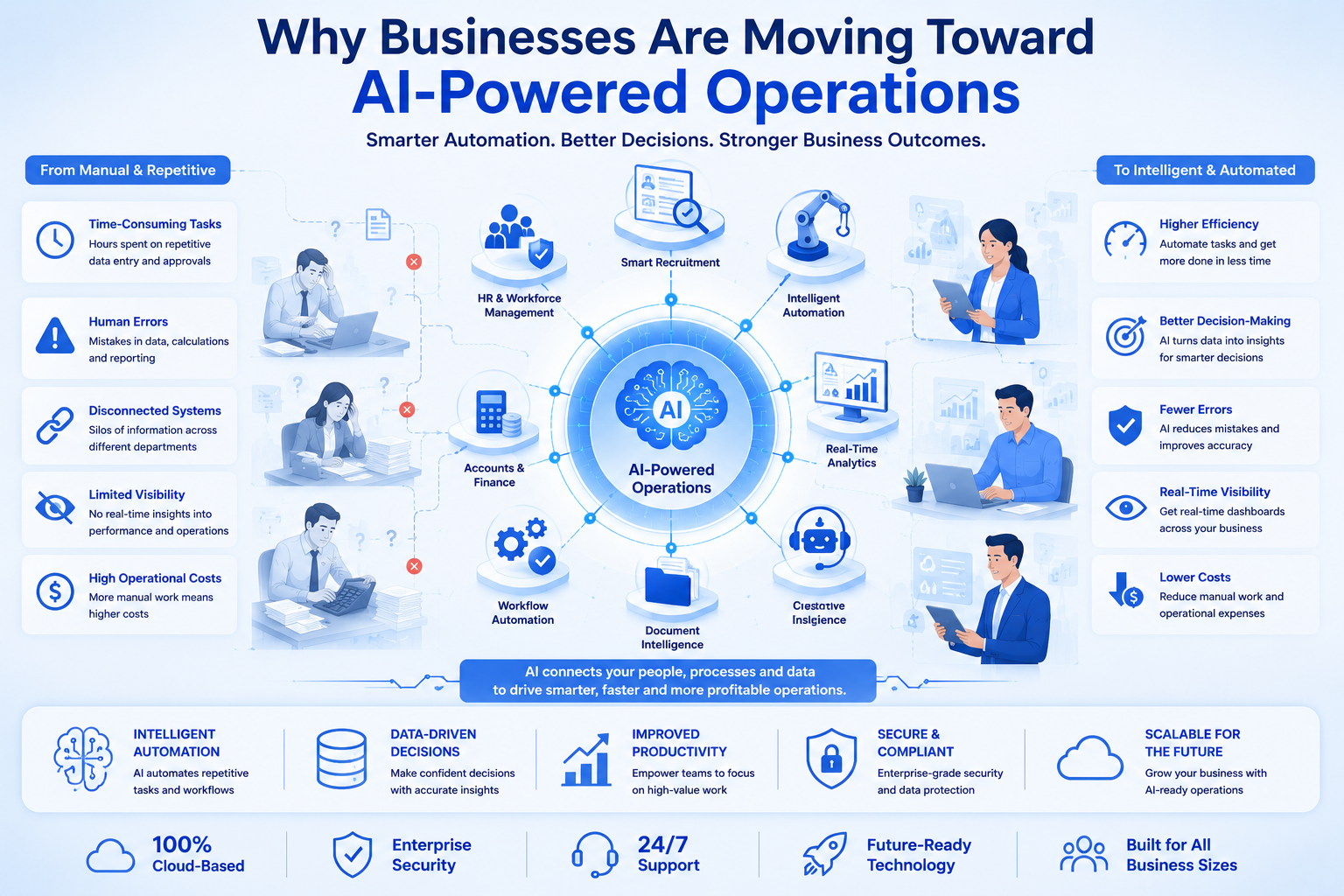
Organizations across industries are embracing Artificial Intelligence (AI) to automate routine work, improve decision-making, enhance customer experiences, and increase operational efficiency. AI is no longer a futuristic concept reserved for technology companies. It has become a practical business tool that is transforming how organizations operate every day.
From recruitment and employee management to accounting, customer service, document processing, and business analytics, AI is helping organizations work smarter rather than harder.
As technology continues to evolve, businesses that embrace AI-powered operations are positioning themselves for greater efficiency, scalability, and long-term success.
What Are AI-Powered Operations?
AI-powered operations refer to the use of artificial intelligence technologies to automate, optimize, and improve business processes.
Unlike traditional automation, which follows predefined rules, AI can analyze information, identify patterns, make recommendations, and continuously improve over time.
AI systems can process large volumes of information far more quickly than humans, allowing organizations to handle complex tasks with greater speed and accuracy.
Examples of AI-powered operations include:
- Automated document processing
- Intelligent recruitment screening
- Predictive analytics
- Customer support automation
These capabilities help organizations reduce manual effort while improving overall performance.
The goal is not to replace people. The goal is to help people focus on higher-value activities that require creativity, judgment, and strategic thinking.
Why Traditional Business Processes Are No Longer Enough
Business environments have changed significantly over the past decade.
Organizations now manage larger volumes of data, more complex workflows, and increasingly distributed teams.
Many traditional processes struggle to keep up with these demands.
Employees often spend substantial time on tasks such as:
- Data entry
- Report generation
- Information verification
These activities are necessary but rarely contribute directly to innovation or growth.
As organizations expand, manual processes become more difficult to manage.
Workloads increase, response times slow down, and operational inefficiencies become more visible.
AI helps organizations overcome these challenges by reducing repetitive work and improving process efficiency.
Businesses that continue relying entirely on manual operations may find it increasingly difficult to compete in a rapidly evolving marketplace.
The Growing Demand for Speed and Efficiency
Modern customers and employees expect fast results.
Customers want quick responses to inquiries.
Employees want immediate access to information and streamlined workflows.
Managers need real-time insights to support decision-making.
Meeting these expectations through manual processes can be challenging.
AI-powered operations enable organizations to respond faster by automating routine activities and providing intelligent recommendations.
Benefits often include:
- Faster processing times
- Reduced administrative workload
- Improved service delivery
Organizations that improve operational speed often gain a competitive advantage.
Efficiency is no longer simply a productivity goal. It has become a business necessity.
How AI Improves Decision-Making
One of the most valuable aspects of AI is its ability to support better decision-making.
Organizations generate enormous amounts of information every day.
Financial data, employee records, customer interactions, operational reports, and project updates all contribute to the decision-making process.
The challenge is not collecting information.
The challenge is analyzing it effectively.
AI can process large datasets, identify trends, and highlight insights that may otherwise go unnoticed.
For example, AI can help organizations:
- Forecast future demand
- Identify performance trends
- Detect operational inefficiencies
These insights enable leaders to make more informed decisions based on data rather than assumptions.
Data-driven decision-making is becoming increasingly important in competitive business environments.
AI in Recruitment and Talent Acquisition
Recruitment is one area where AI is creating significant value.
Traditional hiring processes often involve reviewing hundreds of resumes, scheduling interviews, and managing large volumes of candidate information.
These activities require considerable time and effort.
AI helps streamline recruitment by automating tasks such as:
- Resume screening
- Candidate matching
- Interview scheduling
Recruiters can focus more on engaging with qualified candidates and less on administrative work.
AI also helps improve consistency throughout the hiring process.
Organizations can identify suitable candidates more efficiently while reducing manual effort.
As competition for talent increases, AI-powered recruitment tools are becoming increasingly valuable.
Improving Employee Productivity
Productivity remains a top priority for organizations worldwide.
However, productivity is often limited by repetitive administrative tasks.
Employees may spend significant portions of their day managing emails, updating records, generating reports, or searching for information.
AI helps reduce these burdens.
By automating routine activities, employees can devote more time to strategic and creative work.
Examples include:
- Automated data processing
- Smart document search
- Workflow recommendations
When employees spend less time on repetitive tasks, they often become more productive and engaged.
Improved productivity benefits both individuals and organizations.
Enhancing Customer Experiences
Customer expectations continue to rise.
Organizations must provide faster, more personalized, and more consistent service experiences.
AI helps businesses meet these expectations.
Applications include:
- Intelligent chat assistants
- Automated customer support
- Personalized recommendations
AI enables organizations to respond to customer needs more efficiently while maintaining service quality.
Customers benefit from faster responses and more relevant interactions.
Organizations benefit from improved satisfaction and stronger customer relationships.
Customer experience has become a key competitive differentiator, making AI an increasingly valuable investment.
Reducing Human Errors
Human errors are inevitable in any workplace.
Mistakes can occur during data entry, reporting, calculations, approvals, and document management.
While most errors are unintentional, they can create operational challenges and financial risks.
AI helps reduce errors by automating tasks that require accuracy and consistency.
Benefits include:
- Improved data quality
- More accurate reporting
- Reduced operational risks
Organizations that minimize errors often experience greater efficiency and stronger business outcomes.
Accuracy becomes increasingly important as business complexity grows.
AI and Real-Time Business Intelligence
Modern organizations need visibility into their operations.
Leaders must understand what is happening across departments, projects, finances, and workforce activities.
Traditional reporting methods often provide historical information.
AI-powered business intelligence goes further.
AI can analyze information in real time and identify emerging trends, risks, and opportunities.
Organizations gain access to:
- Real-time insights
- Predictive analytics
- Performance forecasting
This visibility supports faster decision-making and more proactive management.
Real-time intelligence is becoming a major advantage in today's business environment.
The Role of AI in Automation
Automation has existed for many years, but AI takes automation to a new level.
Traditional automation follows predefined instructions.
AI-powered automation can learn from information and adapt to changing conditions.
This capability allows organizations to automate more complex activities.
Examples include:
- Intelligent workflow routing
- Smart approvals
- Predictive maintenance
AI-powered automation helps organizations achieve greater efficiency while reducing operational complexity.
The combination of AI and automation is transforming how businesses operate.
Overcoming Common Concerns About AI
Despite its benefits, some organizations remain hesitant to adopt AI.
Common concerns include:
- Cost of implementation
- Employee resistance
- Complexity of technology
However, AI adoption is becoming increasingly accessible.
Modern solutions are easier to implement and often provide measurable returns on investment.
It is also important to understand that AI is designed to assist employees rather than replace them.
Organizations that successfully implement AI often focus on collaboration between people and technology.
The best results occur when AI supports human expertise rather than attempting to replace it.
Why AI Is Becoming a Competitive Advantage
Organizations that embrace AI often gain advantages in several key areas:
- Efficiency
- Productivity
- Decision-making
AI enables businesses to respond faster, operate more effectively, and identify opportunities more quickly.
As adoption continues to grow, organizations that delay AI initiatives may find themselves at a disadvantage.
Competitive advantage increasingly depends on the ability to leverage technology effectively.
AI is becoming a critical component of modern business strategy.
Practical Steps for AI Adoption
Organizations considering AI-powered operations should begin with a clear strategy.
Key steps include:
Identify Repetitive Processes
Focus on tasks that consume significant time and effort.
Improve Data Quality
AI performs best when information is accurate and organized.
Start Small
Begin with targeted initiatives before expanding adoption.
Train Employees
Help teams understand how AI supports their work.
Measure Results
Track improvements in efficiency, productivity, and performance.
Successful AI adoption is often a gradual process rather than a single project.
Frequently Asked Questions
What are AI-powered operations?
AI-powered operations use artificial intelligence to automate, optimize, and improve business processes.
Why are businesses adopting AI?
Businesses adopt AI to improve efficiency, reduce manual work, enhance decision-making, and support growth.
Can AI replace employees?
AI is designed to assist employees by automating repetitive tasks, allowing people to focus on higher-value work.
Which departments benefit from AI?
AI can support HR, recruitment, finance, operations, customer service, project management, and many other functions.
Is AI only for large organizations?
No. AI solutions are increasingly accessible to businesses of all sizes.
Conclusion
The shift toward AI-powered operations represents one of the most significant changes in modern business management.
Organizations are under increasing pressure to improve efficiency, respond faster, manage growing amounts of information, and deliver better experiences for employees and customers.
AI provides a practical solution to these challenges.
By automating routine tasks, improving decision-making, reducing errors, and delivering real-time insights, AI helps organizations operate more intelligently and efficiently.
The future of business will not simply be digital,It will be intelligent.
Organizations that embrace AI-powered operations today are building the foundation for greater productivity, stronger competitiveness, and long-term success in the years ahead.