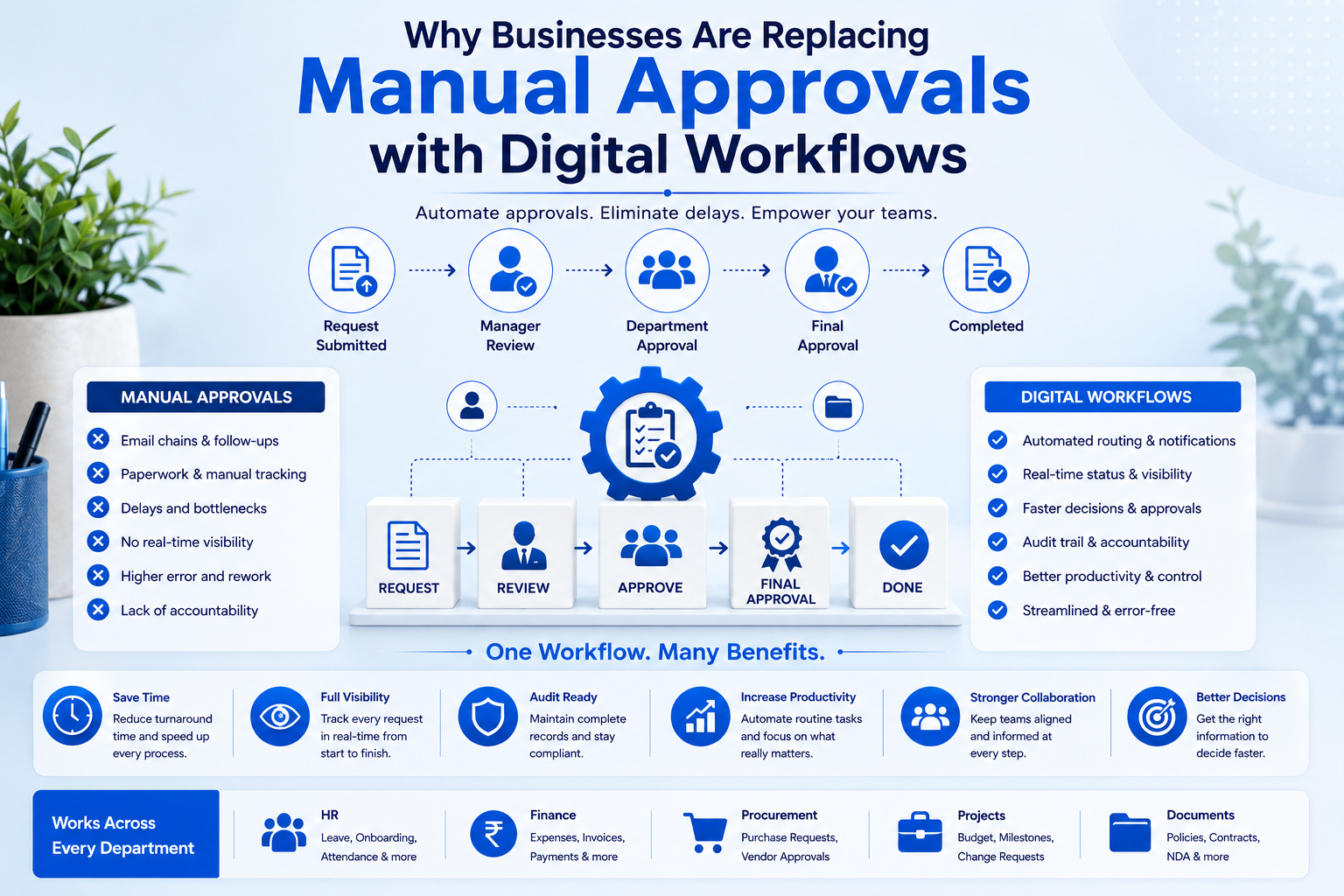
Why Businesses Are Replacing Manual Approvals with Digital Workflows
Every business, regardless of its size or industry, depends on approvals to keep daily operations running smoothly. Whether it is approving an employee's leave request, processing an expense claim, authorizing a purchase order, reviewing an invoice, approving a project budget, or signing an important document, approvals are part of almost every business process. They ensure accountability, maintain compliance, and help organizations make informed decisions.
For many businesses, however, these approval processes still rely on emails, paper forms, spreadsheets, phone calls, or messaging applications. A manager may receive an approval request by email, forget to respond, lose track of the message, or be unavailable for several days. Documents may sit on someone's desk waiting for signatures, while employees spend valuable time sending reminders and following up. These delays not only slow down operations but also create frustration across departments.
As organizations grow, manual approval systems become increasingly difficult to manage. More employees, more departments, and more business transactions mean more approvals every day. Without a structured system, requests can easily get delayed, duplicated, or even overlooked entirely. What begins as a simple process eventually becomes one of the biggest obstacles to productivity.
This is why businesses around the world are replacing manual approval processes with digital approval workflows.
Digital workflows automate the movement of approval requests, notify the right people instantly, record every action, and ensure that no request is forgotten. Instead of chasing signatures or searching through long email threads, employees can submit requests online, managers can review them from anywhere, and organizations gain complete visibility into every stage of the approval process.
Digital approval workflows are no longer just a convenience. They have become an essential part of modern business process automation, helping organizations improve efficiency, reduce delays, strengthen compliance, and create a faster, more connected workplace.
What Are Manual Approval Processes?
A manual approval process is any workflow where approval requests are handled without automation. The request usually moves between employees through paper documents, email attachments, spreadsheets, printed forms, or messaging applications.
For example, an employee requesting leave might fill out a paper form or send an email to their manager. The manager reviews it, forwards it to HR, HR updates attendance records, and finally notifies Payroll. Although this process appears straightforward, it involves multiple manual steps.
Every handoff introduces the possibility of delays, missed emails, misplaced documents, or communication gaps.
Manual approvals are commonly used for:
- Leave requests
- Purchase approvals
- Expense reimbursements
- Vendor payments
- Project budget approvals
- Recruitment requests
- Employee onboarding
- Document reviews
While these processes may work in smaller organizations, they become increasingly inefficient as businesses expand.
Why Manual Approvals Slow Business Growth
Many organizations do not realize how much time is lost because of manual approvals. Employees often spend more time waiting for decisions than completing actual work.
Imagine a purchase request that requires approvals from three different managers. If each manager takes two days to respond because they are busy, the approval process can easily take a week. During that time, procurement is delayed, projects cannot move forward, and productivity decreases.
The same situation occurs with employee leave approvals, project budgets, recruitment requests, vendor invoices, and contract reviews.
The biggest problem is that no one has complete visibility into where the request is currently waiting.
Employees repeatedly ask questions like:
- Has my request been approved?
- Who is reviewing it?
- Why is it delayed?
- Has someone forgotten about it?
Instead of focusing on productive work, employees spend valuable time following up on approvals.
As organizations grow, these delays multiply across hundreds or thousands of requests every month.
The Hidden Cost of Manual Approvals
The true cost of manual approvals extends far beyond slower processes,Every delayed approval affects multiple departments.
For example, if Finance delays approving an invoice, vendor payments may be postponed. Vendors may lose confidence in the organization, affecting future business relationships.
Similarly, delayed recruitment approvals can postpone hiring, leaving teams understaffed and increasing workloads for existing employees.
Manual approval processes also increase the likelihood of:
- Lost documents
- Duplicate requests
- Missed deadlines
Small administrative problems gradually become larger operational challenges.
Over time, organizations may experience reduced productivity, lower employee satisfaction, and slower business growth.
Many companies attempt to solve these issues by hiring additional administrative staff.
However, the real problem is often the approval process itself rather than the number of employees managing it.
What Is a Digital Approval Workflow?
A digital approval workflow automates the movement of requests from one person to another based on predefined business rules.
Instead of relying on emails or paper documents, employees submit requests through a centralized system.
The workflow automatically sends the request to the appropriate manager.Once approved, it moves to the next person if additional approvals are required.Every step is recorded automatically.
Everyone involved can see the status of the request in real time.Managers receive reminders if approvals remain pending.
Employees receive instant notifications when decisions are made.Nothing depends on memory or manual follow-up.
Digital approval workflows create consistency while eliminating unnecessary administrative work.How Workflow Automation Improves Everyday Business Operations
Workflow automation is transforming the way organizations manage routine activities.
Instead of employees manually coordinating approvals between departments, automation ensures that requests move smoothly through predefined workflows.
For example:
An employee submits a leave request.The request automatically reaches the reporting manager.Once approved, HR receives a notification.
Attendance records update automatically.Payroll receives the necessary information without manual intervention.
No emails need to be forwarded.No spreadsheets need updating.No employee needs to remind multiple departments.Everything happens automatically according to business rules.
This level of automation saves time while significantly reducing human errors.
Digital Workflows Create Faster Decision-Making
Modern businesses depend on speed.Whether approving a customer quotation, onboarding a new employee, purchasing equipment, or authorizing project expenses, delays directly affect productivity.
Digital approval workflows help managers make decisions more efficiently because all relevant information is available in one place.
Instead of searching through emails or requesting additional documents, managers can review complete requests immediately.
Approvals can even be completed from mobile devices while travelling or working remotely.This flexibility ensures that business operations continue without interruption.
Organizations become more agile because decisions happen faster.Better Transparency Across DepartmentsOne of the biggest advantages of digital approval workflows is visibility.Every stakeholder knows exactly where a request stands.
Employees no longer need to wonder whether someone has received their request.Managers can identify pending approvals immediately.Department heads can monitor overall workflow performance.Business leaders gain insights into approval times, bottlenecks, and operational efficiency.
Transparency improves accountability because every action is recorded automatically.This reduces confusion and improves communication across departments.
Supporting HR, Finance, Projects, Procurement, and Documents
Digital approval workflows are valuable across every department.Human Resources can automate leave approvals, onboarding, attendance corrections, and employee requests.
Finance teams can manage expense claims, invoice approvals, vendor payments, and budget authorizations.Project teams can approve milestones, change requests, and resource allocations.
Procurement departments can automate purchase requests and supplier approvals.Document management becomes more efficient because contracts, policies, and important files move through structured review processes.
Instead of each department creating separate approval methods, organizations establish consistent workflows that improve efficiency across the entire business.
The Role of Approval Management Software
Rather than depending on multiple emails, messaging apps, and spreadsheets, organizations manage every approval through a structured digital environment.
A modern approval management solution typically offers:
- Multi-level approval workflows based on company policies.
- Real-time notifications, reminders, audit trails, and approval history.
These features improve visibility while helping organizations maintain compliance and operational consistency.
Preparing for the Future
Business operations continue to become more complex as organizations grow.Manual approval processes that worked years ago often become barriers to efficiency today.
Businesses that embrace workflow automation position themselves for faster growth, stronger collaboration, and better decision-making.Digital approval workflows are no longer simply about replacing paper forms.
They represent a smarter way of managing business processes in an increasingly digital world.Organizations that invest in business process automation today are creating workplaces that are more connected, transparent, and productive.
Conclusion
Every approval represents a decision that keeps a business moving forward. When approvals are delayed, operations slow down, employees become frustrated, and opportunities may be lost.
Replacing manual approvals with digital workflows allows organizations to streamline processes, reduce administrative effort, improve transparency, and accelerate decision-making across every department.
Whether managing HR requests, financial approvals, procurement, projects, or document reviews, digital approval workflows create a structured and efficient way to keep business operations running smoothly.
As organizations continue their digital transformation journey, workflow automation and approval management software will play an increasingly important role in building faster, smarter, and more agile businesses.
The future of business approvals is no longer paper-based or dependent on endless email chains. It is digital, automated, and designed to help organizations focus less on administrative delays and more on meaningful growth.