Table of Contents
- Why Businesses Need Visibility Across Every Department
- Understanding Business Visibility
- Why Departmental Silos Create Challenges
- The Relationship Between Visibility and Operational Management
- Why Visibility Improves Decision-Making
- The Growing Importance of Workplace Analytics
- Improving Collaboration Across Departments
- How Visibility Enhances Employee Productivity
- Business Intelligence as a Strategic Tool
- Visibility Supports Organizational Agility
- Creating a Connected Organization
- Conclusion
Why Businesses Need Visibility Across Every Department
In today's business environment, information moves faster than ever before. Organizations are managing employees, customers, projects, finances, vendors, documents, communications, and operational activities simultaneously. Every department generates valuable information that contributes to the overall success of the organization. However, many businesses still struggle with a common challenge: limited visibility across departments.
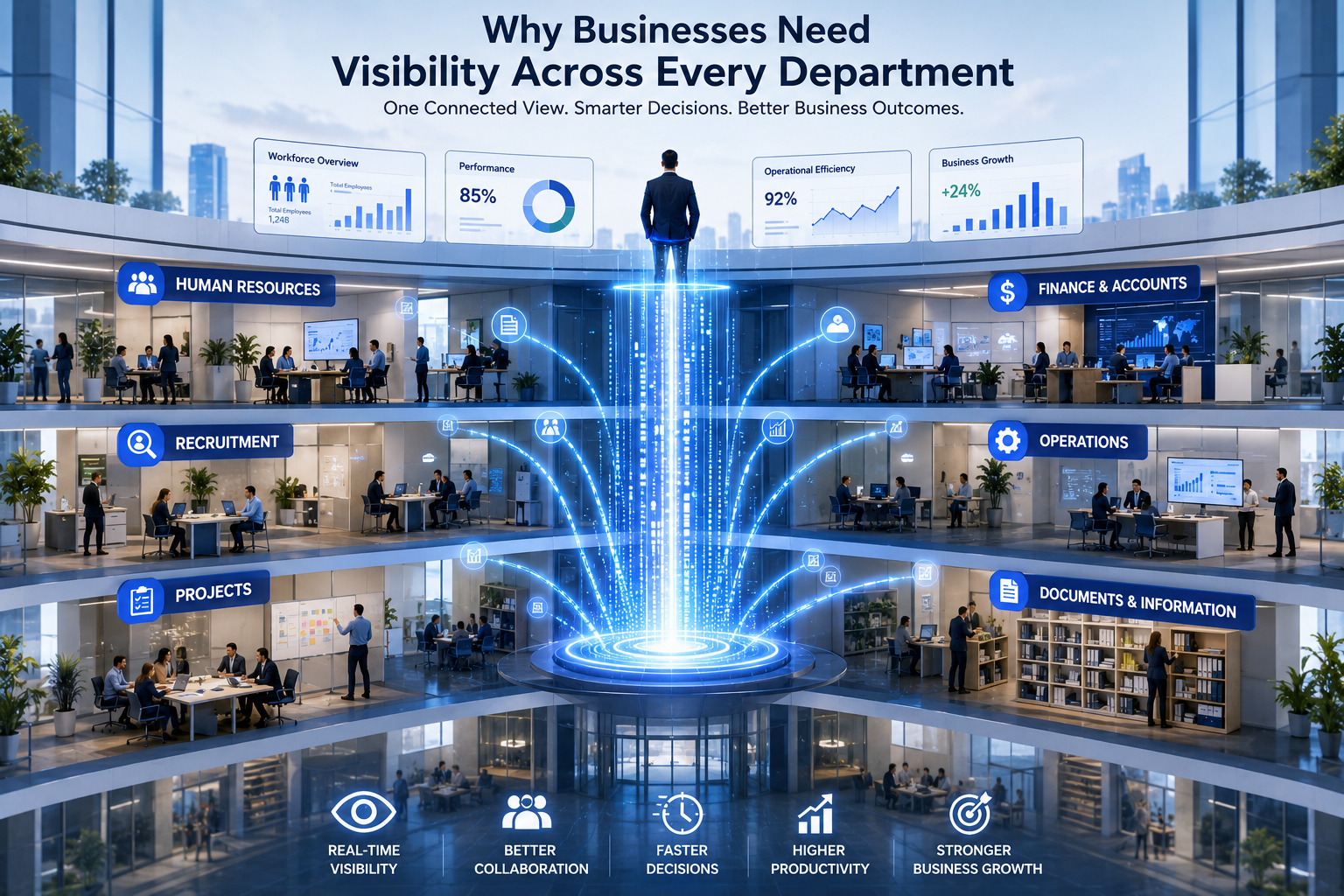
When information remains isolated within individual teams, leaders often find it difficult to gain a complete understanding of what is happening across the organization. Human Resources may have employee data, Finance may manage budgets and expenses, Operations may oversee daily activities, and Project teams may track deliverables. If these departments operate independently without sharing information effectively, decision-making becomes slower, communication becomes fragmented, and opportunities for improvement can be missed.
This is why business visibility has become one of the most important priorities for modern organizations. Businesses need more than reports from individual departments. They need a connected view of the entire organization. They need to understand how different functions interact, where challenges exist, and where opportunities for growth can be found.
Organizations that achieve visibility across every department are often able to make better decisions, improve operational efficiency, strengthen collaboration, and respond more effectively to changing business conditions. In an increasingly competitive marketplace, visibility is no longer just a management tool. It has become a strategic advantage.
Understanding Business Visibility
Business visibility refers to the ability to access, monitor, and understand information across different departments and functions within an organization. It provides leaders and managers with a clear picture of how the organization is performing at any given moment.
Visibility goes beyond simply collecting data. It involves connecting information from different sources and transforming it into meaningful insights that support decision-making.
For example, when workforce information from HR is connected with project data, managers can better understand resource availability. When financial data is connected with operational activities, leaders can evaluate profitability more accurately. When recruitment information is linked with workforce planning, organizations can make more informed hiring decisions.
Business visibility creates a complete view of operations rather than isolated snapshots from individual departments.
Why Departmental Silos Create Challenges
Many organizations experience challenges because information remains trapped within departmental silos. Each team focuses on its own responsibilities and often uses separate systems to manage information.
While these systems may function effectively within individual departments, they can create barriers when information needs to be shared across the organization.
A finance team may not have immediate access to project updates. Project managers may not know workforce availability. HR teams may not have visibility into operational resource requirements.
These disconnects can lead to delays, duplication of effort, and poor decision-making.
Employees often spend valuable time requesting information, searching through multiple systems, and manually combining data from different sources.
As organizations grow, the impact of these silos becomes even more significant.Without visibility, leaders are forced to make decisions based on incomplete information.
The Relationship Between Visibility and Operational Management
Operational management depends on accurate and timely information.Managers need to understand how resources are being used, where bottlenecks exist, and how different activities contribute to business objectives.
Without visibility, operational management becomes reactive rather than proactive.Problems are often discovered only after they have already affected performance.Business visibility changes this dynamic.
When leaders have access to real-time information across departments, they can identify issues earlier and take corrective action before problems escalate.
For example, if a project begins falling behind schedule, managers can immediately review resource availability, workforce allocation, and operational priorities to determine the best course of action.
This ability to respond quickly improves overall efficiency and helps organizations maintain momentum.
Why Visibility Improves Decision-Making
Every business decision relies on information.Whether an organization is planning budgets, hiring employees, launching projects, or evaluating performance, leaders need access to accurate data.
The challenge arises when information is scattered across multiple systems and departments.
Business visibility helps eliminate this challenge by creating a centralized view of organizational activities.
Instead of reviewing separate reports from multiple departments, decision-makers can access connected information that provides a complete picture of the business.
This enables leaders to:
- Make faster decisions based on current information.
- Identify trends and opportunities more effectively.
When decisions are supported by comprehensive data, organizations are more likely to achieve positive outcomes.
The Growing Importance of Workplace Analytics
Workplace analytics plays an increasingly important role in creating visibility.
Modern organizations generate large amounts of information through daily activities. Workforce data, attendance records, project updates, financial transactions, customer interactions, and operational metrics all contribute valuable insights.
Workplace analytics helps transform this information into actionable intelligence.Rather than simply storing data, organizations can analyze patterns, identify trends, and monitor performance across departments.
For example, workplace analytics can reveal:
- Productivity trends across teams.
- Resource utilization patterns.
- Operational bottlenecks.
- Workforce engagement levels.
These insights help leaders make informed decisions and continuously improve organizational performance.
Improving Collaboration Across Departments
Collaboration is essential for modern business success.Projects often require contributions from multiple departments. Customer experiences depend on coordination between teams. Strategic initiatives involve collaboration across the organization.
However, collaboration becomes difficult when information is fragmented.Business visibility helps break down communication barriers by providing access to shared information.
When departments operate with the same information, collaboration becomes more effective.Employees spend less time requesting updates and more time focusing on meaningful work.
This creates stronger alignment between departments and improves overall organizational performance.Connected information leads to connected teams.
How Visibility Enhances Employee Productivity
Employees perform best when they have access to the information they need.Without visibility, workers often waste time searching for data, requesting approvals, or waiting for updates from other departments.
These delays reduce productivity and create frustration.Business visibility improves employee experiences by making information more accessible.
When employees can quickly access relevant data, they can make decisions faster and complete tasks more efficiently.
Productivity increases because time is spent performing valuable work rather than managing information.
Organizations that improve visibility often see measurable improvements in workforce efficiency.
Business Intelligence as a Strategic Tool
Business intelligence is closely connected to visibility.Business intelligence platforms collect, organize, and analyze information from multiple sources.
The goal is to provide leaders with meaningful insights that support strategic decision-making.
With effective business intelligence, organizations can monitor performance across departments in real time.
They can identify opportunities for growth, detect operational challenges, and evaluate business outcomes more effectively.Business intelligence transforms raw data into actionable information.
This capability becomes increasingly valuable as organizations grow and manage more complex operations.
Visibility Supports Organizational Agility
Agility has become a critical business capability.
Markets change rapidly. Customer expectations evolve. Competitive pressures increase.
Organizations need the ability to adapt quickly to changing circumstances.
Business visibility supports agility by providing leaders with timely information.
When managers understand what is happening across departments, they can respond more effectively to new opportunities and challenges.
Instead of relying on outdated reports, leaders can make decisions based on current conditions.This responsiveness helps organizations remain competitive and resilient.
Creating a Connected Organization
Achieving visibility requires more than technology alone.Organizations must create processes and cultures that encourage information sharing and collaboration.
Technology provides the tools, but leadership drives the mindset.
Successful organizations focus on:
- Connecting systems and data sources.
- Encouraging cross-functional collaboration.
When people, processes, and technology work together, visibility becomes a natural part of organizational operations.
The result is a more informed, efficient, and agile business environment.
Conclusion
Business visibility is no longer a luxury reserved for large enterprises. It has become a necessity for organizations of all sizes.
As businesses continue managing increasing amounts of information, leaders need a complete view of operations to make informed decisions, improve efficiency, and support growth.
Visibility across every department enables stronger operational management, more effective workplace analytics, better collaboration, and improved business intelligence.
Organizations that invest in visibility gain a clearer understanding of their operations and are better equipped to respond to change.In a world where information drives success, the organizations with the greatest visibility often gain the greatest advantage.
The future belongs to businesses that can see, understand, and act on information across every department—quickly, accurately, and confidently.