Table of Contents
- How Email Chains Create Delays
- The Problem With Long Email Conversations
- Business Workflow Management Brings Structure to Work
- Better Visibility for Managers
- Reducing Dependency on Individual Employees
- Workflow Management Can Improve Accountability
- The Connection Between Workflow and Workplace Productivity
- When Should a Business Move Beyond Email?
- Creating a Better Digital Workplace
- The Role of Integrated Business Software
- How Businesses Can Start Improving Their Workflows
- Conclusion
https://i-spur.com/mail-lift-information Email is one of the most useful tools in business. It allows employees to communicate with customers, colleagues, vendors, managers, and external partners quickly and professionally. However, as businesses grow, email can gradually become something more than a communication tool. It can become an unofficial system for managing tasks, approvals, documents, requests, follow-ups, and decisions.
An employee sends an email asking for approval, another person replies with a question, someone forwards the conversation to a manager, a document is attached, another version is sent later, and eventually several people are involved in the same conversation. At first, this may seem like a normal way of getting work done. But when hundreds of similar conversations happen every week, email can become difficult to manage.
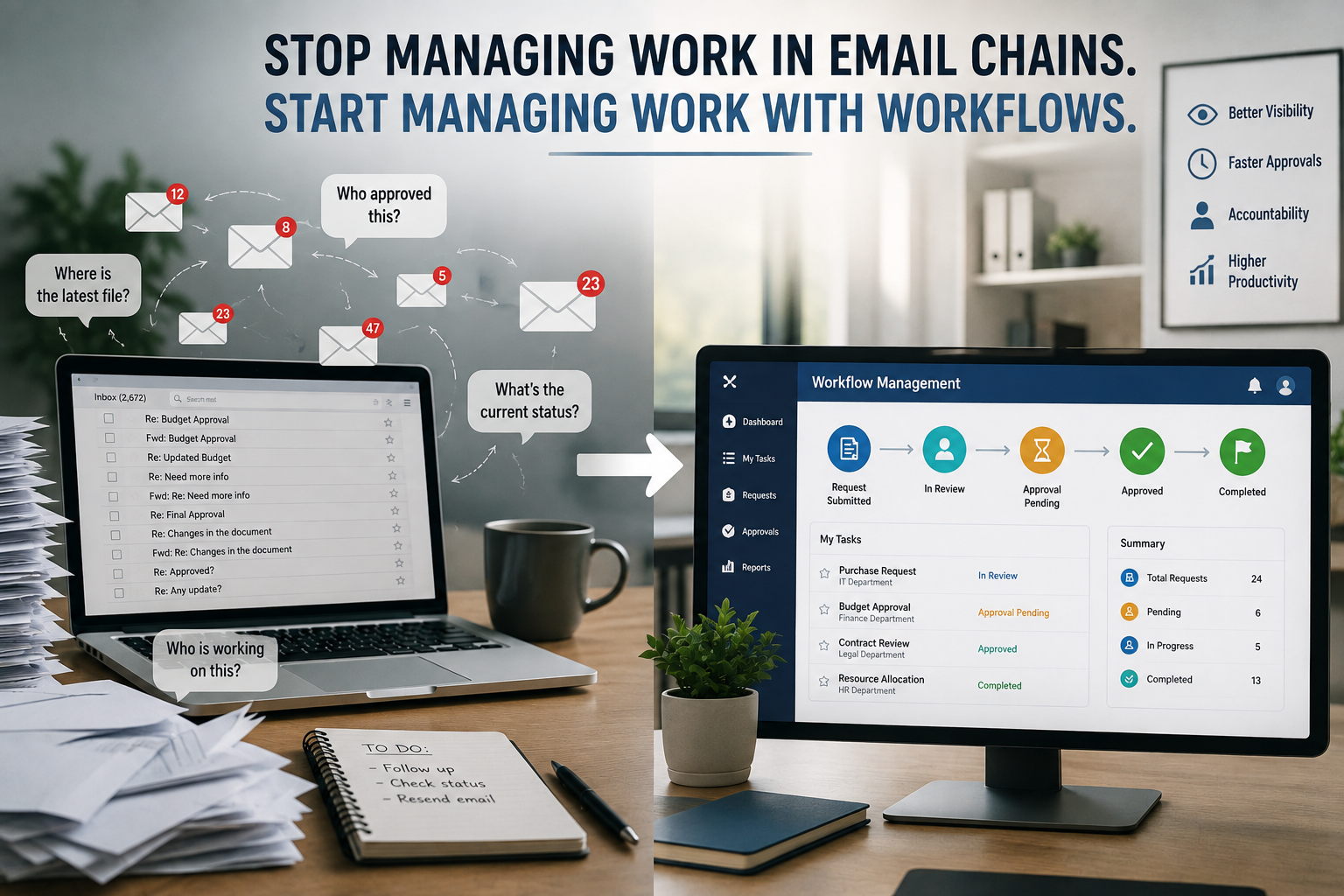
Important requests can get buried under unrelated messages, approvals may be delayed, employees may not know who is responsible for the next step, and managers may have difficulty understanding the current status of a task. This is why businesses need to think beyond email communication and start looking at business workflow management as a separate requirement.
The problem is not that email is bad. The problem is using email for jobs it was never designed to handle. Email is excellent for communication, but it is not always the best environment for managing structured business processes.
A growing company needs to know what has been requested, who is responsible, what stage the request is in, what action is pending, which document is the latest, and whether the process has been completed. When all of this information is buried inside long email chains, employees have to manually interpret the conversation before they can understand the work.
That creates unnecessary effort and makes business operations dependent on individual attention. A more structured digital workplace can separate communication from workflow management, allowing employees to communicate when needed while using dedicated processes for tasks, approvals, requests, and follow-ups.
The Hidden Cost of Email-Based WorkflowsMany businesses do not realize how much time they lose through email-based processes because the wasted time is spread across hundreds of small activities.
An employee may spend five minutes searching for an approval email, another employee may spend ten minutes finding the correct attachment, and a manager may spend several minutes reading an entire conversation simply to understand what decision is required. None of these activities looks expensive on its own, but when repeated every day across an organization, they become a productivity problem.
Consider something as simple as requesting a purchase approval. An employee sends the request to a manager. The manager asks for additional information. The employee replies.
The manager forwards the conversation to Finance. Finance asks another question. Someone sends a revised document. The manager approves it in another email. A week later, someone needs to confirm whether the request was actually approved.
They search through email and find several related conversations. Now the business is spending time reconstructing the history of a process that should have been straightforward.
A structured workflow can make the same process much easier to understand. The request can be submitted through a defined process, the responsible person can be notified, required information can be captured, approval can be recorded, and the status can be visible to authorized users. Instead of searching through communication history, employees can look at the current state of the request.
How Email Chains Create Delays
https://i-spur.com/mail-lift-information Email-based workflows often depend on people noticing messages at the right time. If someone misses an email, is on leave, has a crowded inbox, or does not realize that an action is waiting for them, the entire process may slow down.This creates a dependency that is easy to overlook.
Imagine a five-step approval process where each step depends on one person responding to an email. If the third person misses the message, the fourth and fifth steps cannot begin. The process effectively stops even though the business itself is ready to continue.
A structured workflow can make pending actions more visible. Instead of relying entirely on someone remembering an email, the system can show outstanding tasks, pending approvals, assigned responsibilities, and workflow status.This creates greater visibility and reduces the chance that important work will disappear inside an inbox.
The Problem With Long Email Conversations
Long email conversations are difficult to manage because they contain both useful and unnecessary information. A conversation may include several questions, replies, attachments, explanations, forwarded messages, and unrelated comments.
When someone joins the conversation later, they may need to read through the entire chain before understanding the current situation.This is particularly difficult for managers.
A manager should ideally be able to understand the current status of an important request quickly. If the information is buried inside a long email chain, the manager may have to spend unnecessary time reconstructing the context.
A structured business workflow provides a clearer picture. Instead of reading twenty emails, the manager can see the request, relevant information, current status, previous actions, and required decision in one place.
This does not eliminate communication. It makes communication more useful by connecting it to the work being managed.
Business Workflow Management Brings Structure to Work
Business workflow management is about creating a structured sequence through which work moves from one stage to another. The workflow can define responsibilities, approvals, actions, deadlines, and outcomes.For example, a simple internal request could follow this pattern:
Request Created → Review → Approval → Processing → Completion
Each stage has a clear purpose. The employee knows what happens next, and the responsible person knows what action is expected.This structure becomes particularly useful when a business has repeated processes.
If employees regularly handle the same type of request, there is little reason to recreate the process manually through email every time.Workflow management allows businesses to establish repeatable processes that employees can follow consistently.
Better Visibility for Managers
Managers are often responsible for multiple teams and projects at the same time. They cannot realistically read every email conversation involving their departments.A structured workflow environment gives managers a higher-level view of work.
They can potentially understand:
- Which requests are pending.
- Which tasks require attention.
- Where approvals are delayed.
- Which processes have been completed.
- Which activities are approaching deadlines.
- Where bottlenecks are developing.
This changes management from reactive follow-up to proactive oversight.Instead of asking employees individually for status updates, managers can use workflow information to identify where attention is actually required.
That can improve productivity across the organization because employees spend less time preparing manual status updates while managers receive more structured information.
Reducing Dependency on Individual Employees
Another weakness of email-driven processes is that important information can become attached to individual inboxes. An employee may know the complete history of a request because they were included in every email.
If another employee needs to take over, they may struggle to understand what has happened.This creates a form of organizational dependency.A structured workflow keeps process information associated with the work rather than relying entirely on one person's inbox.
This becomes valuable when employees:
- Change departments.
- Take extended leave.
- Move into new roles.
- Leave the organization.
- Transfer responsibilities to another team.
Business continuity becomes easier when work has a clear structure and history that authorized employees can understand.
Workflow Management Can Improve Accountability
When work is managed through email, accountability can sometimes become unclear. Several people may be copied on an email, but being copied does not necessarily mean someone owns the task.
A structured workflow can assign responsibility more clearly.If a task is assigned to a particular employee, that person understands that action is required.
If approval belongs to a manager, the workflow can reflect that responsibility. If another department needs to process the request afterward, the next stage can be clearly defined.
This creates a stronger sense of ownership.Employees do not have to guess whether someone else is handling the request, and managers can identify where work is currently waiting.
The Connection Between Workflow and Workplace Productivity
Workplace productivity is often discussed in terms of employee performance, but the systems surrounding employees also influence how productive they can be.
An employee can be highly capable and motivated but still lose time if the organization requires them to search through emails, manually request information, wait for unclear approvals, or repeatedly follow up with colleagues.
A better workflow removes some of these obstacles.This is why businesses should look at productivity from two perspectives:
Individual productivity — how effectively employees perform their responsibilities.
Operational productivity — how effectively the organization's processes allow employees to perform those responsibilities.A strong digital workplace supports both.
When Should a Business Move Beyond Email?
Not every business activity needs a dedicated workflow. Employees will always need email for communication, external correspondence, discussions, and many other purposes.
However, businesses should consider structured workflow management when a process involves repeated steps, multiple people, approvals, deadlines, or important records.
Common examples include:
- Leave and employee requests.
- Purchase approvals.
- Expense submissions.
- Document approvals.
- Project task assignments.
- Internal service requests.
- Customer issue escalation.
- Recruitment processes.
- Administrative approvals.
- Departmental requests.
If employees repeatedly say, “I sent an email, but I don't know what happened next,” the process may need more structure.
Creating a Better Digital Workplace
A modern digital workplace should not simply provide employees with more applications. It should help them complete work with less unnecessary friction.
This means businesses need to think about how communication, documents, tasks, approvals, employee information, and other activities work together.Email can remain an important communication channel while dedicated systems handle structured work.
For example:
Email → Communication
Workflow → Process
Document management → Information
Task management → Responsibility
Analytics → Visibility
When these functions are clearly defined and connected where appropriate, employees have a better understanding of where work belongs.
The Role of Integrated Business Software
As organizations grow, they often adopt separate applications for different departments. While specialized tools can be useful, too many disconnected systems can create another problem: employees have to move between multiple platforms to complete simple activities.
Integrated business software can help reduce this fragmentation by bringing related business functions into a more connected environment.
For an organization, the goal should not necessarily be to eliminate every separate application. Instead, businesses should identify where integration can reduce repetitive data entry, duplicated information, and unnecessary switching between systems.A connected environment can help employees move from communication to action without losing context.
How Businesses Can Start Improving Their Workflows
Businesses do not need to automate every process immediately. A practical starting point is to identify processes that create frequent delays or require significant manual follow-up.
Ask employees which tasks they regularly manage through email. Look for processes where multiple people are involved and where the current status is difficult to determine.Then identify the steps involved.
For example:
Current process:
Email request → Reply → Forward → Question → Reply → Approval email → Follow-up → Completion
Improved process:
Request → Review → Approval → Processing → Completion
The second process is easier to understand because responsibility and progress are visible.Businesses can gradually introduce workflow management where it creates the greatest operational benefit.
Conclusion
https://i-spur.com/mail-lift-information Email will continue to be an important part of business communication, but businesses should be careful about turning their inboxes into unofficial workflow systems.
As organizations grow, email chains can become difficult to track, approvals can be delayed, responsibilities can become unclear, and employees can spend significant amounts of time searching for information or following up on requests.
A structured approach to business workflow management creates a better way to handle repeated processes. It gives work a defined path, makes responsibilities clearer, improves visibility, supports accountability, and reduces unnecessary manual coordination.
The goal is not to eliminate email. The goal is to use the right tool for the right job.Email is excellent for conversations.Workflows are better for structured processes.
Documents are better managed through organized document systems.Tasks need clear ownership.And managers need visibility into progress.
When these elements work together inside a modern digital workplace, businesses can reduce operational friction and create an environment where employees spend less time managing the process of work and more time actually doing the work.
For growing companies, that difference can become significant. A process that saves five minutes for one employee may save hours across a department. A workflow that prevents one missed approval can keep an entire project moving.
A clear task assignment can eliminate unnecessary follow-ups. Small improvements in how work moves through an organization can eventually create a much larger improvement in overall efficiency.
Businesses do not need more email chains. They need clearer ways to move work forward.That is where structured workflow management and connected enterprise software can make a real difference.