Why Every Business Needs a Single Source of Truth
Every business depends on information. From employee records and customer details to financial reports, project updates, sales information, documents, approvals, and operational data, information is involved in almost every decision an organization makes. As a business grows, however, managing this information becomes increasingly difficult. Data starts appearing in different spreadsheets, email conversations, individual folders, software applications, shared drives, and departmental systems. One team may have one version of a customer record while another department has completely different information. Finance may be working with one set of numbers while management is looking at another. HR may update an employee record while another system continues to show old information.
This creates a problem that many growing businesses do not notice immediately: people are working with different versions of the truth.
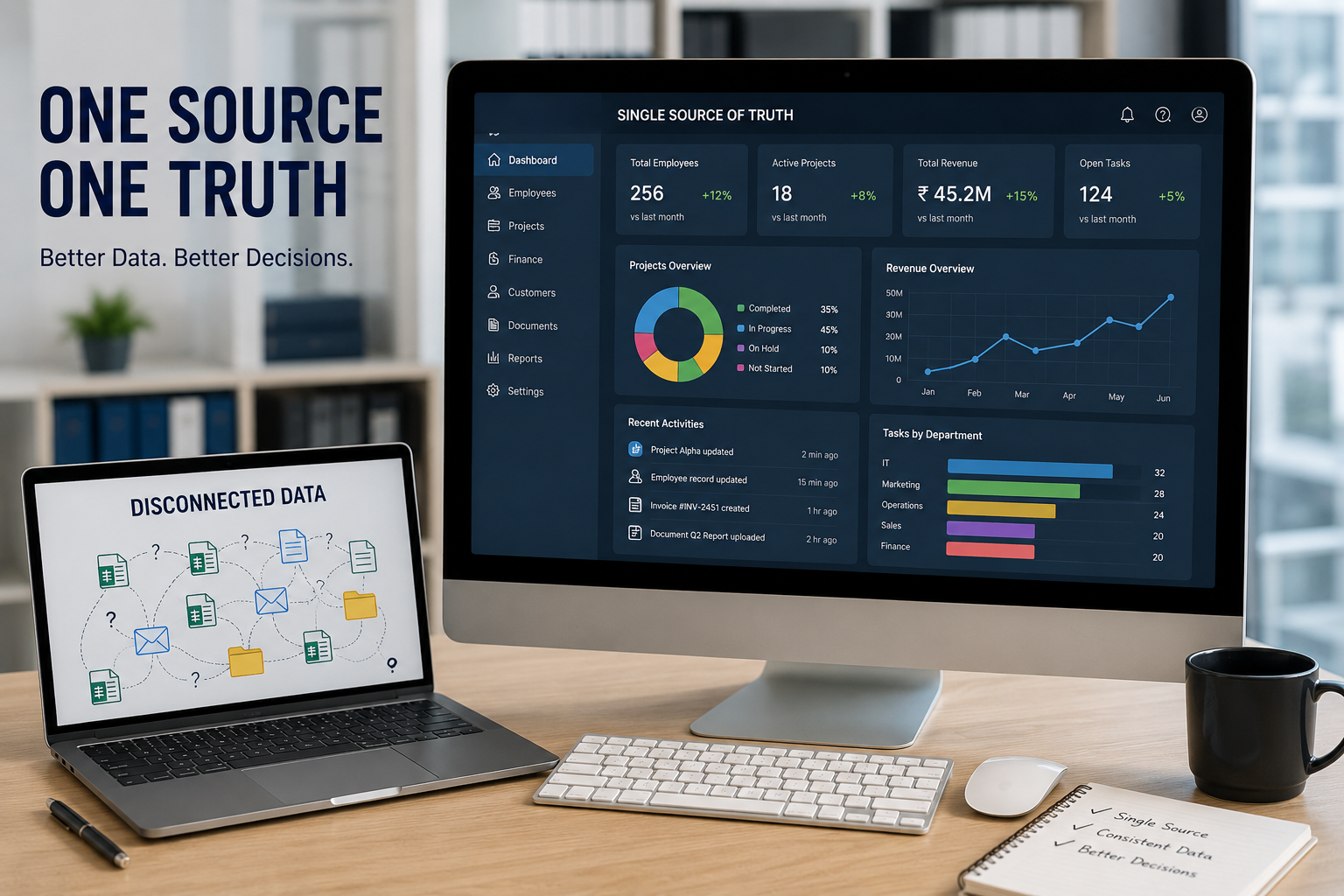
A single source of truth provides a solution to this problem. It means creating one reliable and centralized place where important business information can be stored, maintained, accessed, and used by authorized people. Instead of employees searching through different systems to find the information they need, they can work from a trusted source. This does not necessarily mean putting every piece of information into one physical database. Rather, it means establishing a reliable information structure where employees know where the correct information lives and which source should be trusted.
The importance of a single source of truth becomes even greater as organizations become more digital. Businesses today may use separate tools for HR, finance, documents, projects, communication, customer management, recruitment, and reporting. Each system can be useful on its own, but disconnected information can create unnecessary complexity. The goal is not simply to collect more data. The goal is to make the right information available to the right people at the right time.
When businesses establish centralized data and reliable information processes, employees can make decisions with greater confidence, departments can collaborate more effectively, and management can gain a clearer understanding of what is happening across the organization.
Why Businesses Struggle With Disconnected Information
Information rarely becomes disconnected overnight. It usually happens gradually.
A company starts with a spreadsheet. Later, another department creates its own spreadsheet. An employee creates a separate document because the original file is difficult to access. Someone sends updated information through email. Another employee downloads a copy and makes changes locally.Over time, multiple versions begin to exist.
This can create problems such as:
- Duplicate information across departments.
- Outdated records being used for decisions.
- Employees spending time searching for information.
- Different departments reporting different numbers.
- Repeated data entry.
- Difficulty tracking changes.
- Delays in decision-making.
- Increased risk of human error.
The problem becomes especially serious when employees do not know which source should be trusted.
The Cost of Having Multiple Versions of the Truth
Businesses often think of data problems as technical issues, but they can have direct operational and financial consequences.Suppose a manager asks for the current number of employees. HR has one spreadsheet, Finance has another, and an older report contains a third number. Before management can even begin using the information, someone has to determine which number is correct.
That requires time.Now imagine the same situation happening with sales figures, project budgets, customer records, invoices, inventory information, or employee attendance.The time spent checking, comparing, correcting, and reconciling information can become significant.Employees may spend hours each week performing tasks that exist only because information is fragmented.A centralized information approach reduces this unnecessary effort.
Centralized Data Creates Better Business Visibility
One of the biggest benefits of a single source of truth is improved visibility.Management needs to understand what is happening across the organization. They need to know whether projects are progressing, whether employees have completed important tasks, whether financial activities are on track, and whether departments are meeting their objectives.When information is scattered, gaining this visibility becomes difficult.
Centralized data makes information easier to organize and access.Instead of asking multiple departments to prepare separate reports, management can work with information that is maintained through structured systems and processes.This creates a clearer view of the organization.
Improving Decision-Making
Business decisions are only as reliable as the information behind them.A manager deciding whether to increase a project budget needs accurate financial information. A department planning recruitment needs current employee information. A leadership team reviewing performance needs reliable business data.
If the information is outdated or inconsistent, the decision may also be incorrect.A single source of truth gives decision-makers greater confidence because they know where the information comes from.This is particularly valuable for important decisions where inaccurate information can have a larger impact.
The Role of Business Intelligence
Business intelligence depends heavily on reliable information.Business intelligence involves turning business data into useful insights that help organizations understand performance and make better decisions.However, business intelligence becomes difficult when the underlying information is inconsistent.
If three departments use different definitions for the same metric, a dashboard may present numbers that appear accurate but do not actually represent the same thing.
Centralized and properly managed information provides a stronger foundation for business intelligence.When data is organized and consistent, businesses can analyze it more effectively and identify meaningful patterns.
Supporting Better Collaboration
Departments rarely operate completely independently.HR works with Finance.Finance works with Procurement.Projects work with Finance and Operations.Management depends on information from almost every department.When each department maintains separate information, collaboration becomes slower.
Employees may need to request information repeatedly.They may need to send updated files.They may need to confirm whether the information they received is still current.A single source of truth reduces these communication gaps.
Authorized employees can access the information they need without constantly requesting separate copies.This creates a more connected workplace.
Reducing Duplicate Data Entry
Repeated data entry is another major problem created by disconnected systems.An employee's information may need to be entered into multiple spreadsheets or applications.A customer detail may be recorded by Sales and then manually entered by another department.A project update may be copied from one report into another.
Every additional manual entry creates another opportunity for an error.Centralized data reduces unnecessary duplication by giving employees a common information source.Instead of repeatedly recreating the same information, employees can work with existing records.This saves time and improves accuracy.
Keeping Information Current
Information becomes less useful when it is outdated.A customer address may have changed.An employee may have moved departments.A project deadline may have been updated.A budget may have been revised.A contract may have received a new version.
If employees continue using old copies, they may unknowingly make decisions based on information that is no longer correct.A centralized approach makes it easier to maintain current information.When the authorized source is updated, employees know where to find the latest information.This is one of the most practical advantages of having a single source of truth.
Creating Accountability
Reliable information management also improves accountability.When business information is maintained through structured systems, organizations can better understand who created, updated, reviewed, or approved information.This is particularly important for documents, financial information, employee records, approvals, and other business-critical data.Instead of relying on memory or searching through email conversations, organizations can maintain a clearer record of information activity.This helps create greater transparency.
Improving Employee Productivity
Employees should spend their working hours solving business problems, serving customers, managing projects, and completing meaningful tasks.They should not spend a large part of their day searching for information.Yet information searching can consume significant time.
Employees may search email inboxes, shared folders, spreadsheets, messaging applications, and old documents before finding what they need.A centralized information approach reduces this friction.When employees know where reliable information is maintained, they can find it faster.This creates a more productive workplace.
Supporting Faster Approvals
Many business activities require approvals.Expenses, purchases, documents, leave requests, contracts, project changes, and financial transactions may all require different levels of authorization.Approvals can become slow when the information required to make a decision is scattered across different systems.
A manager may need to request additional information before approving a task.Centralized information makes the approval process easier because the relevant information can be available when the request reaches the decision-maker.This helps reduce unnecessary back-and-forth communication.
Strengthening Business Continuity
Businesses should not depend on one employee's personal knowledge or individual files.If an employee leaves, becomes unavailable, or changes roles, the organization should still be able to access important information.
Centralized information management helps protect organizational knowledge.Important records remain part of the business rather than remaining trapped inside individual computers, email accounts, or personal folders.This makes the organization more resilient.
Supporting Business Growth
The need for a single source of truth becomes more important as a business grows.A small company may be able to manage information informally because only a few employees are involved.As the company expands, more employees create and use information.
More departments become involved.More customers and projects are added.More documents are created.More decisions need to be made.Without structured information management, complexity grows rapidly.A centralized approach provides a foundation that can scale with the organization.
Security and Controlled Access
Centralized information does not mean everyone should have access to everything.Business information often needs different levels of protection.Employees may need access only to information relevant to their responsibilities.Managers may require additional access.Certain financial, HR, legal, or confidential documents may need restricted permissions.
A well-designed information management system can combine centralized information with role-based access.This allows businesses to maintain one trusted source while still protecting sensitive information.
How to Build a Single Source of Truth
Businesses do not need to transform everything overnight.A practical approach starts with identifying the information that is most important to daily operations.The organization can then determine where that information currently exists and identify duplicate or outdated sources.
The next step is to establish the authoritative source for each major information category.Businesses should also define ownership.Someone should be responsible for ensuring that important information remains accurate and up to date.
Finally, employees should understand where they should find information and how they are expected to maintain it.
Key Principles for Creating a Reliable Information Environment
A successful single-source-of-truth strategy should focus on a few important principles:
- Centralize important information so employees know where reliable records are maintained.
- Define information ownership so someone is responsible for maintaining accuracy.
- Control access so employees can access the information they need without exposing sensitive data.
- Reduce duplication by avoiding unnecessary copies of the same information.
- Maintain current records so decisions are based on reliable information.
- Connect business workflows so information can move efficiently between departments.
- Use reporting and analytics to turn reliable data into useful business insights.
Creating a More Connected Digital Workplace
A single source of truth becomes even more powerful when it is part of a connected digital workplace.Employees should not have to think about where every piece of information exists before they can complete their work.Business systems should support the movement of information between processes.
For example, an employee record may support HR processes, attendance, payroll, documents, and reporting. A project record may connect tasks, documents, approvals, and financial information.
When these systems are organized around reliable information, businesses can create smoother workflows.This is where centralized data and business automation can work together.
Why the Single Source of Truth Matters for the Future
Businesses are becoming increasingly dependent on information.Customers expect faster responses.Employees expect easy access to the information they need.Managers expect real-time visibility.Leadership expects reliable reports.As organizations become more digital, fragmented information becomes increasingly difficult to manage.
Businesses that establish reliable information systems can respond faster because they spend less time finding and validating information.They can make decisions with greater confidence.They can collaborate more effectively.They can scale operations more smoothly.Most importantly, they can build a workplace where information supports employees instead of becoming an obstacle.
Conclusion
Every business creates enormous amounts of information. The challenge is not simply creating or collecting that information. The real challenge is ensuring that employees can trust it, access it, understand it, and use it effectively.
When information is spread across spreadsheets, emails, personal folders, disconnected applications, and outdated documents, employees can easily end up working with different versions of the same reality. This creates confusion, slows decisions, increases errors, and makes collaboration more difficult.A single source of truth provides a better approach.
By establishing reliable and centralized information sources, businesses can reduce duplication, improve collaboration, strengthen accountability, and make information easier to access. Employees spend less time searching for the correct record and more time focusing on meaningful work. Managers gain better visibility, while leadership can make decisions using information they can trust.
The value of centralized data also extends beyond everyday productivity. It creates the foundation for effective business intelligence, allowing organizations to turn reliable information into useful insights. When data is accurate and consistently managed, businesses can identify trends, understand performance, recognize bottlenecks, and make better strategic decisions.
A single source of truth does not mean that every department must abandon specialized systems. Instead, it means creating a clear information structure where every important type of business information has a trusted source, defined ownership, appropriate access controls, and reliable processes for maintaining it.
Ultimately, businesses should not have to waste time asking, “Which information is correct?”
They should be able to focus on the much more valuable question:
“What can we do with the information we already have?”
That is the real power of a single source of truth. It transforms scattered information into a reliable business foundation—helping organizations work faster, collaborate better, make smarter decisions, and build a stronger path toward sustainable growth.