
Table of Contents
- Why Every Growing Business Needs a Digital Document Lifecycle
- Understanding the Digital Document Lifecycle
- Why Traditional Document Management No Longer Works
- The Challenges of Managing Large Volumes of Business Documents
- What Is Document Lifecycle Management?
- How a Document Management System Supports Business Growth
- Creating Documents More Efficiently
- Streamlining Reviews and Approvals
- Improving Security for Digital Documents
- Supporting Compliance Requirements
- Better Collaboration Across Departments
- Supporting Remote and Hybrid Work
- Business Benefits of a Digital Document Lifecycle
- Preparing for the Future
- Conclusion
Why Every Growing Business Needs a Digital Document Lifecycle
Every business runs on documents. From employee records and customer agreements to invoices, purchase orders, contracts, compliance reports, policies, and project files, documents play a vital role in almost every business activity. As organizations grow, the number of documents they create, receive, and manage increases rapidly. What starts as a few folders and spreadsheets can quickly turn into thousands of files spread across computers, emails, cloud drives, and filing cabinets.
Many businesses do not realize how much time employees spend searching for documents, requesting the latest versions, waiting for approvals, or recreating files that cannot be found. These seemingly small inefficiencies gradually become major operational challenges. Important documents may be stored in multiple locations, outdated versions may be shared with clients, confidential files may be accessed by unauthorized employees, and valuable business information may become difficult to retrieve when it is needed most.
In today's digital business environment, documents are no longer just records. They are valuable business assets that support daily operations, decision-making, compliance, customer relationships, and long-term growth. Managing them efficiently has become just as important as managing employees, finances, or projects.
This is why more organizations are adopting a digital document lifecycle instead of relying on traditional file storage methods. A digital document lifecycle ensures that every business document follows a structured process from creation to archival. Rather than simply storing files, organizations manage how documents are created, reviewed, approved, shared, updated, secured, and eventually archived or deleted.
Combined with a modern document management system, a digital document lifecycle helps businesses improve productivity, strengthen security, reduce errors, and ensure that employees always have access to accurate and up-to-date information.
As companies continue to embrace digital transformation, document lifecycle management is becoming one of the most important foundations for building efficient and scalable business operations.
Understanding the Digital Document Lifecycle
A document does much more than exist as a file stored on a computer. Every document goes through several stages during its lifetime.
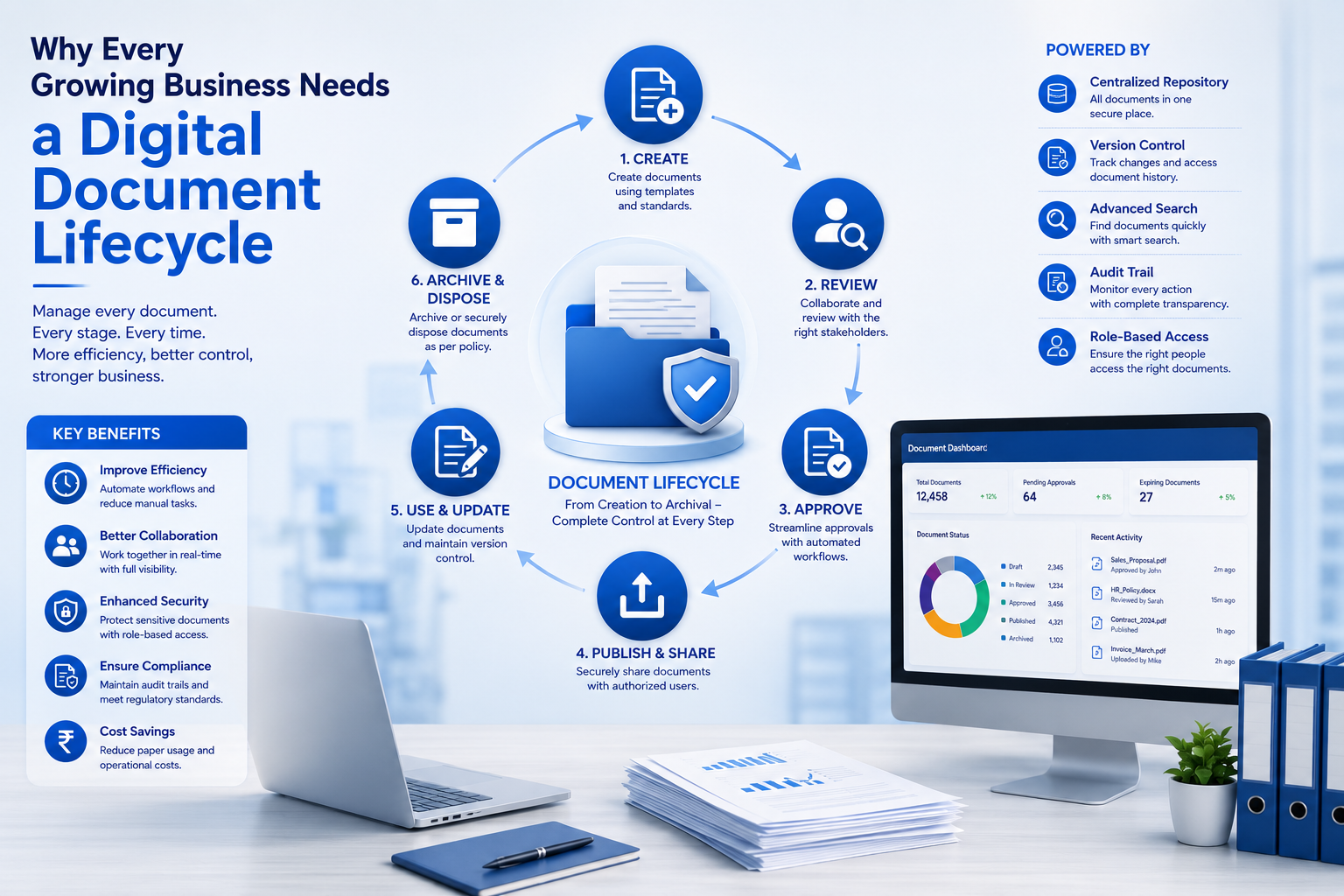
It begins when someone creates it. The document is then reviewed, approved, shared with different departments, updated multiple times, and eventually archived once it is no longer actively used.This complete journey is known as the document lifecycle.
Traditionally, many businesses managed these stages manually. Employees created files, emailed them for approval, saved multiple versions on different computers, and eventually stored old files in folders that were rarely organized properly.
As organizations expanded, this approach became increasingly difficult to manage.A digital document lifecycle introduces structure into this process.
Every document follows predefined workflows that ensure consistency, security, and accountability throughout its entire lifecycle.
Why Traditional Document Management No Longer Works
Many growing businesses continue using shared folders, email attachments, USB drives, or paper files to manage business documents.
While these methods may appear simple, they create significant operational risks.
Employees often struggle to determine which version of a document is the latest. Important contracts become buried in long email conversations. Approval processes are delayed because documents are manually forwarded between departments.
As businesses hire more employees and expand operations, these problems become even more noticeable.Documents become scattered across multiple locations.
Searching for information takes longer.Duplicate files increase.Confidential information becomes difficult to protect.
Without a structured system, organizations gradually lose control over one of their most valuable business resources.
The Challenges of Managing Large Volumes of Business Documents
Growing organizations create thousands of documents every year.These include employee files, payroll records, invoices, vendor agreements, customer contracts, compliance reports, project documentation, policies, proposals, technical manuals, and operational procedures.
Managing such large volumes manually is both time-consuming and inefficient.
Employees frequently encounter problems such as:
- Difficulty locating the correct document.
- Multiple versions of the same file.
- Delayed approvals.
- Unauthorized document access.
These challenges reduce productivity and increase operational risks.Instead of supporting business growth, poorly managed documents become obstacles to efficiency.
What Is Document Lifecycle Management?
Document lifecycle management is the process of controlling every stage of a document's journey from creation to final disposal.Rather than simply storing files, organizations establish clear processes for managing documents throughout their entire lifecycle.
This includes:
- Creating documents using standardized templates.
- Reviewing and approving content.
- Maintaining version history.
- Controlling access permissions.
- Tracking changes.
- Archiving outdated files securely.
Each stage is managed consistently, reducing confusion while improving collaboration.Document lifecycle management ensures that every employee works with accurate and approved information.
How a Document Management System Supports Business Growth
A document management system serves as the foundation for digital document lifecycle management.Instead of storing files across multiple locations, all documents are organized within one secure platform.
Employees can quickly search for information, collaborate on documents, monitor approval status, and retrieve historical versions whenever needed.This centralized approach significantly improves efficiency.
Rather than asking colleagues to send files repeatedly, employees can access the latest approved version immediately.Managers gain visibility into document activity, while administrators maintain control over security and permissions.The result is a more organized and productive workplace.
Creating Documents More Efficiently
Every business creates documents every day.Employment letters, invoices, proposals, purchase requests, reports, meeting minutes, project documentation, and policies all begin with document creation.
Without standardized processes, different employees often create documents in different formats.This inconsistency creates confusion and affects professionalism.
A digital document lifecycle encourages organizations to use standardized templates and workflows.
Employees spend less time formatting documents and more time focusing on content.Consistency improves across the organization.
Streamlining Reviews and Approvals
Document approvals often become one of the biggest causes of business delays.A contract may require review by Legal, Finance, and Management before it can be finalized.
Without automation, documents move manually through emails and messaging applications.Approvals become difficult to track.
Employees spend valuable time following up.A digital document lifecycle automates this process.
Documents move automatically between reviewers according to predefined workflows.Notifications keep stakeholders informed.
Managers can approve documents from anywhere.Every approval is recorded for future reference.The process becomes faster, more transparent, and easier to manage.
Improving Security for Digital Documents
Business documents often contain sensitive information.Employee records, financial statements, contracts, customer information, and confidential business strategies require strong protection.
Traditional storage methods make it difficult to control who can access specific documents.
Digital document lifecycle management improves security through role-based permissions.Employees only access documents relevant to their responsibilities.
Sensitive files remain protected.Every document activity can be tracked.Organizations maintain greater control over confidential information.
Supporting Compliance Requirements
Many industries require businesses to maintain accurate records for legal and regulatory purposes.Documents must often be retained for specific periods and protected from unauthorized changes.
Manual document storage makes compliance difficult.Organizations may struggle to demonstrate document history during audits.
A document management system automatically records document activities, approvals, edits, and access history.These audit trails simplify compliance while improving accountability.Organizations become better prepared for internal and external audits.
Better Collaboration Across Departments
Modern business depends on collaboration.HR, Finance, Projects, Procurement, Legal, and Operations frequently work together on shared documents.
Without centralized document management, collaboration becomes slow and inefficient.Employees send multiple email attachments, creating duplicate files and communication delays.
Digital document lifecycle management allows authorized employees to work from the same document.Everyone accesses current information.
Teams collaborate more effectively without creating unnecessary duplicates.Communication improves across departments.
Supporting Remote and Hybrid Work
Today's workforce is increasingly mobile.Employees work from offices, homes, customer locations, and different cities.
Paper documents and local file storage no longer support these flexible work environments.
Digital document management allows authorized employees to securely access business documents from anywhere.Work continues without interruption.
Managers approve documents remotely.Projects move forward regardless of employee location.Organizations become more flexible while maintaining security.
Business Benefits of a Digital Document Lifecycle
Organizations implementing document lifecycle management often experience measurable improvements throughout their operations.
Some of the most valuable benefits include:
- Faster document creation, approvals, and retrieval.
- Better collaboration between departments.
- Stronger security through controlled access permissions.
- Improved compliance with complete audit history.
- Reduced document duplication and version confusion.
These improvements create more efficient workflows while supporting long-term business growth.
Preparing for the Future
As businesses continue adopting Artificial Intelligence, workflow automation, cloud platforms, and digital transformation strategies, document management will become even more important.Future technologies depend on accurate, well-organized information.
Organizations that establish strong document lifecycle processes today will be better prepared for automation, business intelligence, and advanced digital workflows tomorrow.Digital documents are no longer simply electronic files.
They are strategic business assets that drive operational efficiency and organizational knowledge.
Conclusion
https://i-spur.com/link-bridge Every growing business eventually reaches a point where traditional document management methods are no longer sufficient. As document volumes increase, manual storage, scattered folders, and email attachments create delays, confusion, security risks, and compliance challenges.
A digital document lifecycle provides a structured approach to managing business documents from creation to archival. Combined with a modern document management system, organizations gain better control, stronger security, improved collaboration, faster approvals, and greater operational efficiency.
Instead of searching for files, correcting version conflicts, or managing scattered documents, employees can focus on meaningful work that supports business growth.
Organizations that invest in document lifecycle management are not simply organizing files—they are building a smarter, more connected workplace where information is accurate, accessible, secure, and ready to support better business decisions.
In the digital age, every successful business depends on reliable information. Managing that information effectively begins with a well-designed digital document lifecycle.