Table of Contents
- Why Every Growing Company Needs a Centralized Employee Information System
- What Is a Centralized Employee Information System?
- Why Employee Information Becomes Difficult to Manage
- The Problems with Traditional Employee Record Management
- Why HR Data Management Matters
- One Employee Record for Every Department
- Simplifying Employee Onboarding
- Better Employee Records Management
- Supporting Payroll Accuracy
- Improving Data Security
- Easier Compliance and Audit Preparation
- Better Workforce Planning
- Supporting Hybrid and Remote Work
- Improving Employee Experience
- Business Benefits of a Centralized Employee Information System
- Preparing for the Future
- Final Thoughts
Why Every Growing Company Needs a Centralized Employee Information System
People are the foundation of every successful business. No matter the industry or the size of an organization, employees drive productivity, innovation, customer satisfaction, and business growth. As a company expands, however, managing employee information becomes increasingly complex. What may have started as a few spreadsheets or paper files quickly grows into hundreds or even thousands of employee records, contracts, attendance logs, payroll details, performance reviews, compliance documents, training certificates, and personal information. Without a structured system to manage all this information, even the most organized HR department can struggle to keep everything accurate and accessible.
Many growing businesses still rely on a combination of spreadsheets, shared folders, email attachments, and paper documents to store employee information. While these methods may appear manageable in the early stages of a business, they often create serious challenges over time. Employee records become scattered across multiple locations, different departments maintain separate copies of the same information, outdated documents continue circulating, and HR teams spend valuable hours searching for files or updating records manually. These small inefficiencies accumulate every day, reducing productivity and increasing the risk of costly mistakes.
Imagine an HR executive trying to process payroll while attendance records are stored in one system, leave balances in another, employee bank details in spreadsheets, and employment documents inside email attachments. Every payroll cycle requires collecting information from multiple sources, verifying accuracy, and manually updating data. The process becomes time-consuming, stressful, and vulnerable to human error. A single incorrect employee record can affect payroll, compliance, reporting, and employee satisfaction.
As organizations continue to grow, these challenges extend beyond Human Resources. Finance teams require accurate employee information for payroll and reimbursements. Managers need updated employee profiles for performance reviews and project planning. Compliance officers depend on accurate documentation during audits. Leadership teams require reliable workforce data to make strategic business decisions. When information is spread across disconnected systems, every department experiences delays and inconsistencies.
This is why modern organizations are adopting a Centralized Employee Information System. Instead of storing employee data in multiple places, all workforce information is managed through a single secure platform. Employee records become easier to maintain, information remains consistent across departments, and HR teams can focus on strategic initiatives instead of administrative work.
A centralized employee information system is much more than a digital filing cabinet. It serves as the foundation of effective employee records management, HR data management, and digital employee records, helping businesses improve efficiency, strengthen security, support compliance, and prepare for long-term growth.
What Is a Centralized Employee Information System?
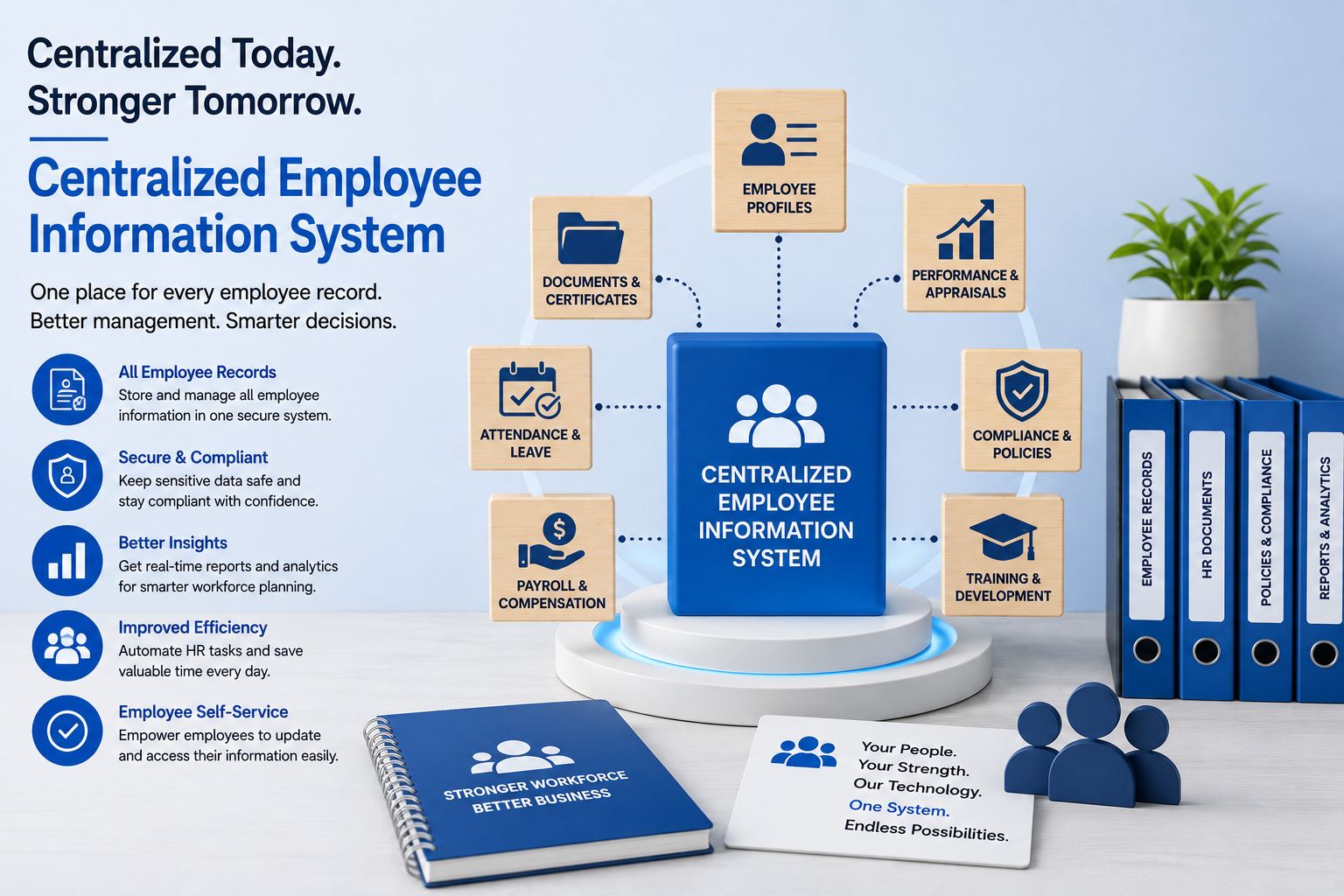
A centralized employee information system is a digital platform that stores, manages, and organizes all employee-related information in one secure location.
Instead of maintaining separate spreadsheets, paper files, and disconnected software applications, organizations manage employee records through a unified system.
This includes personal details, employment history, attendance, leave records, payroll information, performance reviews, training records, compliance documents, emergency contacts, and other workforce-related information.
Every authorized department accesses the same reliable information, eliminating duplicate records and reducing administrative complexity.
Why Employee Information Becomes Difficult to Manage
As businesses grow, the number of employee records increases rapidly.New employees join regularly.
Existing employees receive promotions, transfers, salary revisions, and role changes.
Training certifications are updated.Compliance documents require renewal.Attendance and leave records grow every day.
Without centralized management, employee information becomes scattered across different locations.
HR teams spend valuable time updating multiple files instead of focusing on employee development and organizational growth.
What begins as a simple administrative task eventually becomes a major operational challenge.
The Problems with Traditional Employee Record Management
Many organizations still manage employee information using spreadsheets, shared folders, email conversations, and paper files.
Although these methods seem familiar, they often create serious problems.
Different departments may maintain separate versions of employee records.Contact information becomes outdated.Documents are misplaced.Payroll teams work with inaccurate attendance data.
Managers struggle to locate important employee information when making decisions.
These issues not only reduce efficiency but also increase the risk of payroll errors, compliance issues, and poor employee experiences.
Traditional employee records management simply cannot support the needs of a growing organization.
Why HR Data Management Matters
Employee data supports almost every HR activity.Recruitment, onboarding, attendance, payroll, leave management, performance evaluations, training, promotions, reimbursements, compliance, and employee engagement all depend on accurate information.
Poor HR data management creates confusion throughout the organization.
Incorrect employee records can delay payroll.Outdated contact information affects communication.Missing documentation creates compliance risks.Duplicate records reduce confidence in workforce reporting.
A centralized employee information system ensures that HR data remains accurate, complete, and consistently maintained
One Employee Record for Every Department
One of the biggest advantages of centralized employee information is having a single, reliable employee profile.
Instead of different departments maintaining separate employee records, everyone works with the same information.
When an employee updates their address, bank account, emergency contact, or personal details, the change becomes available throughout the authorized system.
Human Resources, Finance, Payroll, Administration, and Managers all access consistent information.
This reduces duplicate work while improving collaboration across departments
Simplifying Employee Onboarding
The onboarding process creates numerous employee records.Employment contracts, identity documents, tax information, bank details, emergency contacts, educational certificates, and policy acknowledgements must all be collected and stored.
Managing these documents manually often results in delays and incomplete employee files.
A centralized employee information system simplifies onboarding by collecting and organizing all required information within one platform.
New employee records are created once and become available throughout connected HR processes.
This creates a smoother onboarding experience while reducing administrative effort.
Better Employee Records Management
Employee records continue evolving throughout an individual's career.
Performance reviews, promotions, salary revisions, attendance history, training certifications, compliance documents, and leave records all become part of the employee profile.
Without centralized management, maintaining complete employee histories becomes difficult.
Digital employee records automatically organize this information in chronological order.Authorized users can quickly access employment history whenever needed.
Organizations gain a complete picture of every employee without searching through multiple systems.
Supporting Payroll Accuracy
Payroll depends entirely on accurate employee information.Attendance, leave balances, overtime, salary structures, tax information, bank details, and employment status all influence payroll calculations.If any of this information is inaccurate, payroll errors become likely.
A centralized employee information system improves payroll accuracy by ensuring that employee records remain consistent across HR and payroll functions.
Information flows automatically instead of requiring manual updates.Payroll becomes faster, more reliable, and less stressful for HR teams.
Improving Data Security
Employee information contains highly sensitive data.Personal identification details, salary information, tax records, medical declarations, employment contracts, and financial information must be protected carefully.
Paper files and spreadsheets provide limited security.Documents may be copied, misplaced, or accessed by unauthorized individuals.
Centralized employee information systems improve security through role-based permissions, encrypted storage, audit trails, and controlled access.
Only authorized users can view or update sensitive employee information.Organizations protect both employee privacy and business integrity.
Easier Compliance and Audit Preparation
Many labour regulations require organizations to maintain accurate employee records.
Employment contracts, attendance records, payroll information, tax documentation, statutory compliance records, and training certifications must often be available during audits.
Preparing these records manually consumes significant time.A centralized employee information system organizes documentation automatically.
Audit preparation becomes much easier because employee information is already structured and searchable.
Organizations reduce compliance risks while improving confidence during inspections.
Better Workforce Planning
Business leaders require accurate workforce information when making strategic decisions.
They need visibility into employee numbers, department structures, attendance trends, turnover rates, recruitment progress, training completion, and workforce costs.
Scattered employee information makes reporting difficult.A centralized employee information system provides reliable workforce data through real-time dashboards and reports.
Leadership teams gain valuable insights that support planning, budgeting, recruitment, and organizational development.
Supporting Hybrid and Remote Work
Today's workforce is more flexible than ever.Employees may work from offices, homes, or different geographical locations.
Managing employee information through paper files or office-based storage becomes increasingly impractical.
Digital employee records provide secure access from authorized locations.HR professionals can update records remotely.Managers access employee information whenever necessary.
Employees can submit documents digitally without visiting the office.Organizations become more flexible while maintaining security.
Improving Employee Experience
Employees appreciate organizations that manage information efficiently.
Nobody wants repeated requests for documents that have already been submitted or delays caused by missing Records.
A centralized employee information system creates a smoother employee experience.Employees receive faster responses to HR requests.Payroll issues Decrease.
Personal information remains accurate.Document submissions become easier.Routine administrative tasks require less effort from both employees and HR teams.
Business Benefits of a Centralized Employee Information System
Organizations implementing centralized employee information systems often experience significant operational improvements.
Some of the most important benefits include :
- Better employee records management with one centralized employee profile.
- Improved HR data management and reduced duplicate records.
- Faster payroll processing supported by accurate employee information.
- Stronger security through digital employee records and controlled access.
- Easier compliance with organized documentation and complete employee histories.
- Better reporting and workforce planning through centralized HR information.
These improvements allow organizations to operate more efficiently while supporting long-term growth.
Preparing for the Future
Human Resources continues evolving alongside technology.Artificial Intelligence, predictive workforce analytics, digital onboarding, automated payroll, employee self-service, workflow automation, and integrated HR platforms all depend on reliable employee information.
Businesses that continue managing employee records manually may struggle to adopt these technologies effectively.
A centralized employee information system creates the foundation for future digital transformation.
Accurate employee data supports automation, reporting, collaboration, and strategic decision-making across the organization.
Organizations become better prepared for growth without increasing administrative complexity.
Final Thoughts
As businesses grow, managing employee information becomes far more than an administrative responsibility. Accurate employee records influence payroll, compliance, recruitment, workforce planning, employee engagement, reporting, and overall business performance. Relying on spreadsheets, paper files, and disconnected systems may work temporarily, but these methods eventually create unnecessary delays, errors, and operational risks.
A centralized employee information system provides a smarter approach by bringing all employee records into one secure and organized platform. Human Resources gains better control over employee records management, departments work with consistent information, payroll becomes more accurate, compliance becomes easier, and leadership gains access to reliable workforce insights.
More importantly, digital employee records help organizations create a better experience for both employees and HR professionals. Administrative work decreases, collaboration improves, and information becomes available whenever it is needed.
In today's fast-changing business environment, employee information is one of the organization's most valuable resources. Managing it through a centralized employee information system is not simply about storing records—it is about creating a connected, efficient, and future-ready workplace where accurate information supports every decision, every employee, and every stage of business growth.