Table of Contents
- Why Information Accessibility Is Critical for Business Growth
- What Does Information Accessibility Mean?
- Information Accessibility Directly Affects Productivity
- Better Access Leads to Better Decision-Making
- The Role of a Digital Workplace
- Breaking Down Information Silos
- Improving Collaboration Between Departments
- Faster Access to Enterprise Information
- Information Accessibility and Employee Experience
- Improving Business Continuity
- Security Must Remain Part of Accessibility
- Keeping Business Information Accurate
- Reducing Repetitive Work
- Supporting Business Growth
- How Information Accessibility Supports Scalability
- The Connection Between Information and Automation
- The Long-Term Value of Accessible Information
- Key Benefits of Information Accessibility
- Final Thoughts
Why Information Accessibility Is Critical for Business Growth
Business growth is often associated with increasing sales, hiring more employees, entering new markets, or launching new products. While all of these factors are important, there is another part of growth that businesses sometimes overlook: how easily employees can access the information they need to do their work.
Every business generates information every day. Employees create documents, managers approve requests, Finance prepares invoices and reports, HR maintains employee records, Project teams update tasks, Sales manages customer information, and leadership reviews business performance. As a company grows, the amount of information grows with it. What begins as a few folders and spreadsheets can eventually become thousands of documents, records, reports, approvals, conversations, and business files.
The problem is not simply having a large amount of information. The real challenge is finding the right information at the right time.
An employee may know that a document exists but may not know where it is stored. A manager may need an updated report but receive an older version. A department may wait for another team to share information before completing its own work. Important business knowledge may remain inside someone's email inbox or personal folder. These small delays may seem insignificant individually, but across an organization they can result in hours of lost productivity every week.
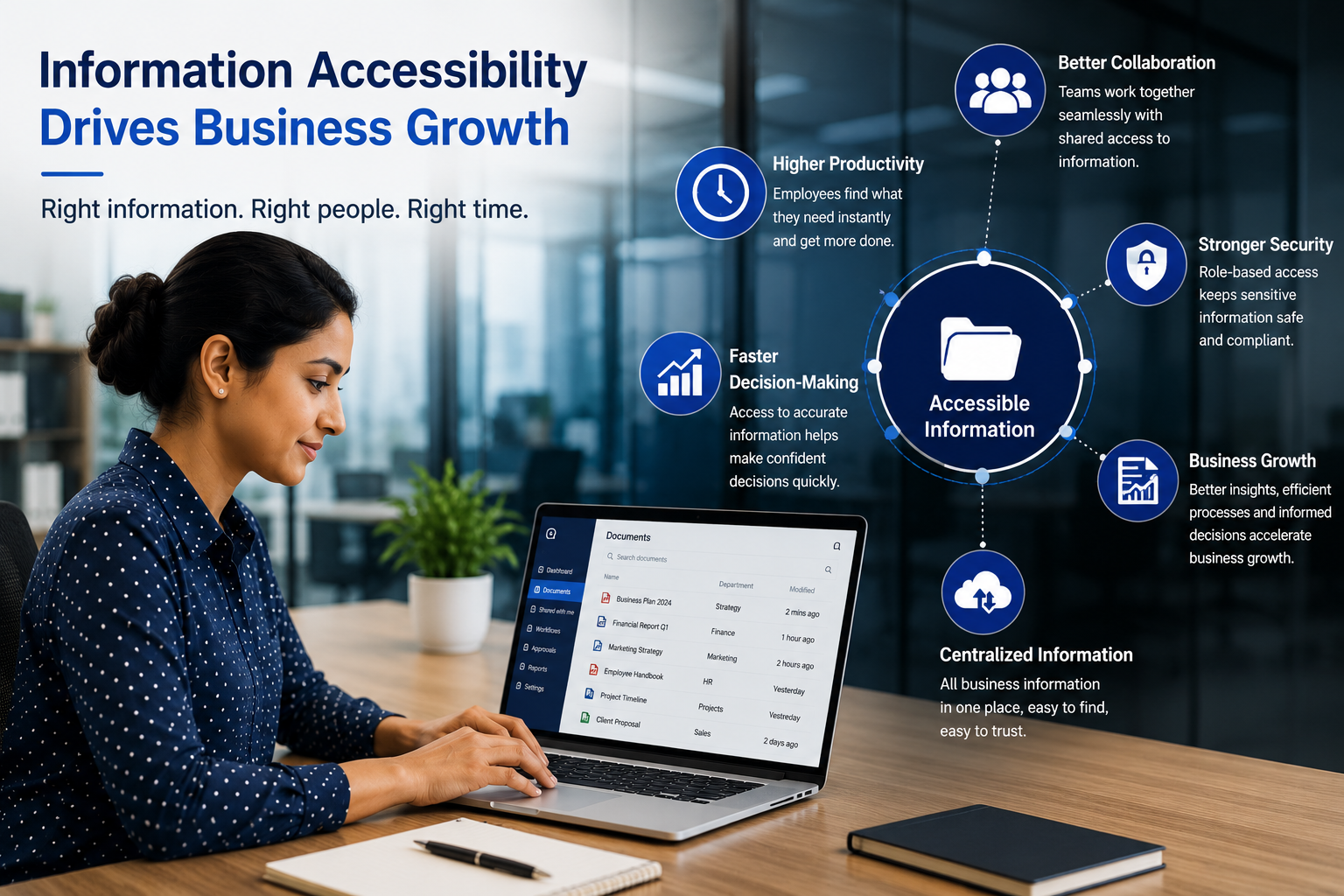
This is why information accessibility has become an important part of modern business operations. When employees can quickly find reliable business information, they can work faster, collaborate better, solve problems more effectively, and make decisions with greater confidence.
A modern digital workplace should not only provide employees with digital tools. It should also make important enterprise information easy to find, secure to access, and simple to share with the right people.
Information accessibility is therefore not just an IT concern. It is a business growth strategy.
What Does Information Accessibility Mean?
Information accessibility means making important business information available to authorized employees whenever they need it, without unnecessary searching, delays, or communication barriers.
This does not mean that every employee should have access to every business document. Security and privacy remain essential. Instead, it means that employees should be able to quickly access the information relevant to their responsibilities.
For example, an HR employee should be able to access employee records required for HR activities. A Finance employee should be able to access financial documents relevant to their role. A Project Manager should be able to find project documents, approvals, schedules, and reports without depending on another employee to send them.
Good information accessibility combines availability, organization, security, accuracy, and usability.
When these elements work together, employees spend less time looking for information and more time using it.
Information Accessibility Directly Affects Productivity
Employee productivity is not only about how quickly people complete tasks. It is also about how much unnecessary work they have to perform before they can begin those tasks.
Imagine an employee spending 15 minutes searching for a document several times a day. Across a team of 20 employees, those minutes quickly become several hours of lost productivity.
Now imagine the same problem occurring across HR, Finance, Projects, Operations, Procurement, and Management.The total cost can become significant.
Easy access to business information removes many of these unnecessary steps. Employees can search for the required document, open the latest version, review the information, and continue working.This creates a much more efficient workflow.
Better Access Leads to Better Decision-Making
Business decisions depend on information.Managers need accurate data to understand what is happening within their departments. Executives need reports to evaluate performance. Project leaders need current project information to identify risks. Finance teams need reliable financial records to manage budgets.
When information is difficult to access, decisions may be delayed.Sometimes decisions are made using incomplete information simply because obtaining the correct information takes too long.A digitally connected workplace changes this situation.
When decision-makers can access current business information quickly, they can understand situations more clearly and respond faster.
This is particularly important in competitive markets where waiting several days for information can mean missing an opportunity.
The Role of a Digital Workplace
A digital workplace is more than a collection of software applications.A truly effective digital workplace connects people, information, processes, and technology so employees can work efficiently.
Documents should be easy to locate.Business records should be organized.Communication should connect with workflows.Approvals should be trackable.
Important information should be available to authorized employees without unnecessary barriers.
When these elements work together, employees do not need to constantly switch between disconnected systems.
The digital workplace becomes an environment where information naturally moves between people and departments.
Breaking Down Information Silos
One of the biggest barriers to information accessibility is the existence of information silos.An information silo occurs when important information remains isolated within one department, application, team, or individual.
For example, HR may have employee information that Finance needs for payroll. Finance may have payment information required by Procurement. Projects may have documents that Operations needs to complete its work.If these departments cannot easily share information, every team operates with only part of the overall picture.This slows down collaboration.
Centralized information management helps reduce these silos by creating controlled access to shared business information.Employees can access the information they need while maintaining appropriate permissions.
Improving Collaboration Between Departments
Modern businesses depend heavily on cross-department collaboration.A single business process may involve several teams.
Consider employee onboarding. HR collects employee information, Finance may require payroll details, IT may prepare access credentials, Administration may arrange workplace resources, and the manager may assign responsibilities.
If every department stores information separately, onboarding can become slow and complicated.With centralized digital information, the process becomes much smoother.Each authorized department receives access to the relevant information when required.This improves business information sharing while reducing unnecessary communication
Faster Access to Enterprise Information
Large organizations create enormous amounts of enterprise information.Contracts, policies, employee records, invoices, project reports, customer documents, approvals, meeting records, compliance documents, and operational reports all become part of the company's information environment.
If this information is not properly organized, its value decreases.Information that cannot be found quickly is almost as difficult to use as information that does not exist.Centralized digital systems can make enterprise information searchable and organized.
Employees can locate documents using categories, folders, permissions, search functions, and structured records.The result is a workplace where information becomes useful rather than simply stored.
Information Accessibility and Employee Experience
Employees expect modern workplaces to provide efficient tools.When employees repeatedly struggle to locate information, they become frustrated.They may need to contact colleagues for simple documents.They may wait for approvals.They may recreate information that already exists.
These experiences reduce employee satisfaction and productivity.A well-designed digital workplace makes routine information access much easier.Employees can find policies, documents, records, project information, and other resources without depending on someone else for every small request.This creates a more independent and productive workforce.
Improving Business Continuity
Business information should not depend on one employee.If an important employee is absent, leaves the organization, or changes roles, the company should still be able to access the information required to continue operations.Unfortunately, many businesses discover that critical knowledge is stored inside individual inboxes, personal folders, or informal conversations.
This creates operational risk.Centralized digital information helps ensure that important business records remain available to authorized employees.Business continuity improves because knowledge remains with the organization rather than being tied to individuals.
Security Must Remain Part of Accessibility
Making information accessible does not mean making it available to everyone.Modern businesses must balance accessibility with security.
Sensitive enterprise information may include employee records, financial information, contracts, customer data, internal reports, and confidential business strategies.Employees should only access information appropriate to their responsibilities.This is where role-based permissions and access controls become important.
A good information management system allows organizations to determine:
- Who can view information
- Who can edit information
- Who can share information
- Who can approve changes
- Who can manage access
This creates secure accessibility rather than unrestricted access.
Keeping Business Information Accurate
Accessibility is useful only when the information employees access is reliable.If employees regularly find outdated or duplicate documents, centralized storage alone does not solve the problem.
Businesses need proper document management practices, version control, and clear ownership of information.When a document is updated, employees should be able to identify the latest version.
When an old document is replaced, users should not accidentally continue using it.Maintaining accurate enterprise information improves confidence across the organization.Employees know that the information they are accessing can be trusted.
Reducing Repetitive Work
A surprising amount of workplace time is spent recreating information that already exists.An employee cannot find an old report, so they create a new one.A department cannot locate a document, so another employee prepares a replacement.
A manager asks for information that has already been submitted elsewhere.These situations create unnecessary work.Better information accessibility reduces this repetition.
Employees can locate existing information and reuse it instead of recreating it.This saves time and allows teams to focus on more meaningful responsibilities.
Supporting Business Growth
Information accessibility becomes increasingly important as a company grows.A small business may be able to manage information through a few shared folders and direct communication.
But when the company expands to hundreds of employees and multiple departments, informal methods become difficult to maintain.
Growth creates more:
- Employees
- Customers
- Projects
- Documents
- Transactions
- Departments
- Business processes
- Compliance requirements
Without a scalable information system, complexity increases faster than productivity.Accessible and organized enterprise information gives businesses the foundation they need to grow without creating unnecessary administrative barriers.
How Information Accessibility Supports Scalability
Scalability means being able to grow without allowing operational complexity to grow at the same rate.Information accessibility contributes directly to scalability.
When new employees join, they can access approved documents and information without requiring constant one-to-one training.When new departments are created, they can connect to existing information structures.
When a business opens another location, teams can access centralized information without physically depending on the original office.This makes expansion easier.The business becomes less dependent on informal communication and individual knowledge.
The Connection Between Information and Automation
Automation works best when information is structured and accessible.For example, an automated workflow may need employee information, project data, approval records, documents, or financial information to complete a process.
If that information is scattered across disconnected systems, automation becomes difficult.Centralized enterprise information provides a stronger foundation for automation.Businesses can connect information with workflows, approvals, reporting, and other processes.
This allows organizations to move from simply storing information to actively using it to improve operations.
The Long-Term Value of Accessible Information
Information becomes more valuable as a business grows because historical records help organizations understand how they have performed and why certain decisions were made.
Past project records can help teams plan future projects.Previous customer information can improve service.Historical financial information can support planning.
Employee records can help HR understand workforce trends.Business documentation can preserve organizational knowledge.
When information is properly managed and accessible, the organization builds a valuable knowledge base over time.This knowledge becomes a long-term business asset.
Key Benefits of Information Accessibility
Organizations that prioritize information accessibility can experience several important benefits:
- Higher productivity: Employees spend less time searching for documents and more time completing meaningful work.
- Faster decisions: Managers and executives can access the information required to make informed decisions.
- Better collaboration: Departments can share information without unnecessary delays.
- Improved employee experience: Employees can find important resources without depending on colleagues for every request.
- Stronger business continuity: Critical information remains available even when individual employees are unavailable.
- Better scalability: Growing organizations can manage increasing amounts of enterprise information more efficiently.
- Improved security: Controlled access ensures that information is available to the right people without exposing sensitive records.
Final Thoughts
Business growth creates opportunities, but it also creates complexity. More employees, customers, departments, projects, documents, and transactions mean that organizations must become better at managing information. Without a reliable way to access business information, employees spend valuable time searching for files, requesting updates, recreating documents, and waiting for other departments.
Information accessibility solves a fundamental business problem: making sure the right people can find the right information when they need it.
A modern digital workplace brings together people, processes, documents, and enterprise information in a way that supports everyday work. Employees can collaborate more effectively, managers can make decisions faster, and departments can operate with fewer communication barriers.
The value goes beyond productivity. Accessible information strengthens business continuity, supports automation, improves employee experience, reduces duplicate work, and creates a foundation for scalable growth.
As organizations become increasingly digital, information itself becomes one of their most valuable assets. Simply collecting information is no longer enough. Businesses must make that information organized, secure, accurate, and accessible.
Companies that build strong information accessibility today will be better prepared for tomorrow's challenges. They can respond faster, collaborate more effectively, make smarter decisions, and scale their operations with greater confidence.