Table of Contents
- From Disconnected Tools to Connected Operations
- The Challenge of Managing Multiple Systems
- Why Integration Matters
- The Rise of Intelligent Business Operations
- The Importance of Real-Time Visibility
- Improving Employee Productivity
- Enhancing Collaboration Across Departments
- Security and Governance in a Connected Workplace
- Supporting Business Growth
- Why the Future Belongs to Connected Platforms
- Conclusion
From Disconnected Tools to Connected Operations
Modern businesses generate more data, manage more processes, and coordinate more teams than ever before. Human resources, recruitment, visitor management, accounting, communication, project tracking, document storage, payroll, customer interactions, and operational reporting all happen simultaneously across an organization.
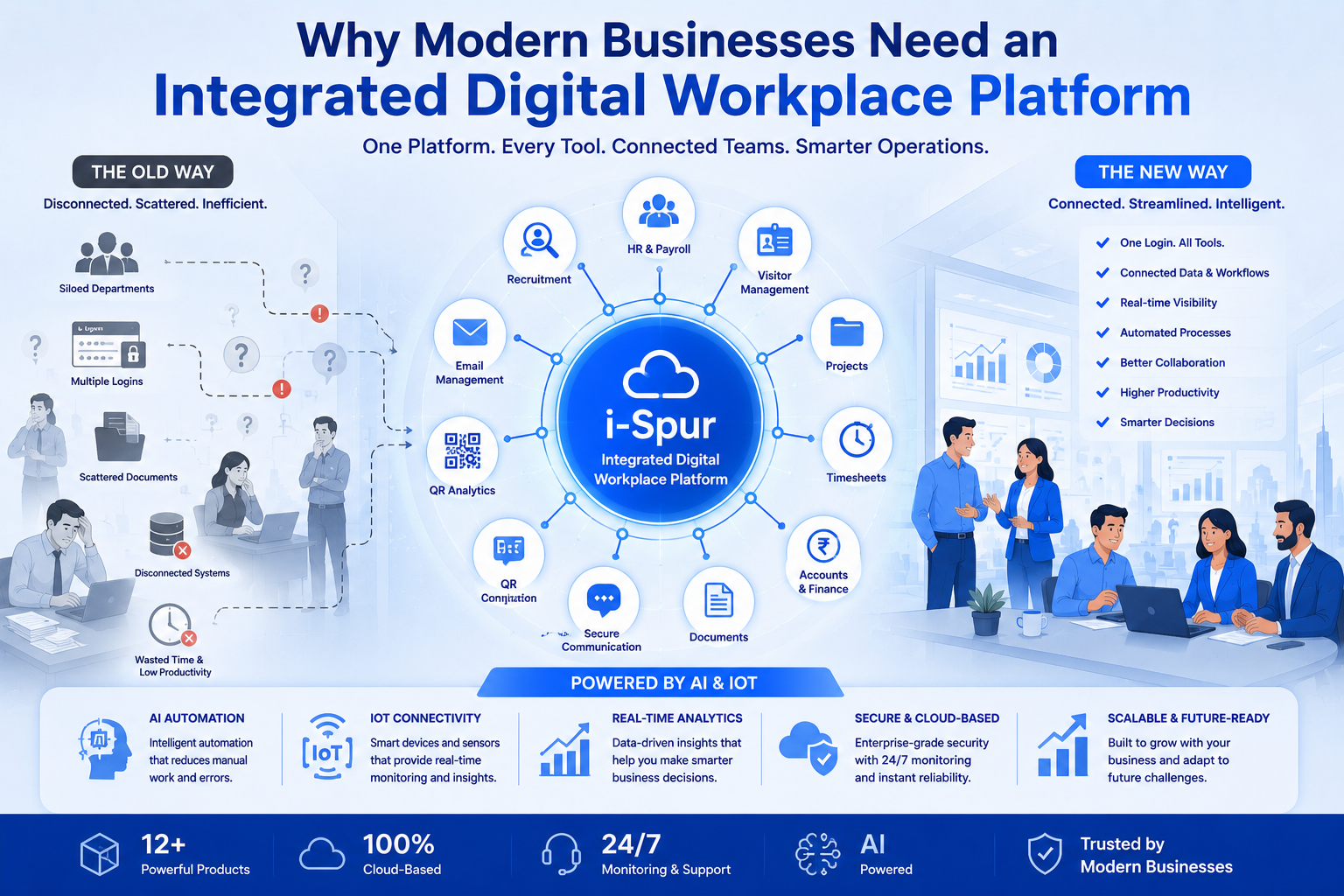
Despite this complexity, many businesses still operate using disconnected systems. HR uses one platform, accounting uses another, project teams use separate applications, and documents are stored in multiple locations. Employees often switch between several tools throughout the day, manually transferring information from one system to another.
At first, this approach may seem manageable. However, as organizations grow, disconnected systems create inefficiencies that affect productivity, visibility, collaboration, and decision-making.
This is why integrated digital workplace platforms are becoming increasingly important.
Businesses are moving away from isolated applications and toward connected ecosystems where information flows seamlessly across departments. Instead of managing multiple software products independently, organizations are adopting unified platforms that bring together essential business functions into a single environment.
The goal is simple: reduce complexity, improve efficiency, and create a smarter way to work.
The Challenge of Managing Multiple Systems
Many organizations do not realize how much time employees spend navigating between different applications.
A typical employee may start the day by checking emails, updating spreadsheets, reviewing HR information, tracking project progress, searching for documents, communicating with colleagues, and entering information into multiple systems.
While each task may only take a few minutes, the constant switching between platforms creates friction.
Common challenges include:
- Duplicate data entry
- Inconsistent information
- Communication delays
Employees often spend more time managing systems than completing meaningful work.
As organizations scale, these inefficiencies become more noticeable.
The problem is not necessarily the software itself. The problem is that the software does not work together.
Why Integration Matters
Integration allows different business functions to connect and share information automatically.
When systems are integrated, information entered once can be used throughout the organization.
For example:
- Employee records can connect with payroll.
- Recruitment data can flow into onboarding.
- Project hours can connect with accounting.
- Documents can link directly to workflows.
This eliminates repetitive tasks and reduces the risk of errors.
Integration also improves visibility.
Leaders gain access to information across departments, allowing them to make better decisions based on complete and accurate data.
Organizations that embrace integration often experience significant improvements in efficiency and collaboration.
The Rise of Intelligent Business Operations
Technology is evolving rapidly.
Artificial intelligence, automation, cloud computing, and the Internet of Things (IoT) are transforming how businesses operate.
These technologies enable organizations to automate repetitive tasks, monitor operations in real time, and gain valuable insights from business data.
AI can help automate routine activities such as:
- Data processing
- Candidate screening
- Report generation
IoT devices can provide real-time visibility into assets, facilities, equipment, and workplace environments.
Together, these technologies create opportunities for smarter decision-making and more efficient operations.
Organizations that embrace intelligent business solutions often gain a competitive advantage.
The Importance of Real-Time Visibility
Business leaders need accurate information to make informed decisions.
However, when data is scattered across multiple systems, obtaining a complete picture becomes difficult.
Integrated platforms improve visibility by centralizing information.
Managers can monitor:
- Workforce performance
- Financial activity
- Project progress
- Operational trends
from a single environment.
Real-time visibility helps organizations respond more quickly to opportunities and challenges.
Instead of relying on outdated reports, leaders can access current information whenever they need it.
This agility becomes increasingly important in fast-changing business environments.
Improving Employee Productivity
Employees perform best when they have access to the tools and information they need.
Disconnected systems often create unnecessary obstacles.
Workers may spend valuable time searching for documents, requesting access, or re-entering information.
Integrated workplace platforms simplify these processes.
Benefits often include:
- Faster access to information
- Reduced administrative work
- Better collaboration
When employees spend less time managing systems, they can focus more on delivering value.
Improved productivity benefits both individuals and organizations.
Enhancing Collaboration Across Departments
Modern business success depends on collaboration.
Departments must share information, coordinate activities, and work toward common goals.
Unfortunately, disconnected systems often create information silos.
When departments operate independently, communication gaps can emerge.
Integrated platforms help break down these barriers.
Information becomes accessible across the organization, improving transparency and teamwork.
Collaboration becomes easier because employees work from the same information source.
This shared visibility supports stronger alignment and more effective decision-making.
Security and Governance in a Connected Workplace
As organizations become more digital, information security becomes increasingly important.
Businesses must protect sensitive information while ensuring authorized employees have access to the resources they need.
Integrated platforms often provide stronger governance capabilities than disconnected systems.
Features may include:
- Role-based access control
- Audit trails
- Activity monitoring
These capabilities improve accountability and support compliance requirements.
Organizations gain greater confidence that information is both accessible and protected.
Supporting Business Growth
Growth creates new opportunities, but it also introduces additional complexity.
More employees, customers, vendors, and projects generate larger volumes of information.
Organizations that rely on fragmented systems often struggle to scale efficiently.
Integrated workplace platforms provide a foundation for sustainable growth.
As operations expand, information remains connected and accessible.
Processes become easier to manage, and leaders gain greater visibility into organizational performance.
Scalability is one of the most important advantages of a unified business platform.
Why the Future Belongs to Connected Platforms
The future workplace will be increasingly connected, automated, and intelligent.
Organizations will continue seeking ways to simplify operations while improving efficiency.
Integrated digital workplace platforms represent a natural evolution in business technology.
Instead of managing separate applications for every function, businesses are moving toward unified ecosystems where information flows seamlessly across departments.
This approach reduces complexity, improves productivity, strengthens collaboration, and supports better decision-making.
Organizations that embrace connected operations today will be better positioned to succeed tomorrow.
Conclusion
Modern businesses face growing challenges related to information management, productivity, collaboration, security, and operational efficiency.
Managing these challenges through disconnected systems becomes increasingly difficult as organizations grow.
Integrated digital workplace platforms offer a smarter alternative.
By bringing together essential business functions within a connected environment, organizations can improve visibility, reduce administrative effort, strengthen collaboration, and support long-term growth.
The future of business is not simply digital,It is connected, intelligent, and integrated.
Organizations that invest in unified workplace solutions today are building the foundation for greater efficiency, stronger decision-making, and sustainable success in the years ahead.