Table of Contents
- The Growing Importance of Email Security
- Understanding On-Premise Email Infrastructure
- Why Data Ownership Matters
- The Rising Cost of Cloud Dependency
- Security Beyond Password Protection
- Why Encryption Is Essential
- Improving Internal Communication Efficiency
- The Benefits of Integrated Business Systems
- Supporting Organizational Growth
- Compliance and Audit Readiness
- Preparing for the Future of Business Communication
- Frequently Asked Questions
- What is an on-premise email system?
- Why do businesses choose on-premise email?
- Is on-premise email more secure?
- Who benefits most from on-premise email systems?
- What role does encryption play in email security?
- Conclusion
- Explore Secure Business Email Solutions
In today's digital-first business environment, email remains one of the most important communication channels. Every day, organizations exchange contracts, financial documents, employee information, client discussions, project updates, and confidential business data through email. While most companies rely on popular cloud-based email services, many organizations are beginning to question whether storing critical communication on third-party servers is truly the best option.
Data privacy concerns, increasing cybersecurity threats, regulatory requirements, and rising subscription costs are encouraging businesses to rethink their email infrastructure. As a result, on-premise email systems are experiencing renewed interest among organizations that want greater control over their communication and data.
For businesses that handle sensitive information, email is not simply a communication tool—it is a critical business asset. The ability to maintain ownership of that asset is becoming more important than ever.
This is where on-premise business email solutions are making a significant impact.
The Growing Importance of Email Security
Email is often the primary target for cybercriminals because it contains valuable information. Financial records, customer data, contracts, invoices, employee documents, and confidential discussions frequently pass through company email systems.
When organizations rely entirely on third-party cloud providers, they are essentially trusting another company to store and manage their most sensitive communication.
While cloud providers invest heavily in security, businesses still face challenges such as:
- Data residency concerns
- Unauthorized access risks
- Compliance requirements
- Dependence on external infrastructure
As cyber threats continue to evolve, many organizations are seeking additional layers of control and protection.
The question many business leaders are asking is simple: "Who truly owns our email data?"
Understanding On-Premise Email Infrastructure
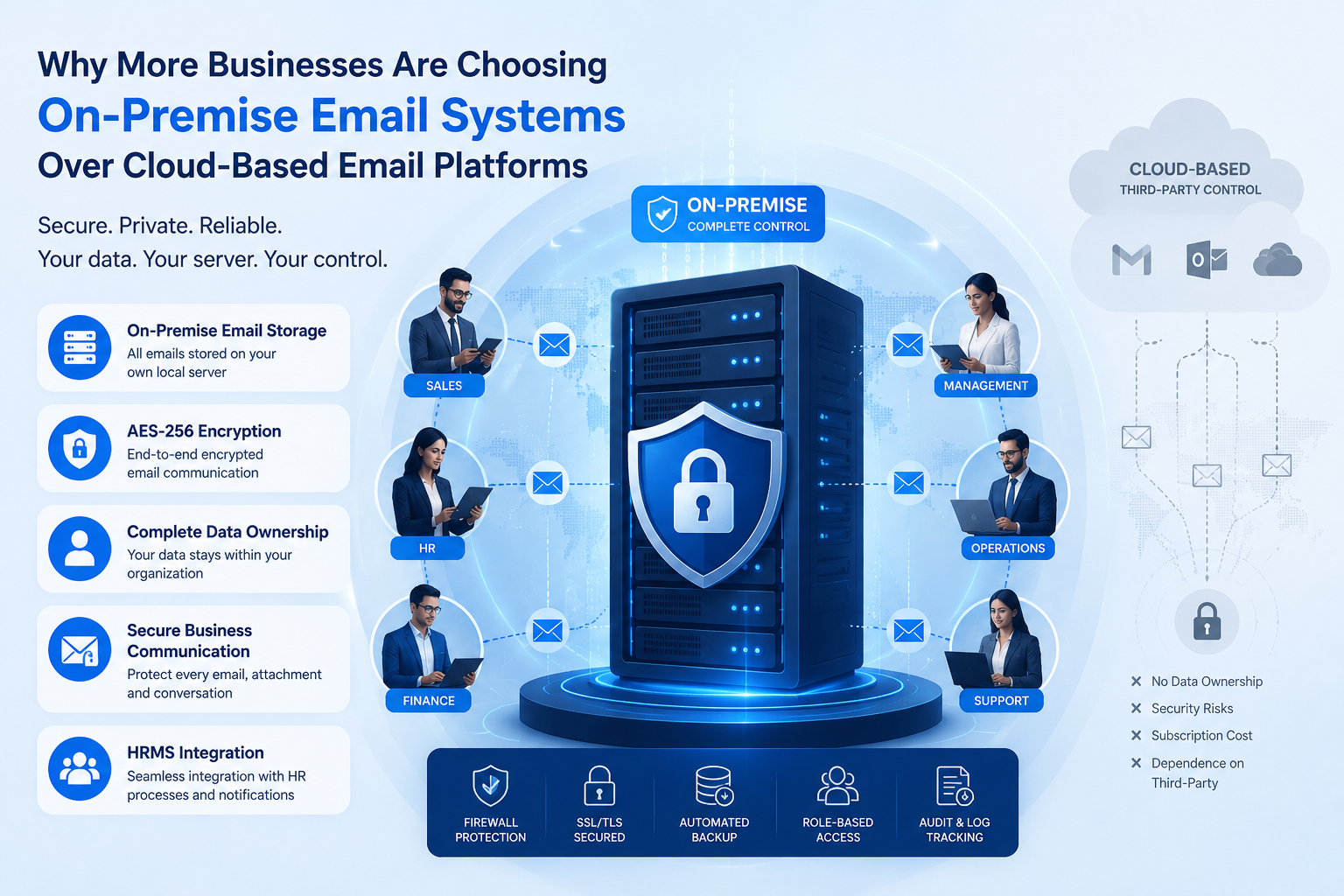
An on-premise email system is hosted entirely within an organization's own infrastructure rather than on external cloud servers.
Instead of storing emails on third-party platforms, businesses maintain their email environment on local servers under their direct control.
This means that:
- Emails remain inside the organization
- Storage policies are internally managed
- Security controls are customized
- Access permissions remain under company oversight
For organizations that prioritize data ownership and confidentiality, this approach offers significant advantages.
Unlike public cloud services, on-premise infrastructure allows businesses to decide exactly how their communication data is stored, protected, and accessed.
Why Data Ownership Matters
Data has become one of the most valuable assets in modern business.
Every email exchanged between employees, customers, vendors, and partners contributes to an organization's knowledge base and operational history.
When data is stored externally, organizations often have limited visibility into how it is managed behind the scenes.
Businesses increasingly want:
- Complete control over business communication
- Internal management of sensitive information
- Reduced dependency on external providers
Data ownership is particularly important for industries such as:
- Manufacturing
- Healthcare
- Legal services
- Financial consulting
- Government contracting
- Chartered accounting firms
These sectors often handle highly confidential information that requires enhanced protection and oversight.
Maintaining local ownership of communication data helps reduce risk while supporting organizational compliance objectives.
The Rising Cost of Cloud Dependency
Cloud-based email platforms offer convenience, but they also introduce ongoing costs.
Many businesses pay recurring subscription fees based on the number of users, storage requirements, and additional services.
Over time, these expenses can become substantial.
Organizations may also encounter challenges such as:
- Vendor lock-in
- Pricing changes
- Storage limitations
- Service dependency
An on-premise email solution provides an alternative approach by allowing businesses to invest in their own infrastructure rather than paying perpetual subscription fees.
For growing organizations, this can provide greater long-term predictability and control.
Security Beyond Password Protection
Many people assume email security begins and ends with strong passwords.
In reality, enterprise email security involves multiple layers of protection.
Modern organizations require:
- Data encryption
- Secure authentication
- Role-based permissions
- Audit tracking
- Threat monitoring
A well-designed on-premise email system can provide enterprise-grade security while allowing organizations to define their own security policies.
This flexibility enables businesses to align security measures with their operational requirements.
As cyberattacks become more sophisticated, organizations are increasingly prioritizing proactive security strategies.
Why Encryption Is Essential
Encryption plays a critical role in protecting business communication.
Without encryption, sensitive information may become vulnerable during transmission or storage.
Modern encryption standards help ensure that emails remain protected from unauthorized access.
Benefits of strong encryption include:
- Protection of confidential business information
- Secure communication between employees
- Reduced risk of data breaches
Organizations that handle sensitive customer or financial data often consider encryption a fundamental requirement rather than an optional feature.
Strong encryption helps create trust while supporting regulatory compliance efforts.
Improving Internal Communication Efficiency
While security is important, organizations also need email systems that support efficient communication.
Employees rely on email for:
- Daily collaboration
- Project updates
- Client communication
- Internal notifications
A modern email environment should help teams communicate effectively without introducing unnecessary complexity.
Key productivity features often include:
- Centralized inbox management
- Advanced search capabilities
- Conversation threading
These capabilities help employees locate information quickly and manage communication more efficiently.
Reducing time spent searching for emails can significantly improve workplace productivity.
The Benefits of Integrated Business Systems
One of the biggest challenges organizations face is managing multiple disconnected systems.
Employees may use separate platforms for:
- HR management
- Payroll
- Leave requests
- Project updates
- Email communication
Disconnected systems often create inefficiencies and increase administrative workload.
Integrated platforms help streamline operations by allowing systems to work together seamlessly.
When communication systems are connected with other business functions, organizations can automate routine notifications and reduce manual processes.
This improves both accuracy and efficiency.
Supporting Organizational Growth
As businesses grow, communication becomes increasingly complex.
New employees, departments, projects, and customers generate additional communication demands.
Organizations need systems that can scale alongside their growth.
An effective email solution should support:
- Multiple users
- Department structures
- Role-based permissions
Scalability helps ensure that communication infrastructure remains effective as organizational requirements evolve.
Businesses that invest in flexible infrastructure are often better prepared for future expansion.
Compliance and Audit Readiness
Many industries operate under strict regulatory requirements.
Organizations may need to maintain detailed records of communication for legal, financial, or operational purposes.
Having access to complete email archives can simplify:
- Internal audits
- Compliance reporting
- Legal documentation
Digital record management provides visibility and accountability while reducing administrative burden.
Organizations that prioritize compliance often benefit from maintaining comprehensive communication records within their own infrastructure.
Preparing for the Future of Business Communication
Technology continues to evolve, but certain business priorities remain constant.
Organizations will always need:
- Secure communication
- Reliable infrastructure
- Data ownership
- Operational efficiency
As concerns about privacy and cybersecurity continue to grow, businesses are becoming more selective about where and how they store information.
The future of business communication will likely involve a stronger focus on control, transparency, and security.
Organizations that invest in robust communication infrastructure today will be better positioned to adapt to future challenges.
Frequently Asked Questions
What is an on-premise email system?
An on-premise email system stores and manages business email communication on a company's own servers rather than on third-party cloud infrastructure.
Why do businesses choose on-premise email?
Organizations choose on-premise email for greater data control, enhanced security, compliance support, and reduced dependency on external providers.
Is on-premise email more secure?
Security depends on implementation, but on-premise systems allow organizations to define and manage their own security policies and infrastructure.
Who benefits most from on-premise email systems?
Industries handling sensitive information, including legal, healthcare, manufacturing, finance, and consulting organizations, often benefit significantly.
What role does encryption play in email security?
Encryption helps protect emails and attachments from unauthorized access during storage and transmission.
Conclusion
Business communication is one of the most valuable assets an organization possesses. As data privacy concerns, cybersecurity risks, and compliance requirements continue to grow, many organizations are reassessing how their communication infrastructure is managed.
On-premise email systems offer a compelling alternative for businesses seeking greater control, stronger security, and complete ownership of their communication data.
By keeping email infrastructure within organizational boundaries, businesses can strengthen security, improve operational oversight, and reduce reliance on external providers.
The future of secure communication belongs to organizations that understand the value of owning and protecting their most important information.
Explore Secure Business Email Solutions
Looking for a private, secure, and fully controlled business email system?
Discover enterprise email solutions designed for data ownership, encrypted communication, HRMS integration, and complete control over organizational communication.
Explore More: https://i-spur.com/mail-lift-information