Table of Contents
- How to Create a GST Invoice in India (2026): Rules, Format, Examples and GST Calculation
- 1. What Is a GST Invoice?
- 2. Who Needs to Issue a GST Invoice?
- 3. Mandatory Details in a GST Invoice
- 4. Understanding CGST, SGST and IGST
- A. CGST – Central Goods and Services Tax
- B. SGST – State Goods and Services Tax
- C. IGST – Integrated Goods and Services Tax
- Difference between CGST, SGST and IGST
- 5. How to Calculate GST on an Invoice
- Example 1: Intra-State Sale (CGST + SGST)
- Final calculation
- Example 2: Inter-State Sale (IGST)
- 6. GST Invoice Sample Format in India
- SAMPLE TAX INVOICE
- 7. How to Create a GST Invoice Step by Step
- 8. What Is GST E-Invoicing?
- Who needs to generate e-invoices?
- 9. When Should a GST Invoice Be Issued?
- For goods
- For services
- For continuous supplies
- 10. Common GST Invoice Mistakes Businesses Should Avoid
- 11. How GST Billing Software Helps Small Businesses
- 12. Frequently Asked Questions (FAQs)
- Conclusion
- About the Author
How to Create a GST Invoice in India (2026): Rules, Format, Examples and GST Calculation
Creating a GST invoice is an important responsibility for businesses registered under India's Goods and Services Tax (GST) system. Whether you operate a retail shop, manufacturing company, IT business, consultancy, trading firm or online store, issuing accurate invoices helps maintain financial records and comply with GST requirements.
However, many small business owners still have questions:
- What details must be included in a GST invoice?
- How do you calculate CGST, SGST and IGST?
- What is the difference between a tax invoice and a bill of supply?
- When should a GST invoice be issued?
- Is GST invoicing software mandatory?
- What is the correct GST invoice format?
In this guide, we explain how to create a GST invoice in India, with practical examples, calculation methods, a sample invoice format and important compliance points.
1. What Is a GST Invoice?
A GST invoice is a commercial and tax document issued by a registered supplier when providing taxable goods or services.
It records the transaction between the supplier and the customer and provides information about the taxable value, applicable GST rate and tax amount.
A GST invoice generally serves three important purposes:
- Business record: It records the sale of goods or services.
- Tax compliance: It documents the GST charged on the transaction.
- Input Tax Credit (ITC): It provides invoice information that a registered recipient may use to support an eligible ITC claim, subject to GST conditions.
For example, suppose a registered computer shop sells a laptop to a business customer for ₹50,000 before GST. If the applicable GST rate is 18%, the invoice will show the taxable value, GST amount and total payable amount.
A properly prepared invoice helps both the supplier and the customer maintain accurate accounting records.
2. Who Needs to Issue a GST Invoice?
Businesses registered under GST and making taxable supplies are generally required to issue tax invoices.
Common examples include:
- Retail and wholesale businesses.
- Manufacturers and distributors.
- IT companies and software service providers.
- Consultants and professional service providers.
- Marketing and digital agencies.
- Contractors and service businesses.
- Registered traders and suppliers.
However, the document issued depends on the nature of the supply and the taxpayer's registration category.
For example:
- A regular registered taxpayer making taxable supplies generally issues a tax invoice.
- A composition taxpayer generally issues a bill of supply instead of a tax invoice.
- A registered supplier making exempt supplies generally issues a bill of supply.
- Certain transactions require receipt vouchers, refund vouchers, debit notes or credit notes.
Businesses should identify the correct document before issuing it.
3. Mandatory Details in a GST Invoice
Under Rule 46 of the CGST Rules, a tax invoice must contain prescribed particulars.
The following table explains the important details businesses should include.
Invoice detailDescriptionSupplier nameLegal name or registered business nameSupplier addressRegistered business addressSupplier GSTIN15-character GST identification numberInvoice numberUnique consecutive invoice numberInvoice dateDate of invoice generationCustomer nameName of the recipientCustomer addressRecipient's registered or relevant addressCustomer GSTINGSTIN, where the recipient is registeredHSN/SACClassification code for goods or servicesDescriptionDetails of goods or services suppliedQuantityQuantity and unit for goodsTotal valueTotal value of the supplyTaxable valueValue on which GST is calculatedGST rateApplicable GST percentageGST amountCGST, SGST, IGST or applicable cessPlace of supplyRequired details for applicable inter-State suppliesReverse chargeWhether tax is payable under reverse chargeSignatureSignature or digital signature, subject to applicable provisions
For an unregistered customer, additional recipient and delivery information is required in specified circumstances, including taxable supplies of ₹50,000 or more.
The exact invoice requirements can vary for particular transactions and taxpayer categories.
4. Understanding CGST, SGST and IGST
One of the most important parts of GST invoicing is selecting the correct tax type.
India uses different GST components depending on whether a supply is intra-State or inter-State.
A. CGST – Central Goods and Services Tax
CGST is collected by the Central Government on applicable intra-State supplies.
For example, if a business in Gujarat sells goods to a customer in Gujarat, CGST may apply along with SGST.
B. SGST – State Goods and Services Tax
SGST is collected by the State Government on applicable intra-State supplies.
For a transaction within Gujarat, the applicable GST may be divided between CGST and SGST.
C. IGST – Integrated Goods and Services Tax
IGST generally applies to inter-State supplies and is administered under the IGST framework.
For example, if a supplier in Gujarat sells goods to a customer in Maharashtra, IGST will generally apply, subject to the applicable place-of-supply rules.
Difference between CGST, SGST and IGST
GST componentWhen it generally appliesExampleCGSTIntra-State supplyGujarat to GujaratSGSTIntra-State supplyGujarat to GujaratIGSTInter-State supplyGujarat to Maharashtra
Important: Do not decide the GST type only by looking at the supplier's and customer's addresses. The legally applicable place-of-supply rules must be checked, especially for services, imports, exports and special transactions.
5. How to Calculate GST on an Invoice
Let's understand GST calculation using a simple example.
Suppose a business sells office furniture for ₹50,000 before GST.
Assume the applicable GST rate is 18%.
Example 1: Intra-State Sale (CGST + SGST)
Supplier location: Gujarat
Customer location: Gujarat
Taxable value: ₹50,000
GST rate: 18%
For this example, the 18% GST is divided equally:
- CGST = 9%
- SGST = 9%
Step 1: Calculate CGST
CGST = ₹50,000 × 9%
CGST = ₹4,500
Step 2: Calculate SGST
SGST = ₹50,000 × 9%
SGST = ₹4,500
Step 3: Calculate total GST
Total GST = ₹4,500 + ₹4,500
Total GST = ₹9,000
Step 4: Calculate invoice total
Invoice total = Taxable value + Total GST
= ₹50,000 + ₹9,000
= ₹59,000
Final calculation
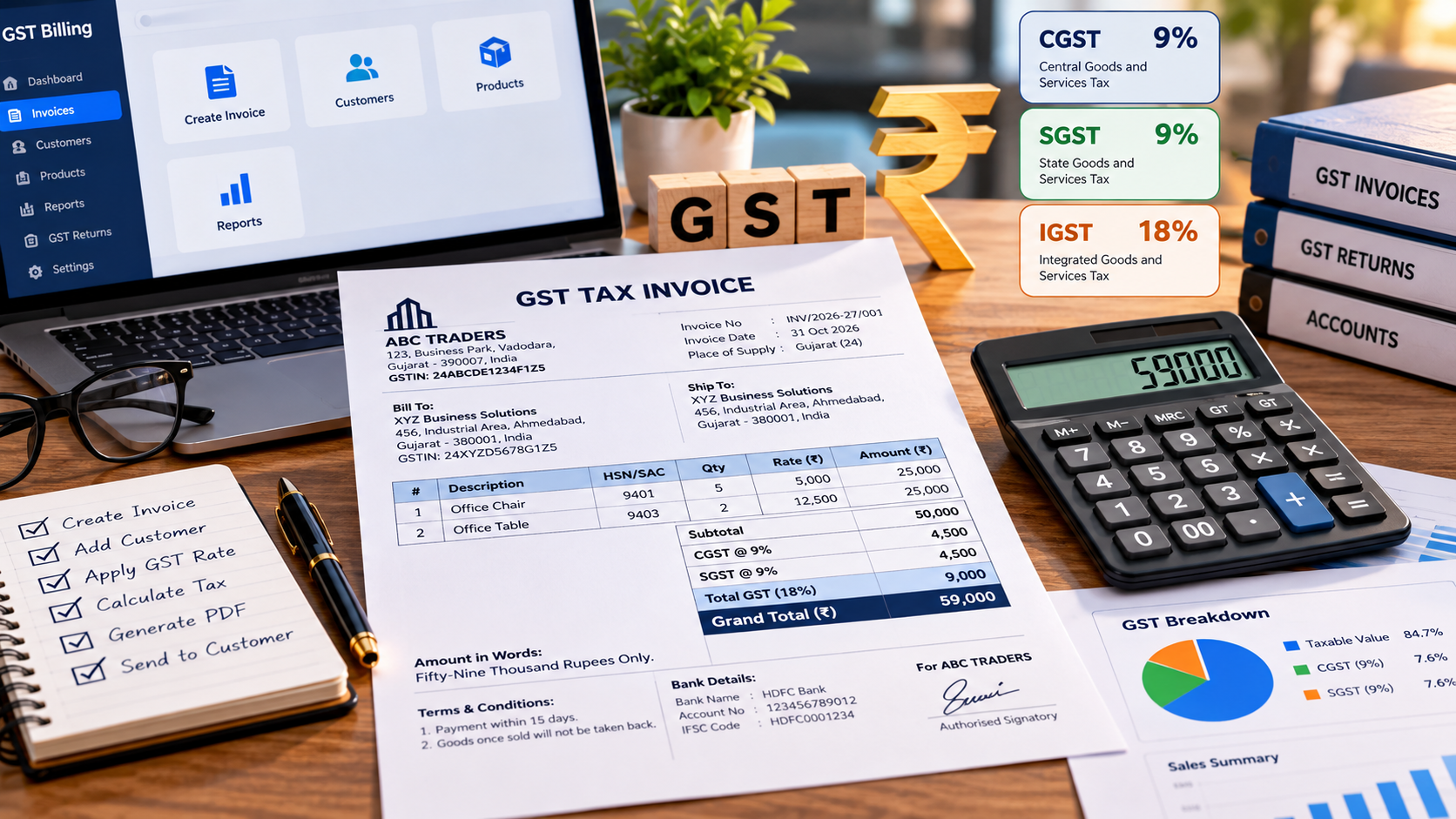
ParticularsAmountTaxable value₹50,000CGST @ 9%₹4,500SGST @ 9%₹4,500Total GST₹9,000Grand total₹59,000
Example 2: Inter-State Sale (IGST)
Now suppose the same supplier in Gujarat sells the furniture to a customer in Maharashtra.
Taxable value: ₹50,000
Applicable GST rate: 18%
Since this is assumed to be an inter-State supply, IGST applies.
IGST = ₹50,000 × 18%
IGST = ₹9,000
Invoice total = ₹50,000 + ₹9,000
Invoice total = ₹59,000
ParticularsAmountTaxable value₹50,000IGST @ 18%₹9,000Grand total₹59,000
Notice that the total tax is the same in these examples. Only the tax components differ.
The 18% rate used here is illustrative. Always confirm the correct GST rate and classification for the actual goods or services being supplied.
6. GST Invoice Sample Format in India
Below is a practical sample of a GST invoice that a business can use as a reference when preparing its billing format.
SAMPLE TAX INVOICE
ABC Office Solutions
Vadodara, Gujarat, India
GSTIN: 24ABCDE1234F1Z5 (Illustrative only)
Invoice Number: ABC/2026-27/001
Invoice Date: 31 October 2026
Bill To:
XYZ Business Services
Ahmedabad, Gujarat
GSTIN: 24XYZDE5678G1Z5 (Illustrative only)
Product Details
DescriptionHSNQtyRateAmountOffice Chair94015₹5,000₹25,000Office Table94032₹12,500₹25,000Subtotal
₹50,000
Tax Calculation
Tax descriptionRateAmountTaxable value
₹50,000CGST9%₹4,500SGST9%₹4,500Total GST18%₹9,000Grand Total
₹59,000
Amount in words: Fifty-Nine Thousand Rupees Only.
Payment Terms: Payment within 15 days.
Bank Details: As applicable.
Authorised Signatory: ABC Office Solutions.
This is an illustrative sample, not a ready-to-use legal invoice. The GSTINs, HSN classifications, product tax rates and other particulars must be replaced with verified business information.
7. How to Create a GST Invoice Step by Step
Businesses can prepare GST invoices using accounting software, billing applications or other suitable systems.
Follow these steps:
Step 1: Add your business details
Enter your legal business name, registered address and GSTIN.
Step 2: Add customer information
Enter the customer's name, address and GSTIN if registered.
Also identify the relevant place of supply.
Step 3: Generate a unique invoice number
Use a consecutive invoice series that is unique for the financial year.
For example:
- INV/2026-27/001
- INV/2026-27/002
- INV/2026-27/003
Your invoice number should follow a consistent numbering process.
Step 4: Add product or service details
Enter:
- Product or service name.
- HSN or SAC code.
- Quantity.
- Unit price.
- Discount, where applicable.
- Taxable value.
Step 5: Select the applicable GST rate
Verify the classification and applicable rate for the supply.
Do not assume that every product or service attracts 18% GST.
Step 6: Calculate the GST amount
Determine whether CGST and SGST or IGST applies.
Check the calculation before finalising the invoice.
Step 7: Add payment details
Include payment terms, bank information or other payment instructions where relevant.
Step 8: Generate and share the invoice
Save the invoice in PDF or another suitable format and share it with the customer.
If e-invoicing applies to your business and transaction, complete the required Invoice Registration Portal process and include the valid IRN and QR code.
8. What Is GST E-Invoicing?
GST e-invoicing is a system in which specified GST documents are reported to a government-notified Invoice Registration Portal (IRP).
The IRP validates the submitted information and returns:
- Invoice Reference Number (IRN).
- Digitally signed invoice information.
- QR code.
An important point is that e-invoicing does not mean that the government portal creates your invoice from scratch.
Businesses continue to prepare invoices using their accounting or ERP systems and report the applicable documents to the IRP.
Who needs to generate e-invoices?
As of 2026, the general e-invoicing threshold is an aggregate annual turnover exceeding ₹5 crore in any preceding financial year from 2017-18 onwards, subject to notified exemptions and conditions.
E-invoicing generally covers specified B2B supplies and exports, including applicable credit notes and debit notes.
Certain categories of taxpayers are exempt from the requirement.
Businesses should verify their eligibility and applicable exemptions using the latest GST notifications and the official e-invoice portal.
9. When Should a GST Invoice Be Issued?
The timing of invoice generation depends on the type of supply.
For goods
For taxable goods, the invoice is generally issued before or at the time of removal of goods for supply where movement is involved, or before or at delivery or making available of goods in other cases.
For services
For taxable services, the invoice is generally required within 30 days from the date of supply of service.
Certain specified financial institutions and other notified categories may have a different time limit, including 45 days in applicable cases.
For continuous supplies
Different provisions apply to continuous supplies of goods and services, including invoice requirements linked to statements, payments or contractual milestones.
Businesses should not apply one invoice deadline to every transaction.
10. Common GST Invoice Mistakes Businesses Should Avoid
Incorrect invoice details can create accounting and GST compliance problems.
Here are some common mistakes.
1. Incorrect GSTIN
Always verify the supplier's and registered customer's GSTIN before issuing the invoice.
2. Wrong GST rate
Different goods and services can have different GST classifications and rates. Confirm the applicable rate instead of using a default percentage.
3. Incorrect place of supply
This can result in charging CGST and SGST instead of IGST, or vice versa.
4. Duplicate invoice numbers
Invoice numbers should follow a valid consecutive series and should not be duplicated within the relevant financial year series.
5. Missing HSN or SAC details
Include the applicable classification code and follow the HSN/SAC reporting requirements for your business category.
6. Incorrect taxable value
Discounts, additional charges and other adjustments should be considered according to the applicable valuation rules.
7. Ignoring e-invoice requirements
Businesses covered by e-invoicing provisions must follow the IRP process and obtain the required IRN.
8. Poor record management
Keep invoice records organised and reconcile them with accounting books and GST returns.
11. How GST Billing Software Helps Small Businesses
Preparing every invoice manually can become difficult as a business grows.
For example, a shop issuing five invoices daily may manage them manually. However, a distributor, manufacturer or service company issuing hundreds of invoices every month needs a more structured process.
A good billing or accounting system can help businesses with:
- Customer and supplier management.
- Product and service catalogues.
- GST rate configuration.
- Automatic tax calculations.
- Invoice numbering.
- PDF invoice generation.
- Credit and debit note management.
- Sales reports.
- Payment tracking.
- Invoice history and search.
- Accounting and GST reconciliation support.
Businesses with e-invoicing obligations should also use a system that supports the required IRP integration.
Automation can reduce repetitive work and improve the consistency of billing records, although businesses remain responsible for the accuracy of their tax information.
12. Frequently Asked Questions (FAQs)
Q1. What is a GST invoice?
A GST invoice is a tax document issued by a registered supplier for taxable goods or services. It includes supplier details, invoice number, taxable value, GST rate and applicable tax amounts.
Q2. Is GST invoice mandatory for every business?
A tax invoice is generally required for taxable supplies made by registered persons under GST. However, composition taxpayers and suppliers of exempt supplies generally issue a bill of supply instead.
Q3. What is the difference between CGST and SGST?
CGST is the Central Government's component of GST, while SGST is the State Government's component. Both generally apply to intra-State supplies.
Q4. When is IGST applicable?
IGST generally applies to inter-State supplies, subject to the applicable place-of-supply provisions.
Q5. How do I calculate 18% GST on ₹10,000?
GST = ₹10,000 × 18% = ₹1,800.
The total invoice value is ₹11,800.
For an eligible intra-State supply, the illustrative split would be ₹900 CGST and ₹900 SGST. For an inter-State supply, IGST would be ₹1,800.
Q6. Can I create a GST invoice in Excel?
Yes. A suitable Excel template can be used to prepare invoices, provided the business follows the applicable invoice requirements, numbering rules and calculation procedures. Businesses subject to e-invoicing must also complete the required IRP process.
Q7. What is the GST e-invoice turnover limit in India?
The general threshold is aggregate annual turnover exceeding ₹5 crore in any preceding financial year from 2017-18 onwards, subject to notified exemptions.
Q8. Can an unregistered business issue a GST tax invoice?
An unregistered business cannot collect GST as a registered taxable supplier or issue a GST tax invoice representing itself as registered. It may issue an ordinary commercial invoice or bill, as applicable.
Q9. How long should businesses keep GST invoices?
Under Section 36 of the CGST Act, records required under GST generally need to be retained for 72 months from the due date of furnishing the annual return for the relevant financial year. Longer retention may be required in certain proceedings or circumstances.
Q10. What happens if a GST invoice contains incorrect information?
Depending on the nature of the error, the supplier may need to correct the information through the applicable GST return process or issue a credit note, debit note or other permitted document. The correct treatment depends on the circumstances and applicable GST provisions.
Conclusion
Creating a correct GST invoice is an essential part of running a GST-registered business in India.
Businesses should understand the mandatory invoice details, applicable GST rates, CGST and SGST calculations, IGST rules, place-of-supply provisions and e-invoicing requirements.
A structured billing process helps maintain accurate transaction records, makes accounting easier and supports GST compliance.
For growing businesses, using digital billing and accounting workflows can reduce repetitive manual work and improve financial record management.
Looking to organise your business operations digitally? Explore i-SPUR solutions for business management, employee administration and workflow automation to help your organisation manage everyday operations more efficiently.
About the Author
i-SPUR Editorial Team
The i-SPUR Editorial Team publishes practical educational content covering business management, GST and taxation basics, HR administration, payroll, digital transformation and workplace automation. The team aims to make business and technology topics easier to understand for Indian entrepreneurs, small businesses and growing organisations.
Disclaimer: This article is for general educational purposes and does not constitute professional tax, legal or accounting advice. GST rates, exemptions, invoice requirements and compliance deadlines can change through legislation and notifications. Verify the applicable provisions on official government portals or consult a qualified GST practitioner before issuing invoices or filing returns.