Table of Contents
- Leave Policy and Attendance Policy in India (2026): Complete Rules, Templates and Examples for Companies
- 1. What Is a Leave Policy?
- 2. Different Types of Employee Leave in India
- A. Casual Leave (CL)
- B. Sick Leave (SL)
- C. Earned Leave (EL) or Privilege Leave (PL)
- D. Maternity Leave
- E. Unpaid Leave (LWP)
- 3. Leave Rules in India: What Companies Should Know in 2026
- Example: Leave provisions in Gujarat
- 4. What Is an Attendance Policy?
- 5. Sample Attendance Policy for a Private Company
- How should late coming be managed?
- 6. Weekly Offs and Public Holidays
- 7. Leave Approval Workflow: Step-by-Step
- Example of a leave approval table
- 8. How to Calculate Unpaid Leave in India
- Practical example
- 9. Ready-to-Use Employee Leave Policy Template
- EMPLOYEE LEAVE POLICY
- 10. Ready-to-Use Employee Attendance Policy Template
- EMPLOYEE ATTENDANCE POLICY
- 11. Common Leave and Attendance Management Mistakes
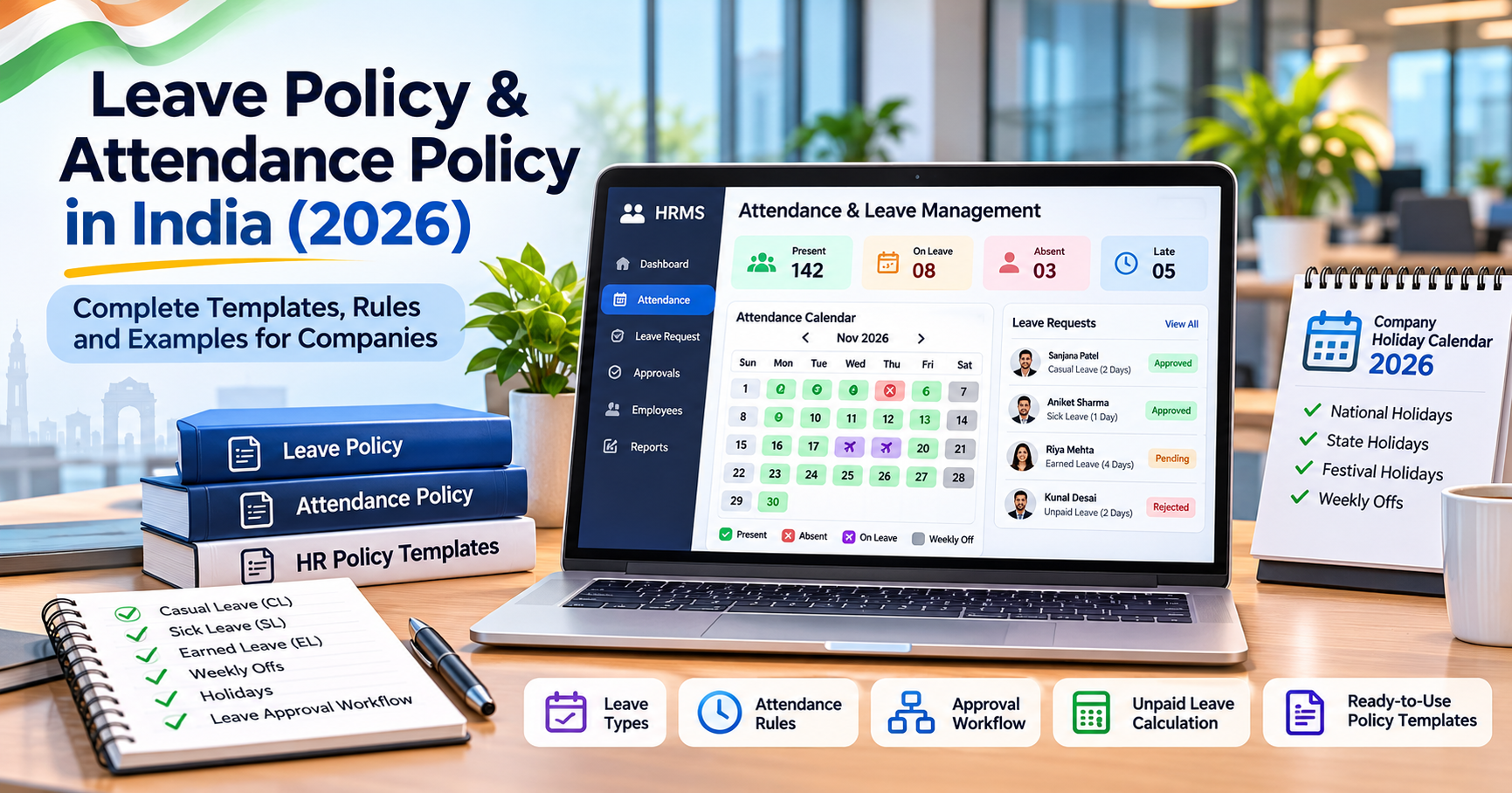
- 12. How HRMS Software Simplifies Leave and Attendance Management
- 13. Frequently Asked Questions (FAQs)
- Conclusion
- About the Author
Leave Policy and Attendance Policy in India (2026): Complete Rules, Templates and Examples for Companies
Managing employee leave and attendance is an important responsibility for every organisation. Whether you run a startup, IT company, manufacturing business, retail store, consultancy or service organisation, a clear leave and attendance policy helps maintain workplace discipline, employee satisfaction and smooth business operations.
Many companies face common HR challenges:
- Employees applying for leave without sufficient notice.
- Confusion about casual leave, sick leave and earned leave.
- Incorrect salary deductions for unpaid leave.
- Attendance mismatches between biometric systems and HR records.
- Employees arriving late or leaving early.
- Difficulty managing weekly offs and public holidays.
- Delays in leave approvals.
- Disputes regarding leave balances and leave encashment.
A properly documented leave and attendance policy helps prevent these problems by explaining employee entitlements, responsibilities, approval procedures and attendance rules.
In this guide, we explain how to create a leave policy and attendance policy for an Indian company, with practical examples, ready-to-use templates, leave calculations and HR management recommendations.
Important: India does not have one identical leave entitlement for every private-sector employee. Applicable requirements depend on the establishment, state, employee category and relevant labour legislation. The templates in this article are model company policies, not substitutes for applicable statutory requirements.
1. What Is a Leave Policy?
A leave policy is a formal document explaining how employees can request and use time away from work.
It defines the types of leave available, eligibility, annual entitlement, approval process, supporting documents, carry-forward rules and leave encashment.
A typical company leave policy covers:
- Casual Leave (CL).
- Sick Leave (SL).
- Earned Leave (EL) or Privilege Leave (PL).
- Maternity Leave.
- Paternity Leave, if provided by the company or applicable law.
- Bereavement Leave, if provided.
- Unpaid Leave (LWP).
- Public and festival holidays.
- Weekly offs.
- Leave during probation.
- Leave during notice periods.
For example, an employee working in an IT company may need two days of casual leave for personal work, while another employee may require medical leave due to illness.
Without a defined policy, HR teams may handle similar requests differently, resulting in confusion and employee dissatisfaction.
2. Different Types of Employee Leave in India
Understanding different leave categories is essential when designing a company leave policy.
A. Casual Leave (CL)
Casual leave is generally intended for short-term personal requirements or unforeseen circumstances.
Examples include:
- Personal appointments.
- Family responsibilities.
- Urgent household work.
- Unexpected personal commitments.
A company may establish an application and approval process for casual leave, subject to applicable statutory entitlements.
Casual leave rules regarding annual entitlement, accumulation and lapse depend on the applicable law and company policy.
B. Sick Leave (SL)
Sick leave allows employees to remain away from work because of illness or medical conditions.
Common situations include:
- Fever.
- Infection.
- Medical treatment.
- Recovery from illness.
- Other health-related reasons.
Companies may establish reasonable medical-documentation requirements, taking into account the length of absence, applicable law and employee privacy.
C. Earned Leave (EL) or Privilege Leave (PL)
Earned leave is accumulated based on qualifying work performed by an employee.
Employees commonly use earned leave for:
- Planned holidays.
- Family vacations.
- Personal commitments.
- Longer periods away from work.
Depending on the applicable legislation, earned leave may have rules regarding eligibility, accumulation, carry-forward and encashment.
D. Maternity Leave
Eligible women employees are entitled to maternity benefits under the applicable maternity legislation.
Under the Maternity Benefit Act, eligible women generally receive:
- Up to 26 weeks of maternity benefit for a woman with fewer than two surviving children.
- Up to 12 weeks for a woman with two or more surviving children.
- Other applicable benefits and protections under the legislation.
Eligibility conditions and specific provisions must be checked before processing maternity leave.
E. Unpaid Leave (LWP)
Leave Without Pay (LWP) is a period of approved absence for which salary is not payable, subject to applicable legal protections and employment terms.
For example, an employee may have exhausted their available casual and earned leave but require two additional days away from work.
If the absence is approved as unpaid leave, the payroll team can calculate the corresponding salary adjustment.
An employer should not use LWP to override statutory paid-leave entitlements.
3. Leave Rules in India: What Companies Should Know in 2026
One of the most important points for HR managers is that leave entitlements are not uniform throughout India.
They can depend on:
- The state in which the establishment operates.
- Whether it is a shop, commercial establishment or factory.
- The employee's legal classification.
- Applicable central and state labour legislation.
- Employment contracts and standing orders.
- More favourable company benefits, where applicable.
The four Labour Codes came into effect on 21 November 2025. The Occupational Safety, Health and Working Conditions Code, 2020 (OSHWC Code) contains provisions relating to annual leave with wages for eligible workers.
The Ministry of Labour and Employment has also clarified that where state legislation provides more favourable leave benefits, those benefits can continue to apply. Its published FAQs explain the treatment of accumulated leave, including leave applied for but refused by the employer.
Therefore, businesses should not simply copy an old leave policy from another company or state.
Example: Leave provisions in Gujarat
For establishments covered by the Gujarat Shops and Establishments (Regulation of Employment and Conditions of Service) Act, 2019, Section 18 provides for:
Leave categoryProvision under Section 18Casual Leave7 paid days per calendar yearMedical Leave7 paid days per calendar yearEarned Leave1 day for every 20 days worked, after meeting the 240-day qualifying conditionWeekly HolidayPaid weekly holidayFestival Holidays8 paid festival holidays per calendar year
The Act also contains provisions relating to earned-leave accumulation, encashment and payment when employment ends.
Important: The Gujarat provisions are an example for covered establishments, not a nationwide leave policy. The interaction between state legislation, the Labour Codes, applicable rules and subsequent notifications must be checked before finalising a company's policy. In particular, verify the current accumulation and encashment provisions rather than relying on an old leave-policy template.
4. What Is an Attendance Policy?
An attendance policy explains the rules employees must follow regarding working hours, check-in, check-out, breaks, punctuality, absence and attendance corrections.
It helps employers maintain accurate employee attendance records and calculate salary correctly.
A typical attendance policy includes:
- Office working hours.
- Shift timings.
- Daily check-in and check-out.
- Biometric or digital attendance.
- Late-coming rules.
- Early departure.
- Half-day attendance.
- Weekly offs.
- Public holidays.
- Overtime approval.
- Attendance correction requests.
- Unauthorised absence.
For example, an IT company may have office timings from 9:30 AM to 6:30 PM. Employees are expected to record their attendance using a biometric device or an authorised attendance application.
If an employee forgets to punch in, they should submit an attendance correction request through the company's HR process.
5. Sample Attendance Policy for a Private Company
The following is a practical model that companies can customise according to their working arrangements and applicable laws.
Policy itemSample company ruleOffice Start Time9:30 AMOffice Closing Time6:30 PMAttendance MethodBiometric or HRMSCheck-inAt the start of dutyCheck-outAt the end of dutyGrace Period10 minutes, if approved by company policyLate MarkAfter the permitted grace periodEarly LeavingPrior approval requiredAttendance CorrectionRequest through HRWeekly OffAs per published shift scheduleOvertimePrior authorisation and applicable payment
These are illustrative company settings, not statutory working-hour limits.
Companies must configure their working hours, rest intervals, overtime and weekly holidays in accordance with applicable legislation.
How should late coming be managed?
A transparent late-coming process can include:
- Record the actual employee check-in time.
- Apply the company's documented grace-period rule.
- Notify employees when attendance irregularities occur.
- Allow employees to submit corrections for genuine technical or operational issues.
- Review repeated late arrivals with the employee.
- Apply only lawful and properly documented salary adjustments or disciplinary measures.
Late arrival should not automatically result in arbitrary salary deductions or loss of statutory leave.
6. Weekly Offs and Public Holidays
Employees need adequate weekly rest and applicable public holidays.
A company's holiday calendar should identify:
- Weekly rest days.
- National holidays.
- State-specific holidays.
- Festival holidays.
- Other declared holidays.
For example, a Gujarat-based company may prepare an annual holiday calendar containing Republic Day, Independence Day, Gandhi Jayanti and agreed festival holidays.
Companies operating in multiple states should maintain separate holiday calendars wherever local requirements differ.
If employees are required to work on a weekly rest day or prescribed holiday, the organisation must follow applicable provisions concerning compensatory rest, additional wages or other statutory benefits.
The HR team should publish the holiday calendar before the beginning of the relevant year and communicate changes to employees.
7. Leave Approval Workflow: Step-by-Step
A clear approval process prevents confusion between employees, managers and HR.
A recommended leave workflow is:
Step 1: Employee submits a leave request
The employee selects the leave type, start date, end date and reason.
Step 2: Manager receives the request
The reporting manager reviews the request based on team availability and work requirements.
Step 3: Manager approves or rejects
The manager records the decision and provides a reason when rejecting or postponing leave.
Step 4: HR verifies leave balance
HR checks the employee's available leave balance and applicable eligibility.
Step 5: Attendance records are updated
Approved leave is reflected in the employee's attendance record.
Step 6: Payroll receives the updated information
The payroll team uses approved attendance and leave information when calculating payable salary.
Step 7: Employee receives confirmation
The employee can view the leave status and updated balance.
Example of a leave approval table
EmployeeLeave TypeDatesDaysStatusEmployee ACasual Leave5–6 Nov2ApprovedEmployee BSick Leave8 Nov1ApprovedEmployee CEarned Leave12–15 Nov4PendingEmployee DUnpaid Leave18–19 Nov2Rejected
This is an illustrative HR register.
A digital leave approval process makes it easier to maintain records and identify pending requests.
8. How to Calculate Unpaid Leave in India
Unpaid leave affects the salary payable to an employee.
However, businesses should use a consistent salary calculation method based on applicable law, employment terms and the organisation's documented payroll policy.
Practical example
Suppose an employee has:
- Monthly salary: ₹30,000.
- Payroll calculation days: 30.
- Approved unpaid leave: 2 days.
Step 1: Calculate daily salary
Daily salary = Monthly salary ÷ Payroll calculation days
= ₹30,000 ÷ 30
= ₹1,000.
Step 2: Calculate unpaid leave deduction
Deduction = Daily salary × Unpaid leave days
= ₹1,000 × 2
= ₹2,000.
Step 3: Calculate payable salary
Payable salary = Monthly salary − Unpaid leave deduction
= ₹30,000 − ₹2,000
= ₹28,000.
ParticularsAmountMonthly salary₹30,000Unpaid leave2 daysDaily salary₹1,000LWP deduction₹2,000Payable salary₹28,000
This is a simplified example. The actual salary calculation may depend on the applicable wage definition, payroll method, working days, salary components and statutory requirements.
9. Ready-to-Use Employee Leave Policy Template
The following template can be customised by HR departments.
EMPLOYEE LEAVE POLICY
Company Name: [Enter Company Name]
Effective Date: [Enter Date]
Policy Version: 1.0
1. Purpose
This policy establishes the guidelines for employee leave applications, approvals, leave balances and absence management.
2. Scope
This policy applies to employees of [Company Name], subject to their employment category, applicable statutory requirements and individual employment terms.
3. Leave Categories
The company will provide the following leave categories, as applicable:
- Casual Leave.
- Sick Leave.
- Earned Leave.
- Maternity Leave.
- Other statutory or company-provided leave.
- Unpaid Leave.
4. Leave Application
Employees should submit planned leave requests through the authorised HR system or to their reporting manager in advance.
For emergencies or unexpected illness, employees should inform their manager or HR as soon as reasonably possible.
5. Leave Approval
Leave approval will be managed by the reporting manager and HR according to the company's authorisation process.
All requests will be handled consistently and in accordance with applicable legal entitlements.
6. Leave Balance
HR will maintain accurate employee leave records, including leave credited, utilised, carried forward and encashed where applicable.
7. Unpaid Leave
Unpaid leave will be processed according to the company's policy and applicable legal requirements.
8. Leave During Separation
Outstanding leave payments and encashment will be calculated according to applicable law, employment terms and company policy.
9. Policy Review
The company may review and update this policy when business requirements or applicable legislation changes.
Approved By: [HR Manager / Authorised Management]
10. Ready-to-Use Employee Attendance Policy Template
EMPLOYEE ATTENDANCE POLICY
Company Name: [Enter Company Name]
Effective Date: [Enter Date]
1. Working Hours
Employees must follow their assigned working hours and shift schedules communicated by the company.
2. Attendance Recording
Employees must record their attendance using the authorised biometric, mobile application, web portal or other approved system.
3. Late Arrival
Employees should report to work on time. Any grace period or late-coming procedure will be communicated by HR.
4. Early Departure
Employees requiring early departure must obtain the required approval, except in emergencies where prompt notification is expected.
5. Attendance Correction
Employees should submit attendance correction requests within the period specified by HR, along with relevant information.
6. Unauthorised Absence
Employees who are absent without proper communication may be asked to explain the absence. Any disciplinary action will follow applicable law and company procedure.
7. Weekly Holidays
Weekly rest days will be communicated through the company's approved work schedule.
8. Overtime
Overtime must be authorised and recorded, and payment or compensatory treatment will follow applicable statutory requirements.
9. Policy Compliance
Employees are responsible for recording accurate attendance and following their assigned working schedules.
Approved By: [HR Manager / Authorised Management]
11. Common Leave and Attendance Management Mistakes
Companies should avoid these common HR mistakes:
1. Using the same leave policy across every state
Different states and establishment categories can have different statutory requirements.
2. Not maintaining leave balances
Without proper records, employees and HR teams may disagree about available leave.
3. Rejecting leave without a documented process
Managers should follow a transparent approval process and respect statutory entitlements.
4. Deducting salary incorrectly
Payroll deductions must be based on actual unpaid absence and applicable calculation rules.
5. Ignoring weekly rest requirements
Businesses must provide the weekly rest and other applicable holidays required by law.
6. Not recording attendance corrections
Biometric failures, forgotten punches and authorised field work should be handled through a documented correction process.
7. Keeping leave and payroll records separately
Disconnected systems can result in mismatches between approved leave and salary calculations.
8. Not updating policies
HR teams should review policies when employment laws, state rules or company working arrangements change.
12. How HRMS Software Simplifies Leave and Attendance Management
Managing leave and attendance manually becomes difficult as the number of employees increases.
For example, a company with 50 employees may receive multiple leave applications every week. HR must track leave balances, approvals, attendance, holidays and payroll adjustments.
A centralised HRMS can simplify this process.
Important features include:
- Employee profile management.
- Digital leave applications.
- Manager approval workflows.
- Automatic leave balance updates.
- Attendance tracking.
- Biometric integration.
- Check-in and check-out records.
- Shift and weekly-off management.
- Holiday calendars.
- Late-coming reports.
- Unpaid leave calculations.
- Monthly attendance reports.
- Payroll integration.
- Employee self-service.
For example, when an employee submits a leave application, the reporting manager can approve it through the HRMS. The approved leave can then be reflected in the attendance report and made available to payroll.
This reduces manual coordination and improves the accuracy of employee records.
However, automation does not replace the need for correct policy configuration and statutory compliance checks.
13. Frequently Asked Questions (FAQs)
Q1. Is a leave policy mandatory for private companies in India?
Employers must provide applicable statutory leave benefits and comply with relevant employment requirements. A written company policy is a useful way to document those entitlements and internal procedures.
Q2. How many casual leaves are allowed in India?
There is no single nationwide casual-leave entitlement applicable to every private-sector employee. The entitlement depends on applicable state legislation, establishment category and other relevant provisions.
Q3. What is the difference between casual leave and earned leave?
Casual leave is generally used for short-term personal requirements, whereas earned leave accumulates based on qualifying work and is generally used for planned or longer absences.
Q4. Can companies reject employee leave applications?
Employers may manage the timing of leave subject to applicable law and statutory entitlements. They cannot use an internal approval process to unlawfully deny mandatory leave benefits.
Q5. Is sick leave mandatory in India?
Sick-leave requirements depend on the applicable state law, establishment category and relevant employment provisions. Companies should verify the rules applicable to their employees.
Q6. What is Leave Without Pay (LWP)?
LWP refers to an approved period of absence for which salary is not payable, subject to applicable legal requirements and employment terms.
Q7. Can an employer deduct salary for late coming?
Any wage deduction must comply with applicable wage legislation. Arbitrary fines or deductions are not permitted simply because an internal attendance rule says so.
Q8. How is unpaid leave calculated?
A common illustrative method is to divide monthly salary by the applicable payroll calculation days and multiply the daily rate by unpaid leave days. The actual method must follow applicable law and employment terms.
Q9. Can employees carry forward unused earned leave?
Carry-forward limits and encashment conditions depend on the applicable legislation. Employers must configure their leave systems according to the correct rules.
Q10. Why should companies use HRMS for leave and attendance?
An HRMS helps manage employee leave requests, approval workflows, attendance records, holiday calendars, leave balances and payroll-related information in one system.
Conclusion
A clear leave policy and attendance policy are essential for maintaining an organised and productive workplace.
Businesses should define leave categories, attendance procedures, weekly offs, holiday schedules, approval workflows and unpaid leave calculations while ensuring that all statutory entitlements are respected.
For growing organisations, connecting leave management, attendance tracking and payroll processing through an HRMS can reduce administrative work and improve record accuracy.
The most important step is to create a policy that matches the organisation's working arrangements and applicable labour laws rather than copying a generic template.
Looking to simplify employee attendance and leave approvals? Explore i-SPUR HRMS solutions to manage employee records, attendance, leave applications, approval workflows and HR operations through a centralised digital platform.
About the Author
i-SPUR Editorial Team
The i-SPUR Editorial Team publishes practical educational resources covering HR management, employee attendance, leave administration, payroll, business operations and workplace automation. The team aims to help Indian startups, entrepreneurs, HR professionals and growing businesses understand workplace processes and improve everyday operations through digital solutions.
Disclaimer: This article is for general educational purposes and does not constitute legal advice. Leave entitlements, working hours, weekly holidays, overtime, leave accumulation and encashment can differ according to the applicable central and state legislation, establishment category, employee classification and subsequent notifications. Employers should verify the latest applicable provisions and consult a qualified labour-law or compliance professional before adopting the templates in this article.