Payroll Management for Small Businesses in India (2026): Complete Step-by-Step Guide
Managing employee salaries is one of the most important responsibilities of running a business. Whether you operate a startup, IT company, manufacturing unit, retail shop, consultancy or service-based organisation, having an organised payroll process helps ensure employees are paid accurately and statutory responsibilities are managed properly.
However, payroll management involves much more than transferring salaries to employee bank accounts. Businesses must maintain salary structures, track attendance, calculate working days, manage leave, process deductions, prepare payslips and maintain statutory records.
For small businesses without a dedicated HR or finance department, these activities can become time-consuming and difficult to manage manually.
In this guide, we explain how payroll management works in India, how to calculate employee salaries, understand CTC and gross salary, manage PF and ESI deductions, and process monthly payroll using a practical example.
1. What Is Payroll Management?
Payroll management is the process of calculating, processing and maintaining employee salary payments and related records.
It includes all activities required to ensure employees receive the correct salary according to their employment terms, attendance and applicable deductions.
A typical payroll process includes:
- Creating employee salary structures.
- Maintaining employee information.
- Tracking attendance and working days.
- Calculating paid and unpaid leave.
- Calculating overtime and other earnings.
- Deducting PF, ESI, professional tax and applicable TDS.
- Calculating monthly net salary.
- Generating employee payslips.
- Transferring salaries to employee bank accounts.
- Maintaining payroll registers and statutory records.
For example, if a company has 25 employees, the HR or accounts team must calculate 25 individual salaries every month. If attendance, leave and deductions are maintained separately, even a small payroll operation can become complicated.
A structured payroll system helps bring these activities together.
2. Understanding CTC, Gross Salary and In-Hand Salary
Before calculating payroll, businesses should understand three important salary terms: CTC, gross salary and net salary.
A. What Is CTC?
CTC stands for Cost to Company.
It represents the overall annual cost incurred by an employer for employing an individual.
CTC may include:
- Basic salary.
- House Rent Allowance (HRA).
- Special allowance.
- Other eligible allowances.
- Employer PF contribution.
- Employer ESI contribution, where applicable.
- Gratuity provision.
- Bonus and other employment benefits.
CTC is not necessarily the amount an employee receives in their bank account.
B. What Is Gross Salary?
Gross salary is the employee's earnings before employee-side deductions.
It generally includes basic salary, HRA and other applicable salary allowances.
C. What Is In-Hand Salary?
In-hand salary, also called net salary, is the amount transferred to an employee after applicable deductions.
A simplified formula is:
Net Salary = Gross Salary − Employee Deductions
Employee deductions may include:
- Employee PF contribution.
- Employee ESI contribution.
- Professional tax, where applicable.
- TDS on salary, where applicable.
- Other legally permitted deductions.
Difference between CTC, Gross Salary and Net Salary
ParticularsMeaningCTCTotal annual employment cost to the companyGross SalarySalary earned before employee deductionsNet SalaryAmount payable after applicable deductions
Understanding these differences helps businesses prepare transparent salary structures and avoid confusion during employee salary discussions.
3. How to Create an Employee Salary Structure
A salary structure defines how an employee's compensation is divided into different components.
Consider an employee whose monthly gross salary is ₹20,000.
An illustrative salary structure could be:
Salary componentMonthly amountBasic Salary₹10,000HRA₹5,000Special Allowance₹5,000Gross Salary₹20,000
This is a simplified example, not a universal salary structure.
Under the Code on Wages, 2019, applicable wage definitions and the 50% rule must be considered when structuring compensation. Where excluded allowances exceed 50% of total remuneration, the excess is added back to wages for statutory calculations, subject to the applicable provisions.
Employers should therefore review the actual salary components instead of assuming that any salary split is automatically compliant.
A proper salary structure should also consider applicable minimum wages, employment terms, statutory contributions, bonus and gratuity obligations.
4. How to Calculate Employee Salary Based on Attendance
Employee attendance directly affects monthly salary processing.
Businesses must consider:
- Total calendar days in the month.
- Paid working days.
- Weekly offs.
- Declared holidays.
- Approved paid leave.
- Unpaid leave.
- Unauthorised absence.
- Overtime, where applicable.
Practical attendance calculation example
Suppose an employee has:
- Monthly gross salary: ₹20,000
- Salary calculation days: 30
- Unpaid leave: 2 days
- Paid days: 28
Daily salary rate:
₹20,000 ÷ 30 = ₹666.67
Salary payable:
₹666.67 × 28 = ₹18,666.76
Rounded payable gross salary = ₹18,667.
The actual salary calculation method should follow the employment terms, applicable wage rules and the company's documented payroll policy.
Businesses should not automatically deduct weekly offs or declared holidays as unpaid leave.
5. How to Calculate PF and ESI in Payroll
Provident Fund (PF) and Employee State Insurance (ESI) are important components of statutory payroll management.
PF calculation
Under the standard EPF contribution arrangement, the employee contributes 12% and the employer contributes 12% of applicable PF wages, subject to statutory provisions and applicable exceptions.
The employer's contribution is allocated between EPF and EPS where the employee is eligible for pension membership.
For example, assume applicable PF wages are ₹10,000.
PF contributionCalculationAmountEmployee PF₹10,000 × 12%₹1,200Employer PF₹10,000 × 12%₹1,200Total
₹2,400
PF eligibility, membership conditions and the applicable wage ceiling must be checked before calculating contributions.
ESI calculation
The standard ESI contribution rates are:
ContributionRateEmployee contribution0.75%Employer contribution3.25%Total4%
The general ESI wage eligibility ceiling is ₹21,000 per month, with a separate prescribed limit for employees with disabilities.
For example, assume the employee has ESI wages of ₹20,000 and is covered under ESI.
Employee ESI:
₹20,000 × 0.75% = ₹150
Employer ESI:
₹20,000 × 3.25% = ₹650
ParticularsAmountEmployee ESI₹150Employer ESI₹650Total ESI₹800
PF and ESI have different eligibility conditions and wage definitions. Employers should not automatically use the same salary base for both calculations.
6. Attendance and Leave Management in Payroll
Attendance and leave records are essential for accurate salary processing.
For example, consider an organisation with 30 employees. If attendance is maintained in one spreadsheet and leave applications are recorded through emails or messages, the HR team must manually compare records before processing salaries.
This creates opportunities for:
- Incorrect salary deductions.
- Duplicate leave entries.
- Missing attendance records.
- Incorrect overtime calculations.
- Delayed salary processing.
A structured attendance and leave management process should maintain:
- Employee check-in and check-out records.
- Daily attendance status.
- Weekly offs and holidays.
- Approved leave applications.
- Unpaid leave.
- Half-day attendance.
- Overtime records.
- Monthly attendance summaries.
The company should also maintain a documented leave policy explaining eligibility, approval procedures, leave balances, carry-forward rules and encashment where applicable.
Leave entitlements and statutory requirements depend on the applicable labour legislation, establishment category and state rules. A company should not assume that one leave policy applies identically to every Indian business.
7. How to Prepare an Employee Payslip
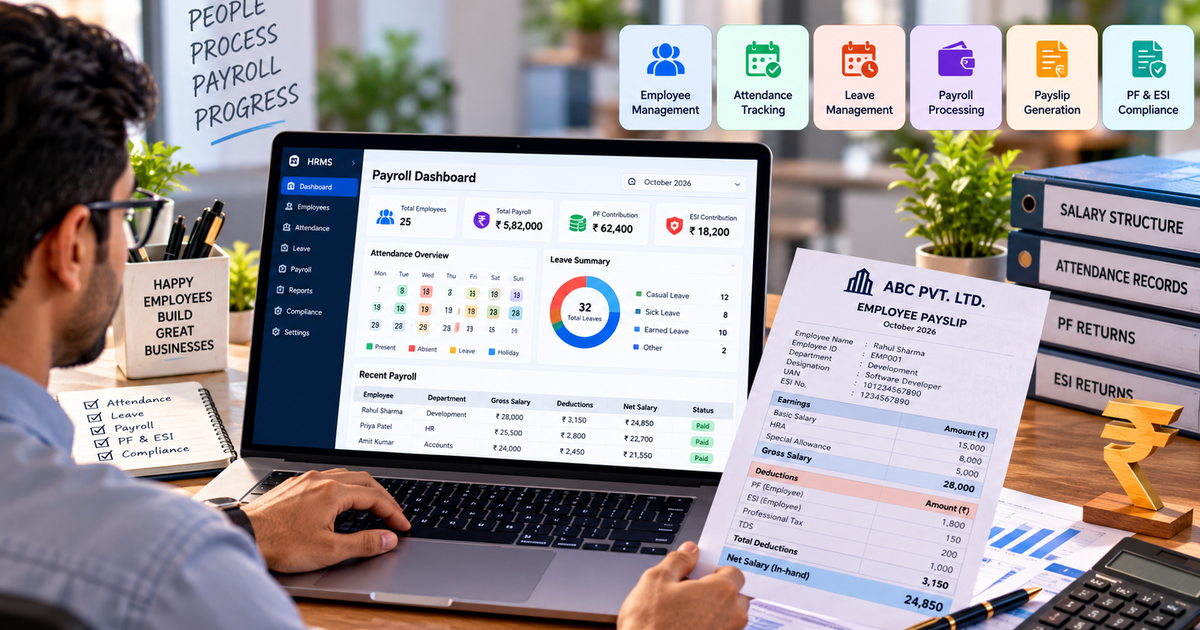
A payslip is a document showing an employee's salary earnings, deductions and net amount payable for a particular wage period.
It helps employees understand how their salary has been calculated.
A useful payslip includes:
Employee information
- Employee name.
- Employee ID.
- Designation.
- Department.
- UAN, where applicable.
- Wage period.
Earnings
- Basic salary.
- Dearness allowance, where applicable.
- HRA.
- Other allowances.
- Overtime wages, where applicable.
Deductions
- PF.
- ESI.
- Professional tax, where applicable.
- TDS, where applicable.
- Other authorised deductions.
Final salary
- Gross wages payable.
- Total deductions.
- Net wages paid.
The prescribed wage-slip format under the applicable central rules should be followed. Employers should also retain wage and attendance records in the required form and for the applicable retention period.
8. Monthly Payroll Processing: Step-by-Step
A business can organise its payroll activities using the following monthly workflow.
Step 1: Update employee records
Verify employee details, salary structures, joining dates, bank details and applicable statutory information.
Step 2: Collect attendance records
Obtain monthly attendance data, working days, leave, holidays and overtime records.
Step 3: Verify leave applications
Check approved leaves, unpaid leaves, half-days and adjustments.
Step 4: Calculate gross salary
Calculate salary earnings based on the employee's salary structure and payable days.
Step 5: Calculate statutory deductions
Calculate applicable PF, ESI, professional tax and TDS.
Step 6: Review payroll
Check salary calculations, employee deductions, employer contributions and unusual changes.
Step 7: Generate payslips
Prepare individual salary statements for employees.
Step 8: Process salary payments
Transfer approved salaries to employee bank accounts and maintain payment records.
Step 9: Complete statutory compliance
Prepare applicable contribution payments, returns, tax deductions and statutory reports within the relevant deadlines.
Step 10: Maintain monthly payroll records
Store payroll registers, payslips, attendance reports and payment confirmations securely.
9. Practical Monthly Payroll Example
Let's combine the calculations using one employee's salary.
Assumptions:
- Monthly gross salary: ₹20,000.
- Basic salary and applicable PF wages: ₹10,000.
- ESI wages: ₹20,000.
- Full attendance.
- Employee is eligible for PF and ESI.
- Standard PF and ESI contribution rates apply.
- No TDS, professional tax or other deductions in this simplified illustration.
Employee salary calculation
ParticularsAmountBasic Salary₹10,000HRA₹5,000Special Allowance₹5,000Gross Salary₹20,000
Employee deductions
DeductionAmountEmployee PF₹1,200Employee ESI₹150Professional Tax₹0TDS₹0Total Deductions₹1,350
Net salary
₹20,000 − ₹1,350 = ₹18,650
Employer contribution
Employer expenseAmountEmployer PF₹1,200Employer ESI₹650Total additional contribution₹1,850
Simplified employer payroll cost
₹20,000 + ₹1,200 + ₹650 = ₹21,850
Therefore:
- Employee receives ₹18,650.
- Employee contributes ₹1,350 through payroll deductions.
- Employer contributes an additional ₹1,850.
The example excludes other applicable employer costs, such as EDLI, administration charges, gratuity provision and statutory bonus. Actual CTC will depend on the complete compensation structure and applicable obligations.
10. Common Payroll Management Mistakes
Small businesses should avoid these common mistakes:
1. Confusing CTC with in-hand salary
Employees may expect their complete CTC to be credited to their bank accounts. Employers should explain salary components clearly.
2. Ignoring attendance records
Missing check-in, check-out and leave information can produce incorrect salary calculations.
3. Incorrect PF and ESI calculations
Different eligibility requirements and wage definitions must be considered.
4. Delayed salary payments
Employers must follow the applicable statutory wage-payment timelines and employment terms.
5. Missing payslips
Employees should receive wage slips in the prescribed form and within the required period.
6. Poor payroll documentation
Attendance, salary registers, overtime and deductions should be maintained accurately.
7. Incorrect TDS calculations
Salary TDS depends on estimated taxable income and the applicable tax provisions. For payments from 1 April 2026, employers must apply the Income-tax Act, 2025 framework and the relevant rules for Tax Year 2026–27.
11. How Payroll Software Helps Small Businesses
As an organisation grows, manually calculating salaries for every employee becomes difficult.
Payroll software can help businesses organise multiple HR and salary activities in one place.
Important capabilities include:
- Employee management.
- Salary structure configuration.
- Attendance tracking.
- Leave management.
- Monthly payroll calculation.
- PF and ESI calculation support.
- Payslip generation.
- Payroll reports.
- Salary payment records.
- Employee self-service.
- Role-based access and payroll data security.
For example, when an employee's approved leave and attendance records are connected with payroll, the HR team can review payable days without manually collecting information from multiple spreadsheets.
Businesses should still review calculations and ensure that the software reflects the latest applicable statutory rules.
12. Frequently Asked Questions (FAQs)
Q1. What is payroll management in India?
Payroll management is the process of calculating employee salaries, managing deductions, generating payslips, processing salary payments and maintaining statutory payroll records.
Q2. What is the difference between CTC and gross salary?
CTC represents the overall annual employment cost to the company. Gross salary represents employee earnings before employee-side deductions.
Q3. How is in-hand salary calculated?
In-hand salary is generally calculated by subtracting applicable employee deductions from gross salary.
Q4. Is PF mandatory for every employee?
PF applicability depends on establishment coverage, employee membership and statutory wage and eligibility conditions. Employers must check the applicable EPF provisions.
Q5. What is the ESI contribution rate in India?
The standard employee contribution is 0.75%, and the employer contribution is 3.25% of applicable ESI wages.
Q6. Is a payslip compulsory?
Employers must issue wage slips in the prescribed form under the applicable Code on Wages provisions and rules.
Q7. Can small businesses manage payroll in Excel?
Yes. Small businesses can use Excel for salary calculations and records. However, they must maintain correct formulas, statutory calculations, access controls and documentation.
Q8. What is the difference between gross salary and net salary?
Gross salary is calculated before employee deductions. Net salary is the final payable amount after applicable deductions.
Q9. What information is required for monthly payroll?
Businesses generally need employee records, salary structures, attendance, leave details, overtime information, bank details and applicable statutory information.
Q10. Why should businesses use payroll software?
Payroll software helps automate repetitive calculations, organise attendance and leave information, generate payslips and maintain payroll reports.
Conclusion
Payroll management is an essential business activity that directly affects employees, finance teams and organisational compliance.
A well-organised payroll process should connect employee information, salary structures, attendance, leave, statutory deductions, payslips and monthly salary payments.
Small businesses can begin with structured spreadsheets, but as employee numbers increase, digital payroll and HR management systems can make the process more efficient and easier to control.
Want to simplify employee and payroll management? Explore i-SPUR's HRMS solutions to organise employee records, attendance, leave approvals and payroll-related workflows through a centralised business management system.
About the Author
i-SPUR Team
The i-SPUR Editorial Team creates practical educational resources covering HR management, payroll administration, employee attendance, business operations, statutory compliance and workplace automation. The team aims to help Indian startups, entrepreneurs and growing businesses improve their daily operations through structured processes and digital solutions.
Disclaimer: This article is for general educational purposes and does not constitute legal, tax or professional payroll advice. Labour Codes, state-specific rules, PF and ESI eligibility, salary definitions and income-tax requirements must be reviewed against current official notifications. Employers should consult a qualified payroll or compliance professional for organisation-specific implementation.