
Table of Contents
- PF and ESI Calculation in India 2026: Rates, Rules and Examples for Employers
- 1. What is Provident Fund (PF)?
- PF contribution rates in India
- 2. What is Employee State Insurance (ESI)?
- ESI contribution rates in India
- ESI salary eligibility
- 3. PF Calculation: Step-by-Step Example
- Final PF calculation
- 4. ESI Calculation: Step-by-Step Example
- Final ESI calculation
- 5. Combined PF and ESI Calculation
- 6. Difference Between PF and ESI
- 7. Common PF and ESI Mistakes Made by Small Businesses
- 8. How Can Businesses Simplify PF and ESI Management?
- 9. Frequently Asked Questions (FAQs)
- Conclusion
PF and ESI Calculation in India 2026: Rates, Rules and Examples for Employers
Payroll management is one of the most important responsibilities of any business. Whether you operate a small company, a manufacturing unit, a retail shop or an IT organisation, understanding employee salary deductions and statutory contributions is essential.
In India, two important employee social security schemes are the Employees' Provident Fund (EPF) and Employees' State Insurance (ESI).
These schemes provide financial security, retirement savings and medical protection to eligible employees. However, many small business owners and HR professionals find it difficult to understand their contribution percentages, eligibility limits and monthly calculations.
In this guide, we explain how PF and ESI work, their applicable contribution rates in 2026, and how to calculate them using practical salary examples.
1. What is Provident Fund (PF)?
The Employees' Provident Fund (EPF) is a retirement savings scheme managed by the Employees' Provident Fund Organisation (EPFO).
Under this scheme, eligible employees and employers contribute a percentage of the employee's PF wages every month. The accumulated savings help employees build a financial fund for retirement.
PF contributions are generally calculated using:
- Basic Salary
- Dearness Allowance (DA)
- Retaining Allowance, where applicable
PF is not necessarily calculated on an employee's entire gross salary or Cost to Company (CTC). The applicable statutory definition of wages and contribution arrangements must be considered.
PF contribution rates in India
For establishments covered by the standard 12% contribution rate:
ContributionPercentageEmployee contribution12%Employer contribution12%Employer's EPS allocation8.33%Employer's EPF allocation3.67%
The employer's 12% contribution is divided between the Employees' Provident Fund (EPF) and Employees' Pension Scheme (EPS), wherever EPS membership applies.
Important 2026 update: Effective 17 September 2026, the statutory wage ceiling for mandatory EPF coverage has increased from ₹15,000 to ₹25,000 per month. This change expands coverage to additional eligible employees. Existing EPF members continue as members, subject to applicable scheme provisions.
The revised ceiling should not be confused with an automatic requirement to calculate every employee's PF on their full gross salary. Employers must consider actual PF wages, membership eligibility and applicable contribution rules.
2. What is Employee State Insurance (ESI)?
Employees' State Insurance (ESI) is a social security and health insurance scheme managed by the Employees' State Insurance Corporation (ESIC).
It provides eligible employees and their families with medical care and financial support during certain circumstances.
ESI benefits include:
- Medical treatment for insured employees and eligible family members.
- Sickness benefits.
- Maternity benefits.
- Temporary and permanent disablement benefits.
- Dependants' benefits in eligible employment injury cases.
- Other benefits prescribed under the scheme.
ESI is particularly important for employees working in eligible factories, shops, offices and other covered establishments.
ESI contribution rates in India
The standard ESI contribution rates are:
ContributionPercentageEmployee contribution0.75%Employer contribution3.25%Total contribution4%
The employee's share is deducted from salary, while the employer pays its own contribution separately.
ESI salary eligibility
The general monthly wage ceiling for ESI coverage is ₹21,000.
For employees with disabilities, the prescribed ceiling is ₹25,000 per month.
The applicability of ESI also depends on whether the establishment and employee fall within the coverage provisions and applicable notifications.
An important distinction is that PF and ESI do not necessarily use identical definitions of wages. Therefore, the salary components considered for each calculation may differ.
3. PF Calculation: Step-by-Step Example
Let's understand PF calculation with a practical example.
Suppose an employee has the following monthly salary structure:
Salary componentAmountBasic salary₹20,000Dearness allowance₹0Gross salary₹20,000
For this illustration, assume the employee's PF wages are ₹20,000, the employee is eligible for EPS membership, and contributions are calculated on the full PF wages.
Step 1: Calculate employee PF contribution
Employee PF = PF wages × 12%
= ₹20,000 × 12%
= ₹2,400
Therefore, ₹2,400 is deducted from the employee's salary.
Step 2: Calculate employer contribution
Employer PF contribution = ₹20,000 × 12%
= ₹2,400
This is the employer's contribution and is not deducted from the employee's salary.
Step 3: Calculate EPS contribution
EPS contribution = ₹20,000 × 8.33%
= ₹1,666 (rounded)
Step 4: Calculate employer EPF contribution
Employer EPF contribution = Employer's total PF contribution − EPS contribution
= ₹2,400 − ₹1,666
= ₹734
Final PF calculation
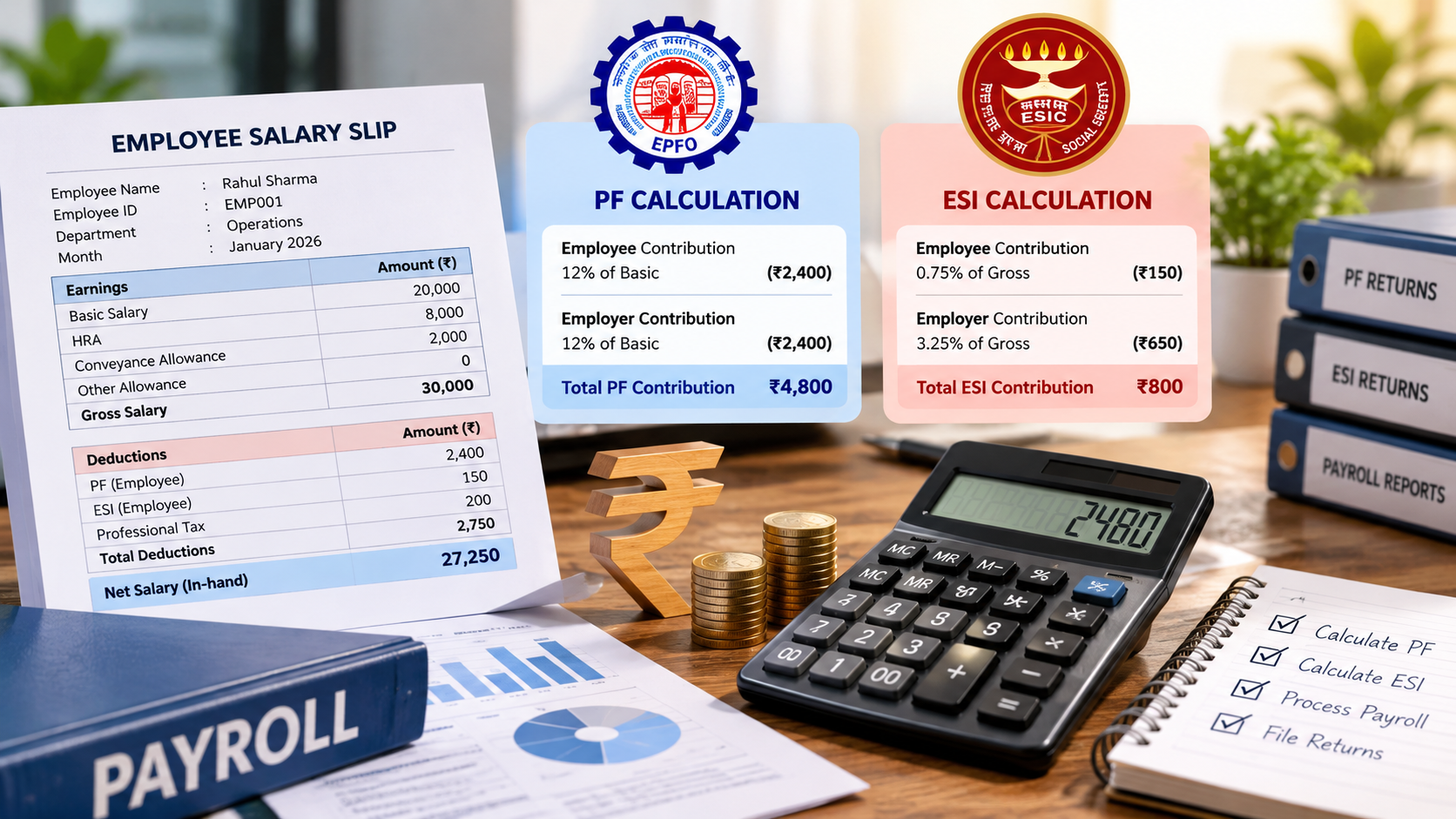
ParticularsAmountEmployee PF contribution₹2,400Employer's total contribution₹2,400Employer's EPS allocation₹1,666Employer's EPF allocation₹734Total monthly PF contribution₹4,800
The employee contributes ₹2,400, and the employer contributes another ₹2,400.
Note: EPS eligibility and allocation depend on the employee's membership history and applicable EPFO rules. This example assumes an eligible EPS member.
4. ESI Calculation: Step-by-Step Example
Now consider the same employee with monthly ESI wages of ₹20,000.
Assume the employee works in an ESI-covered establishment and is eligible for ESI coverage.
Step 1: Calculate employee ESI contribution
Employee ESI = ESI wages × 0.75%
= ₹20,000 × 0.75%
= ₹150
Step 2: Calculate employer ESI contribution
Employer ESI = ESI wages × 3.25%
= ₹20,000 × 3.25%
= ₹650
Final ESI calculation
ParticularsAmountEmployee ESI contribution₹150Employer ESI contribution₹650Total ESI contribution₹800
The employee pays ₹150, while the employer pays ₹650.
5. Combined PF and ESI Calculation
Let's combine both calculations to understand the monthly payroll impact.
Assumptions:
- Basic salary and PF wages: ₹20,000.
- ESI wages: ₹20,000.
- Employee is eligible for both schemes.
- Standard contribution rates apply.
- EPS membership applies.
ParticularsEmployeeEmployerPF contribution₹2,400₹2,400ESI contribution₹150₹650Total₹2,550₹3,050
Employee's estimated salary after these deductions:
₹20,000 − ₹2,550 = ₹17,450.
Employer's additional contribution:
₹3,050 per month.
The employer's actual statutory payroll cost may also include applicable EDLI contributions, administrative charges, gratuity provisions and other employment-related costs.
This example demonstrates why businesses should calculate employee deductions and employer contributions separately.
6. Difference Between PF and ESI
ComparisonPFESIFull formEmployees' Provident FundEmployees' State InsuranceManaging organisationEPFOESICMain purposeRetirement savings and pensionMedical and social securityEmployee rate12%0.75%Employer rate12%3.25%General wage ceiling₹25,000 for mandatory coverage from 17 September 2026₹21,000Employee benefitRetirement savings and eligible pension benefitsMedical and other social security benefits
Both schemes serve different purposes and are important components of statutory payroll compliance.
7. Common PF and ESI Mistakes Made by Small Businesses
Many small businesses manage payroll using spreadsheets or manual calculations. This can lead to errors.
Here are some common mistakes employers should avoid:
1. Using the wrong salary components
PF and ESI have different wage definitions. Using gross salary without checking the applicable rules can produce incorrect calculations.
2. Ignoring the revised PF wage ceiling
From September 2026, the EPF wage ceiling has increased to ₹25,000. Employers should review their employee records and update payroll calculations where applicable.
3. Incorrect employer contribution calculations
The employer's PF contribution may need to be divided between EPF and EPS. Treating the complete employer contribution as EPF can create reporting errors.
4. Missing employee eligibility conditions
Not every employee is automatically covered under both schemes. Employers should verify establishment coverage, employee wages and membership conditions.
5. Maintaining incomplete payroll records
Businesses should maintain salary registers, attendance records, contribution details, employee information and payment records.
8. How Can Businesses Simplify PF and ESI Management?
As a business grows, managing employee salaries and statutory contributions manually becomes increasingly difficult.
A structured payroll process should include:
- Employee salary configuration.
- Attendance and leave tracking.
- Monthly salary calculations.
- Automatic PF and ESI calculations based on applicable rules.
- Employee-wise deduction reports.
- Employer contribution reports.
- Payroll registers and statutory records.
- Monthly compliance reviews.
Businesses should also review statutory rates and notifications regularly instead of assuming that payroll rules remain unchanged.
9. Frequently Asked Questions (FAQs)
Q1. What is the PF contribution rate in India in 2026?
The standard employee contribution is 12%, and the employer's contribution is also 12% of applicable PF wages, subject to the relevant scheme provisions.
Q2. What is the new PF wage ceiling in 2026?
The statutory wage ceiling for mandatory EPF coverage increased from ₹15,000 to ₹25,000 per month with effect from 17 September 2026.
Q3. What is the ESI contribution rate?
The employee contributes 0.75%, and the employer contributes 3.25% of applicable ESI wages.
Q4. What is the ESI salary limit?
The general wage ceiling is ₹21,000 per month. The prescribed ceiling for employees with disabilities is ₹25,000.
Q5. Is employer PF deducted from employee salary?
No. The employer's PF contribution is an employer expense. The employee's own contribution is deducted from salary.
Q6. Can a company calculate PF and ESI using Excel?
Yes. Excel can be used for payroll calculations, but businesses must ensure that formulas, eligibility conditions, salary definitions and statutory rates are correct.
Q7. Why should businesses automate payroll calculations?
Automation helps reduce repetitive work, improve calculation consistency, maintain employee records and prepare payroll reports more efficiently.
Conclusion
PF and ESI are important parts of employee payroll management in India. Understanding their contribution percentages, wage ceilings and eligibility requirements helps businesses maintain accurate payroll records and fulfil statutory responsibilities.
For small and medium-sized businesses, a structured payroll system can make monthly salary processing more organised, reduce manual calculation errors and improve HR efficiency.
Looking to simplify employee management? Explore i-SPUR's HRMS solutions to manage employee records, attendance, leave and payroll-related workflows in one organised system.
Author: i-SPUR Editorial Team
The i-SPUR Editorial Team shares practical information about HR management, payroll processes, employee administration, business automation and workplace technology. Its goal is to help Indian businesses understand operational processes and adopt more organised digital workflows.
Disclaimer: This article is intended for general educational purposes and is not legal, tax or professional compliance advice. PF and ESI eligibility, wage definitions, contribution limits and applicable notifications can change. Employers should verify the latest EPFO and ESIC instructions or consult a qualified compliance professional before processing payroll.